The 2026 FIFA World Cup has delivered plenty of exciting moments. From debutant teams making statements to icons of the game producing incredible stats, the tournament is writing new chapters of its history.
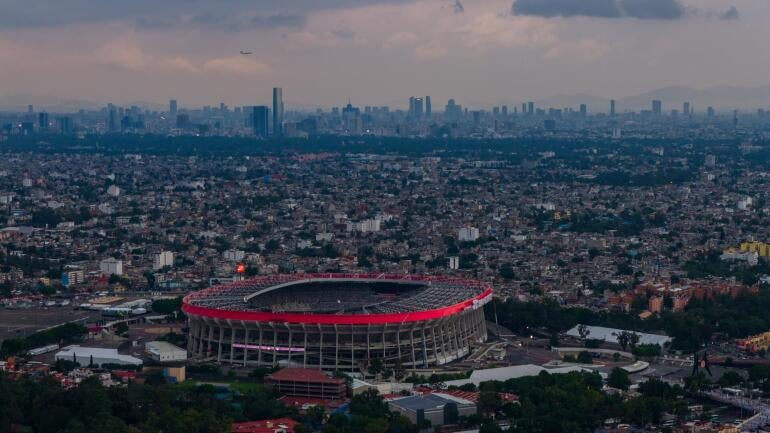
One topic that is being expanded on is the Estadio Azteca, the unofficial cathedral of the World Cup. Sixty years after opening its gates, the facility has been the backdrop to massive moments in both the World Cup and Mexican soccer history. A type of unconquerable fortress that only the most legendary survived to carve their names inside its concrete memories.
Pele conquered the Azteca in 1970, winning his third World Cup title among a throng of fans cheering on Brazil and the history they made. In 1986, Maradona baptized himself in controversy against England with the "Mano de Dios" (Hand of God), and later immortalized his legacy inside the stadium when he lifted the trophy that year. Estadio Azteca made more history in 2026, becoming the first facility to host a World Cup opening match for a third time.
Now the stadium will host a third game in the tournament. A round of 16 match with World Cup hosts Mexico welcoming England to its preferred gauntlet. It's a game with marquee billing, two national teams with rabid fan bases, talented squads, and both on the hunt for their own respective World Cup glory.
Mexico are the only team to concede zero goals through the first four matches. England, led by Harry Kane in attack, are motivated to win another trophy after their previous win 60 years ago. The two sides have a date with destiny in the Azteca on Sunday, kickoff set for 8 p.m. ET.
Entering the match, the lore of the Azteca has little mystery. It's what you know about it that makes it so overwhelming, on both a physical and even a spiritual level. It has given unrivaled joy to many and suffocating agony to others, all while staking its own revered place in the world of football.
But what makes Estadio Azteca such a fortress? Let's dive into some of the history and geography:
The altitude
The pitch at Estadio Azteca sits roughly 7,220 feet (2,240 meters) above sea level. The thinner air reduces oxygen levels for players, while letting the ball travel faster and farther than in sea-level stadiums.
It makes the Azteca such a unique venue in the modern era for the environmental changes alone. With such high altitude, it's a drastic shift for players not used to the settings. Athletes hit fatigue levels quicker, affecting them physiologically, and with the ball moving differently than what they are accustomed to outside of Mexico.
Teams that press early and often end up paying the price in endurance, and ball movement can sometimes throw teams off when they're looking for quicker movements, and the trajectory is not what they anticipated.
For head coach Thomas Tuchel and England, the group is preparing as best they can ahead of the match.
"It is maybe one of the most beautiful fixtures, most exciting fixtures than you can have play against Mexico in the Azteca, and there will be a lot, a lot, a lot of obstacles waiting for us, not to mention, like, the altitude will be, of course, a big disadvantage, because we cannot physically adapt to it in four days, it's just impossible," Tuchel told media after the round of 32 win.
"And more obstacles will maybe come, so, but we are ready for that. We need it, maybe. We have the ideal platform now to genuinely believe that we are ready for that, and when the going gets tough, that we will find the answers."
England's turnaround to the round of 16 is just a few days. It typically takes a longer period to get adjusted to the altitude for a physical sporting event, and the distance above sea-level will be a hurdle that the squad navigates together. Part of the silver lining Tuchel is taking to Mexico is that the group will at least be prepared for any extreme heat or humidity thanks to early training in the United States.
"We came very early to the U.S., and banked good heat training into our bodies. That was basically the idea behind, to acclimatize, so the players have a lot of heat training already in their bodies that would help them, so I think the heat and the humidity will not be the problem for us. We are used to that. We're used to that from training times, and we're used to it from our prep camp in Florida," Tuchel said.
"My understanding is that we cannot adapt to the altitude; that is just a huge advantage that Mexico will have. It just takes too much time. We have only three days in between matches; it's physically just not possible to adapt to the altitude, which is quite high. We knew that before, so this is just something, just a disadvantage, which we will have to deal with, and I think we showed, we showed the attitude that we are ready for that, and from there we go."
The most unforgiving stage in the world
While acclimatization helps, it can never fully solve the equation of environmental changes multiplied by 87,000 fanatics.
Mexico head coach Javier Aguirre has already described the crowd atmosphere at the Azteca as the team's "12th man," but the altitude, with its invisible, relentless efforts, functions like a 13th player.
The added noise that comes from Mexico's most faithful can be measured physically, and has been. During the broadcast of Mexico's knockout game against Ecuador, you could physically see the cameras shaking, being bounced up and down, due to the deliriously happy and celebratory crowd.
When goals were scored by Julian Quinones and Raul Jimenez, Mexico's Digital Platform and Comprehensive Risk Management Platform (SASSLA) noted "a significant artificial signal" recorded by a professional grade seismograph near the Azteca. The system sent a notification on its social platforms saying "the ouburst of euphoria and mass shouting produced vibrations" in the area.
🇲🇽⚽️ ¡El #Gol de Julian Quiñones vs 🇪🇨 #Ecuador acaba de ser registrado en varios sismógrafos de la #CDMX!
— SASSLA (@SasslaMx) July 1, 2026
Así fue registrado en la estación RaspberryShake más cercana al Estadio Azteca, una sobresaliente señal artificial.
La descarga de euforia y grito en masas produjeron… pic.twitter.com/KlJPUfwGZJ
The noise and celebrations that the supporters can generate are a literal physical force that even teams like Ecuador, who have experience playing in altitude, are affected by the surroundings. Outside of players, officials have noted almost echo-chamber-like conditions, and it is something coaches cannot truly prepare for but can only anticipate.
The crowd does not merely support Mexico at the Azteca. It actively makes life harder for everyone else. In 2026, with the whole country invested in a generation finally breaking a four-decade curse, the noise has reached a different level entirely.
El Tri in 2026 at Azteca
Crowd atmosphere and altitude aid El Tri in Estadio Azteca the team has fully embraced the fortress that the stadium can be. While getting acclimated or familiarizing oneself with altitude can help some teams, in 2026, that has yet to prove itself through wins.
Mexico won their tournament opener at Azteca against South Africa, then went away to win in Monterrey against South Korea, and Czechia in Guadalajara, before returning to Mexico City for their knockout path. The 2026 roster, which won outside Azteca, is notable since in past World Cups the team has bowed out of previous tournaments away from Mexico City.
A blowout, 4-1, quarterfinal defeat to Italy in 1970 at the Estadio Luis Dosal in Toluca, followed by a painful 1986 quarterfinal penalty shootout loss to West Germany at the Estadio Universitario in Monterrey, are the two biggest examples of Azteca's stronghold in Mexico and the world.
There's perhaps no home record in international football that can compare with what Mexico have built at the Azteca in World Cup play specifically. El Tri have won seven games, drawn three, and never lost in the stadium. They have eight clean sheets across those 10 fixtures. Outside the World Cup, Mexico's 88 games at the Azteca are nearly unbeaten, with just two losses since the facility opened six decades ago, the most recent being in 2013, a 2-1 loss to Honduras in 2013.
Seismic crowd support, suffocating altitude, potential heat, and a World Cup home record that stands above all others should be all the reasons that Mexico ar considered a favorites, but they are still not according to oddsmakers. Despite Estadio Azteca's aura, all its advantages are just variables.
In 2026, England are chasing their own demons since 1966, and now some roster injuries and an unfriendly environment await. Mexico are playing some of their best football to date but have not reached a World Cup quarterfinal in nearly 40 years. If they want to make more history, they will have to break a four-decade curse of their own making.
No matter the outcome, Estadio Azteca will be there to tell the story, providing an altar for those to worship in celebratory praise, or a pew for those ready to light a candle in remembrance.