

In these ever-changing, ever-uncertain times in college athletics, the Big 12 is not about to slow down just because nobody knows how things will shift over the next 12-plus months. League chieftain Brett Yormark is arguably the most ambitious and aggressive commissioner in college sports, and his constantly evolving visions for making the Big 12 the predominant innovative and outside-the-box league will continue apace over the next calendar year.
Will we see Big 12 basketball benefit as a result? That's one pertinent question ahead of the 2026-27 season.
The league is coming off a prideful 2025-26, having placed three teams on the top two seed lines of the NCAA Tournament for the first time since 2003. The best of the bunch was No. 1 seed Arizona making its first Final Four showing in 25 years. And from a talent perspective, the Big 12 is fresh off its best season ever. It set a conference record with 13 NBA Draft picks in June, including four in the top 10, led by No. 1 overall selection AJ Dybantsa.
The talent won't be as widespread throughout the league in 2026-27, but the Big 12 may well have three more top-10 picks in its ranks. No. 1 prospect Tyran Stokes is at Kansas, No. 3 in the class of '26, Caleb Holt, will wear an Arizona uniform and No. 6 Bruce Branch is the successor to Dybantsa at Brigham Young. The women's side has some high-end players as well, in addition to rising stars in its coaching ranks.
"We have some star power still, so that part is exciting, but I think just because of the nature of what college athletics has been over the past several months, everyone's looking to see what these teams look like once we start bouncing the ball," Big 12 associate commissioner and chief basketball officer Brian Thornton told CBS Sports.
We'll get our first formal look in mid-October, when the league switches up its media days format. The Big 12 opted to have eight schools apiece over two days, with the men's and women's teams intermingling. Previously, the Big 12 had the 16 women's teams on one day and the men on a separate day.
"It's part of our overall plan within the league to unify our basketball product more under one umbrella, and this is a flagship opportunity for us to do that," Thornton said. "We always want to try and enhance the experience."

The league wants its coaches and players to engage more and have cross-promotion both for in-person media settings and with content captures for social media. Like it has done for years now, the conference will continue to hold its media days at the T-Mobile Center in downtown Kansas City, which has hosted the Big 12 Tournament since 2010.
Asking the Big 12 to usurp the SEC and/or Big Ten this season as the top conference in men's college basketball will be tough, but significant changes in the sport this offseason have led to some renewed ambition throughout the league. The most ambitious part is tied to the biggest deal in college basketball: the NCAA Tournament.
Big 12's new standard: 10 tourney teams per year
With the 76-team NCAA Tournament set to debut next March, a big topic of conversation at the Big 12's spring meetings in May was how coaches should look at scheduling and what they can do to materialize a new goal: double-digit Big 12 teams in March Madness moving forward. The Big 12 has never sent more than eight teams to the Big Dance, but eight more at-large spots means a lot of high-major programs are going to have a much wider window to capitalize on qualifying for the tournament.
"We've done a nice job and had eight teams in the tournament [two of the last three years], but with additional teams participating, we want to be hitting double digits annually," Thornton said. "To do that, we will have to increase the size of our bubble."
Thornton, who played at Xavier, spent some time in college coaching and was the commissioner of the WAC earlier this decade, is savvy to the scheduling analytics that can boost a league's chances. (In fact, he had a bold idea in 2022 to bring about more compelling nonconference games that too many coaches across the sport were too afraid to experiment with.)
Thornton said he leaned into the NCAA's Wins Above Bubble (WAB) metric as a primary talking point this past spring. WAB is an analytic that values a team's wins against its schedule and mathematically deduces how well its done vs. how an average bubble team in that same season would have performed against the same schedule. It does not take margin of victory/defeat into account and is now regarded as one of the three most important metrics on a team's NCAA Tournament résumé.
"We wanted them to understand how that will impact, not necessarily seeding, but entry into the tournament," Thornton said.
Every coach/program is going to have a different outlook on their season and different motivations for scheduling the teams they schedule. In the Big 12, Kansas will again be as ambitious as just about anyone on the nonconference slate, while new coaches at places like Kansas State and Cincinnati might see more games vs. teams outside the top 200 in an effort to adapt to their new rosters. Thornton's message was to eliminate as many games against bottom-100 teams as possible to collectively boost the league's metrics.
"We brought Joe Lunardi in person to meet with our coaches and did a whole presentation on WAB, why it's important, did case studies on our programs and showed these were the games you selected, these were the WAB values, and what games were worth what," Thornton said. "If you want to increase that WAB number, you need to have more teams in the 200 NET instead of 300 NET. Almost getting rid of Quad 5 games, so to speak."
Coaches were engaged in the discussions and offering a lot of insight and opinions, Thornton said. It led to a lot of them following up with Thornton, Lunardi and others later in the summer when they were weighing scheduling one team vs. another. We'll see if it translates this season to 10 teams being good enough to see their names called on Selection Sunday. If the Big 12 wants 10 teams in the tournament, it will almost definitely need to get all of those teams ranked 55th or better in WAB to have a fighting chance. Last season, the Big 12 had nine teams in the top 55 and just eight in 2025.
One more note on the scheduling front: There's been a rumor for nearly a year now that the league will move back to a 20-game league schedule for the 2027-28 season.
"It's not a done deal," Thornton said. "It's something we're continuing to evaluate and are having conversations with our membership about. From a Big 12 standpoint, we're always trying to be proactive and creative in terms of ways we can enhance our profile. We're considering 20 games but our 20 games might not be in the traditional sense. We haven't signed up to play 20 games in 2027 at this point and I'm not 100% certain we'll get there at all."
Big 12 bracing for eligibility hearings in courtrooms
For as much as the NCAA Tournament and bid-stalking was discussed, Thornton said the biggest talking point in the spring was eligibility. Keep in mind, at that point the NCAA still had not announced it was changing to an age-based 5-in-5 model; that came in June. So coaches speculated on if 5-in-5 was going to happen. Now that it has, the conference has a variety of teams whose propects may hinge on the decisions of judges in Tennessee, Ohio, Georgia and beyond.
As we sit here in mid-September, some schools have pursued 2026 graduates much more fervently than others. Texas Tech, for example, is waiting on full clearance for three major would-be contributors: Darrion Williams, Donovan Atwell and Jamichael Stillwell. The difference between having those three and having none of them could swing TTU's season by six or more victories.
"Generally speaking, we've been supportive of the NCAA's age-based eligibility model," Thornton said. "I think the concern or the issue is just ensuring equity and that was the issue our coaches had during our spring meeting, and we talked about the process ad nauseam. We knew if this age-based eligibility process was passed in the summer it was going to cause a lot of upheaval. To a certain extent, justifiably so. ... We can't begrudge the student-athletes for pursuing those opportunities, although it has created some chaos."
The NCAA has won on some court stays in the past few weeks, which has prompted some in college sports to think the NCAA might be more successful in these lawsuits than many believed a couple of months ago. But nobody knows.
"What I don't want to see happen, which is likely to happen, is we end up in a world where some kids are eligible, some kids are ineligible based on where you placed your court case," Thornton said. "I don't know if that's a doomsday, but it's the challenge for everyone — the inconsistency of where we're going to land this thing. You've seen which of our coaches are hotly pursuing some of these opportunities and which coaches are more reluctant to go down that path."
The majority of teams in the Big 12 are connected to at least one player who's currently involved in one of the many state-based eligibility lawsuits taking place across the country. Relatedly, in August, the Big 12's presidents ratified new legislation to forbid any post-enrollment players from returning to college if they signed a professional contract at the NFL or NBA level. (I was also told the punishments are similar in severity to the SEC's rules that thwarted Lane Kiffin's designs.) Thornton said that, as of this week, there isn't a Big 12 program trying to test that rule.
"To my knowledge, we're not in that situation," he said. "We put out our statement in terms of how we view pro players returning to college, and our membership was supportive of that. We haven't had anyone push back against that. We'll let the eligibility process play out, but that was an additional layer to create some separation."
Why that LED glass floor might come back eventually
It's no exaggeration to say that the Big 12's decision to go to a glass LED floor for its men's and women's basketball tournaments turned into one of the biggest stories of March, made all the bigger by Yormark's decision to pull the plug on the electronic court midway through the men's tournament. Thornton said the Big 12 will stick with the wood surface for 2027, but offered an opinion that echoed what Yormark told me last season.
"We learned, one, it's in line with who we are as a league that we're willing to take big swings, try new things," Thornton said. "And we also have learned that in spite of it maybe not working out the way we anticipated, it probably still is the wave of the future. That we'll end up in a world where we're playing on interactive courts over the years."
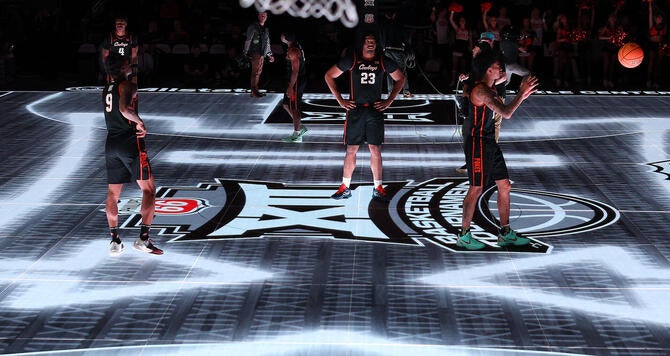
Thornton pointed out how indoor volleyball, which was once always on wood floors, is now played on Taraflex, which is the Division I standard. Basketball in the United States is understandably not quite ready for that change, but LED glass floors have been approved for use in legitimate competition in professional leagues elsewhere around the world. Maybe we'll check in come 2040 and it's going to be part of the culture in this country then. If that happens, the Big 12 will get to boast it got there first.
"The interesting thing about the glass floor is, the feedback we received from officials was, 'Wow, this feels better on my body. My recovery the next day is better because it's a little bit more buoyant,'" Thornton said. "The evolution is still there. ASB still continues to have success — and institutions are reaching out to us about potentially putting it in their facilities down the road. They continue to have success in Europe and the NBA is an equity partner in them. I think you'll find that when we're playing on an interactive court down the road ... we'll get to a point where it's a better surface for the student-athletes, the officials, etc."
Thornton said the league's coaches and administrators were willing to try it, they were collaborative in debate about what to do in the midst of the tournament, and having that kind of environment with healthy communication strengthens the Big 12's general M.O.
But for 2027?
"We'll be on wood," Thornton said.
The consumer will see other changes in the Big 12's playing surfaces this season, though. You've already seen it at play in football.
A Monster league. Literally.
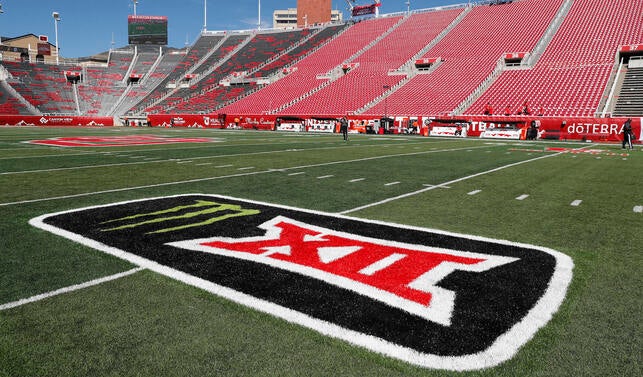
The league's huge financial agreement/partnership with Monster Energy led to a college sports first: a company pairing its brand logo with a conference's symbol on the field of play.
Seeing action on a football field is a different television experience than watching a game play out on a basketball court, so the league hasn't seen much blowback or excessive commentary on its new logo, which has been visible the past two weeks in football games.
"From a conference standpoint, our media rights agreement is always going to be the biggest portion of our revenue and what we are able to deliver to our schools, but one of our responsibilities, and one of the things commissioner Yormark has been focused on, is how to we create additional revenue for our institutions in an a time where everyone needs more money and we're trying to punch up," Thornton said.
Which is to say: The Monster-ization of the Big 12 is coming to college basketball in less than two months. Ad space is taking up more and more real estate on college courts as the years go on, but even still, seeing this on a screen or in person will take some getting used to.
New look to the floor at Fertitta Center. pic.twitter.com/0nmTt6Vnt3
— Joseph Duarte (@Joseph_Duarte) August 10, 2026
Even with the soft rollout of an occasional picture posted on social media, there has already been some negative reaction to the Monster logo on basketball courts, right there in the paint. Traditionalists will of course hate it. But will it stop one person from watching the games? Almost certainly not.
"I think in some cases it looks pretty good. I think it's something you'll get used to," Thornton said. "There will be others that go down this path as well. This is another case of us trying to be a different league and being a first-mover. When you are a first-mover, there are hiccups at times. Monster has been a great partner and worked closely with us not on just the logo but the activation side of it as well. Monster has an opportunity to take us to other places that other sponsors could not. Other conferences are trying to do the same thing, we just happened to find a partner early on that's a world-recognized brand.
Thornton is likely correct that the Big 12 will ultimately prove to be the trendsetter here. Let's check in on the playing surfaces across the SEC, Big Ten, Big East and ACC in 2032 and see which leagues have held out on corporate sponsorships on their fields and courts ... and jerseys. Because part of the Monster deal is also to have the green M-claw on the uniforms as well. Here's how the Bearcats will look this season.
The jerseys 🪡🧵#Bearcats x @jeffwylerauto
— Cincinnati Men’s Hoops (@GoBearcatsMBB) August 31, 2026
📝: https://t.co/jb5iATklBX pic.twitter.com/oh3w4kaaKw
Thornton said the combo logo will only be worn in the regular season. In the conference tournaments and in the NCAA Tournament, the uniforms will not have the M-claw patch attached (due to the contract terms, in addition to NCAA regulations).
It's one more flashy change, one more example of the Big 12 trying to get ahead and differentiate itself. It doesn't ensure one additional win, but it does separate the league in a way that's interesting, if nothing else. Yormark refuses to just sit and wait on the next thing. He's chasing it. Innovation is winning, damn the critics. From a basketball standpoint, that energy needs to seep into every program in order to get the Big 12 back atop college basketball.