
Bracketology: Can unbeaten Miami (Ohio) make the NCAA Tournament if it doesn't win the MAC Tournament?
The Redhawks are 23-0, but their spot in the Big Dance is far from secure

By
David Cobb
•
6 min read
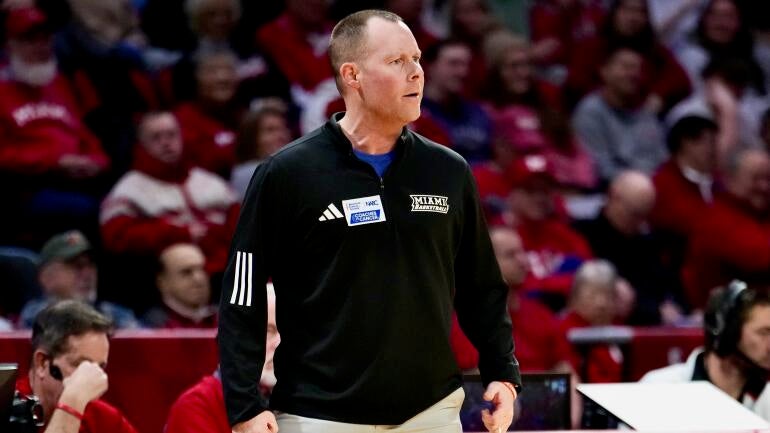
If Miami (Ohio) continues stacking victories but fails to win the MAC Tournament next month, it will arrive at Selection Sunday with one of the most vexing resumes in modern NCAA Tournament history.
Without a single Quad 1 result on their resume, the No. 23 Redhawks have the potential to be a 30-win team that gets left out of the Big Dance, creating a precedent that would send shockwaves through college basketball.
They wouldn't be the first mid-major program with a gaudy record to be punished for a poor strength of schedule on the sport's annual judgment day. But they would be the most glaring example since the NCAA switched from the RPI to a NET-based sorting system for the 2018-19 season.
With eight regular-season games still remaining and a lagging analytics profile, the CBS Sports Bracketology model still gives the Redhawks virtually no chance of making the field without winning the MAC Tournament.
As the projected winner, they are currently listed as an automatic qualifier in the projected field of 68 from the CBS Sports Bracketology model. Otherwise, it's going to be tenuous if the Redhawks want to go dancing for the first time since 2007.
Miami has not played a Quad 1 game and is just 2-0 in Quad 2 with only one more projected Quad 2 game remaining (Saturday at Marshall). With the nation's No. 350 NET strength of schedule, there is little meat on the bone. Tuesday's 73-71 win at Buffalo, which improved the Redhawks to 23-0, was tense and came down to the final possession. In the end, it was a Quad 3 victory that won't do much to bolster Miami's case for an at-large bid.
23-0 🤯
— ESPN (@espn) February 4, 2026
Miami (OH) holds on to continue the largest win streak by any team in MAC history 🔥 pic.twitter.com/65kQyBOaJz
What if Miami started 33-0, lost in the MAC Tournament title game and entered Selection Sunday at 33-1? Could it be left out of the dance? It will be a decision made by humans, who may deem excluding a team like that untenable. But based on the metrics the selection committee uses to evaluate at-large candidates, it could be justified in keeping a Redhawks team with 30+ victories out of the field.
The final determination in that scenario will depend on a number of factors. One of them could be who the opponent is in a hypothetical MAC Tournament title game. If it's Akron, which is currently No. 50 in the NET, then it would mark Miami's first Quad 1 game, and a loss wouldn't be so penal. Playing any other MAC team on a neutral floor would likely constitute a Quad 3 game or worse and make a loss far more harmful.
Here's a look at the Miami (Ohio) resume.
2026 Miami (Ohio)
Regular season record: 23-0 (11-0 MAC)
NET strength of schedule: No. 350 of 365
Wins over top-100 KenPom teams: 1 (vs. Akron)
Quad 1: 0-0
Quad 2: 2-0
Quad 3: 5-0
Quad 4: 13-0
vs. non-Division 1 teams: 3-0
Teamsheet metrics
Net: 52
KPI: 52
SOR: 24
WAB: 33
BPI: 91
KenPom: 89
Torvik: 82
Miami ranks squarely outside of the normal at-large range in advanced metrics that appear on its NCAA team sheet such as BPI (91st), KenPom (89th) and Torvik (82nd). While the Redhawks' resume-oriented metrics are holding steady in at-large territory for now, they aren't bulletproof. Across KPI, WAB and SOR, Miami's average is 37th.
If a loss comes, it will likely be a damaging Quad 3 defeat or even a Quad 4 landmine that brings a significant hit. As a result, Miami's path to an at-large bid is razor-thin.
Here is a look at three historical comparisons to this year's Miami (Ohio) team that illustrate how perilous the path is to an at-large bid for mid-major teams with poor schedule strength. The first two (2004 Utah State and 2018 St. Mary's) failed to reach the NCAA Tournament after losing in their conference tournaments. The third example (2023 Charleston) is arguably the closest comparison to this year's Miami (Ohio) team that we've seen since the NCAA started using the NET system for the 2018-19 season.
Historic NCAA Tournament snubs

2004 Utah State
Regular season record: 25-2 (17-1 Big West)
Conference tournament result: Loss to No. 6 seed Cal State Northridge in semifinals
KenPom non-conference schedule rank: No. 242 (of 326)
Wins over top-100 KenPom teams: 2 (vs. BYU, vs. Pacific)
NCAA Tournament: OUT
Utah State entered the 2004 Big West Tournament with a 25-2 record and No. 22 ranking in the AP poll. The Aggies' only regular-season losses came against Utah and Pacific, both of whom went on to make the NCAA Tournament. But after getting a bye to the Big West Tournament semifinals, the top-seeded Aggies fell to No. 6 seed Cal State Northridge 63-62. That one-point heartbreaker to a sub .500 opponent certainly didn't help Utah State's case, and the Aggies were left out of the Big Dance with a 25-3 record.
A lack of marquee victories was largely to blame. Utah State's best win came at home on Dec. 23 against a BYU team that went on to reach the NCAA Tournament as a No. 12 seed. Otherwise, Utah State's only other victory against a top-100 KenPom team came against Big West foe Pacific, as the teams split their regular-season series.
Aggies coach Stew Morrill likened Utah State's exclusion to "being slapped in the face." Following the snub, the Aggies promptly dropped a first-round NIT game against Hawaii to end the season at 25-4.

2018 Saint Mary's
Regular season record: 27-4 (16-2 WCC)
Conference tournament result: Loss to No. 3 seed BYU in semifinals
KenPom non-conference schedule rank: No. 296 (of 351)
Wins over top-100 KenPom teams: 4 (vs. New Mexico State, at BYU, at Gonzaga, vs. BYU)
NCAA Tournament: OUT
Saint Mary's entered the 2018 WCC Tournament at 27-4 (16-2 WCC) with a 1-1 record against a Gonzaga team that earned a No. 4 seed in the Big Dance. Even with a victory over the Zags — and three more wins against teams that finished in the top 75 at KenPom — the Gaels missed out on the Big Dance.
Losses to Washington State and San Francisco were both unseemly blemishes, which dragged the Gaels down in resume-based metrics. On Selection Sunday, Saint Mary's was strong analytically with an average ranking of 32nd across advanced metrics such as BPI, KenPom and Sagarin. But their resume-based metrics (RPI, KPI and strength of record) averaged out at 48.67.
"They didn't play a very challenging schedule, even non-conference," 2018 selection committee chair Bruce Rasmussen said in an interview with TBS after the bracket was revealed. "We just didn't feel like there was enough of a resume."
A NET era comparison

2023 Charleston
Regular season record: 28-3 (16-2 CAA)
Conference tournament result: Beat No. 4 seed UNC Wilmington in finals
NET strength of schedule: No. 333 of 363
Wins over top-100 KenPom teams: 2 (vs. Virginia Tech, vs. Kent State)
NCAA Tournament: No. 12 seed (automatic bid)
Charleston made the NCAA Tournament at 31-3 as an automatic qualifier for winning the CAA Tournament. But the Cougars, coached by Pat Kelsey, only received a No. 12 seed and would have been snubbed at 30-4 if they'd lost to UNC Wilmington in the CAA finals. On Selection Sunday, Charleston was ranked No. 51 in the NET and No. 73 at KenPom. The Cougars were 0-1 in Quad 1, 2-0 in Quad 2, 12-2 in Quad 3 and 16-0 in Quad 4.
Because of their high volume of wins but lack of Quad 1 and 2 opportunities, the Cougars are perhaps the closest comparison to this year's Miami (Ohio) team since the NCAA transitioned to the NET system for the 2018-19 season. The 2021 Winthrop team – also coached by Kelsey – was 23-1 on Selection Sunday after winning the Big South Tournament and received a No. 12 seed. But that was during a COVID-impacted season which produced skewed data.