Bracketology: Race for NCAA Tournament's top seeds enters final stretch before Selection Sunday
Duke, Arizona and UConn begin postseason play Thursday, with conference tournament results likely determining the No. 1 overall seed and final spot on the NCAA Tournament's top line as Houston pursues a prime No. 2 seed in the South Region.

A sprint to the finish for the prospective No. 1 seeds in the 2026 NCAA Tournament begins Thursday, when Duke, Arizona and UConn start their postseason journeys with conference tournament action. The duration of their stays will determine how the top line in the bracket ends up looking when the field of 68 is revealed March 15 on CBS (6 p.m. ET).
While Duke, Arizona and Michigan are all destined for No. 1 seeds, the battle for the No. 1 overall seed will come down to what transpires over the next few days. So will the battle for the final No. 1 seed.
In both cases, the selection committee's valuation of head-to-head results could prove significant.
Duke, which opens ACC Tournament play on Thursday against Florida State, owns a slight edge on Michigan for the No. 1 overall seed in CBS Sports Bracketology because of a head-to-head win over the Wolverines on a neutral court last month. Because the teams are so close by every measure, our model gives deference to the team with a head-to-head win.
"I think the committee has been very, very consistent, at least since my time on it, that head-to-head matters," selection committee chair Keith Gill said Wednesday.
More on that in a moment. First, here's a glimpse at how the top of the bracket is shaping up as more of the heavy-hitters begin postseason play.
Bracketology top seeds








Check out the full field of 68 at the CBS Sports Bracketology hub.
Head-to-head may not overrule UF vs. UConn
Though Gill was clear that head-to-head results are a factor the committee will consider, he added that, "it's not the only thing that matters."
There is nuance in the discussion of how large a gap a single head-to-head result will overcome in the selection committee's side-by-side "scrubbing" process of teams next to each other in the 1-68 hiearchy.
When it comes to the battle for the fourth No. 1 seed, UConn owns a head-to-head win over Florida from Dec. 9 in the Jimmy V Classic at Madison Square Garden. However, the Gators have opened up enough of a gap in the metrics used by the committee that the Huskies' head-to-head victory may not be enough to bridge the gap between the teams.
That's why the CBS Sports Bracketology model is giving a slight edge to the Gators in the race for the final No. 1 seed. If UConn won the Big East Tournament and Florida failed to win the SEC Tournament, the calculus could change. In that scenario, it's feasible -- if not likely -- that UConn would get the edge for the last No. 1 seed with its head-to-head victory accounting for at least some of the rationale.
"Whether it's the most compelling thing, you know, I think that that's based on the situation or the circumstances," Gill said. "I would say it absolutely is important, but it's another data point, and we'll use it in our evaluation. Certainly sometimes it can put a team ahead of another, but it doesn't happen all the time."
Houston playing for cushy path
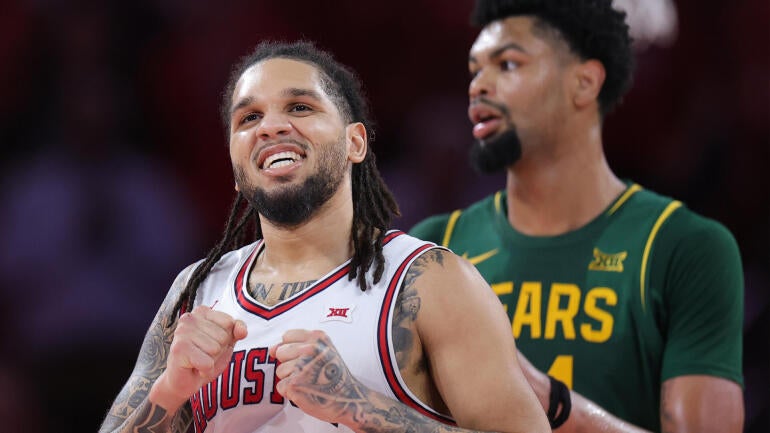
Houston smartly passed off its South Region hosting responsibilities to Rice, its Space City neighbor, which cleared the path for the Cougars to be permitted to play in the South Region's pod, which culminates in Houston this season. If the Cougars end up in the South and survive the first weekend of the Big Dance, they would play inside the Toyota Center for the Sweet 16 and Elite Eight, which would be a huge advantage.
Making that happen would likely require the Cougars to either be first or second in the No. 2 seed hierarchy. That will be determined in part by how Houston performs in the Big 12 Tournament and by how other potential No. 2 seeds such as UConn, Michigan State and Illinois fare over the next week.
Suffice it to say, if a No. 1 seed ends up at a potential home-court disadvantage vs. the Cougars in an Elite Eight game, they won't be thrilled. But under NCAA bracketing guidelines, it is permissible since Houston is not the host institution.
"We would follow our principles and let our process play out, and they would end up where they end up," Gill said.