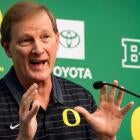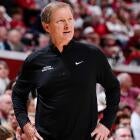


ROSEMONT, Ill. -- Dana Altman announced his retirement after 16 seasons as Oregon's men's basketball coach on Wednesday, exactly one day before he was scheduled to appear here at Big Ten Media Day inside the Donald E. Stephens Convention Center.
Obviously, the timing isn't ideal.
Oregon's season starts two weeks from Monday, which is among the reasons the announcement was met with some raised eyebrows, in part because this kind of thing has developed into something of a trend. This is the third straight year a power-conference coach with a Final Four on his resume has retired late in the calendar and well outside of the normal firing-and-hiring cycle. In 2024, it was Virginia's Tony Bennett who walked away on Oct. 18. In 2025, it was Auburn's Bruce Pearl who stepped down on Sept. 22. In 2026, it's Oregon's Dana Altman calling it a career on Oct. 7.
So why now?
On X, where everybody is free to share opinions, sensible or otherwise, speculation ran rampant.
Was Altman doing this now just to trap Oregon's players because, I mean, how many transfer options are even available in the middle of October? Was Altman doing this now just to ensure the only option Oregon had was to promote his assistant, Tony Stubblefield? Was Altman doing this now just to keep the direct deposits coming throughout the offseason, always with the intent to walk away before things tip?
Every theory was out there somewhere.
Unprompted, Altman offered an explanation during Wednesday's press conference that spanned roughly an hour. To me, it sounded sincere. Without getting specific, Altman cited health concerns. Meanwhile, longtime Oregon-based columnist John Canzano, forever as connected as anybody in the state, reported he was told that Altman had to lie down on the hardwood multiple times last week just to get through a practice.
"I'm not as healthy as I should be," Altman acknowledged. "Or as I want to be."
Is it life-threatening? Altman insisted it's not. But he did tell a story about reaching the age where sleeping through the night without having to wake up to use the bathroom is impossible. Then he said he has trouble getting back to sleep. Then he suggested he doesn't have the energy he needs to get through days the way he used to glide through them.
So on and so forth.
Dana Altman was born in 1958. He is 68 years old.
The average retirement age for a man in the United States is 65. So there's really nothing strange about this once you remove the basketball component. If Altman had retired seven months ago, or even three years ago, nobody would've blinked, provided it happened in March or April.
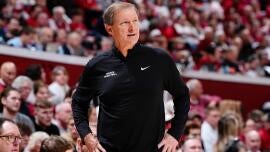
This happened in October, though. Again, the timing isn't ideal. We can all agree on that, Altman included. But if you listened to Altman talk Wednesday, through broken sentences and tears, he sounded a lot like a mix of Tony Bennett and Roy Williams at their out-of-nowhere press conferences announcing their retirements. Just like Bennett, Altman explained how he realized during the offseason that he was losing whatever it is coaches often refer to as "that fire." And, just like Bennett, Altman explained he hoped, and even thought, that so-called fire would return -- especially after he took two weeks off in August.
"It didn't," Altman said.
Altman also explained how he simply no longer believes he's the best man to do the job, which is exactly what Williams said after announcing his retirement from North Carolina in 2021. Altman has won 792 games as a college coach. He's won seven conference regular-season championships, 10 conference tournament championships and has been his conference's coach of the year seven different times.
He took Oregon to the 2017 Final Four.
He's been a great basketball coach.
But Altman hasn't guided Oregon to the Sweet 16 since 2021. His Ducks finished tied for 15th in the Big Ten last season and weren't expected to be much better this season. Truth be told, the combination of transfer-waivers, revenue-sharing and big NIL deals has changed college basketball dramatically -- and not in ways that benefitted Altman or the Oregon program he was running. That's not my opinion as much as it's his.
"The main factor [in this decision] is, I looked in the mirror, and I'm not the guy to take these guys where they can get to," Altman said while motioning toward his players in attendance and clearly getting emotional. "You know, guys feed off of energy. They feed off confidence. And if I don't have that energy and that confidence for them to feed off, I'm not the leader."
What Altman said next was interesting.
"Kelvin Sampson, Rick Barnes, those guys are older than I am -- but they're still getting it done, you know?" Altman said. "We all have standards. And I'm not trying to act like ... but I'm not going to be able to perform to my standard."
In summary, here's what I heard Wednesday.
I heard a man, over the course of about an hour, talk about how he's grateful for his career and for the family that allowed him to have it. I heard a man say his one regret was missing things with his children, and that he would be better at that as a grandfather than he was as a father, and all of that resonated with me. I heard a man talk about how he admires the way Houston's coach (Sampson) and Tennessee's coach (Barnes) have been able to adjust and adapt and maintain a standard of success despite the dramatic changes in the sport, and despite the fact that one of them is 71 (Sampson) and the other is 72 (Barnes). And I heard a man acknowledge, hard as it might've been to do, that he hasn't adjusted and adapted quite as well, and that his last season wasn't like theirs, and that his upcoming season probably wasn't going to be like theirs, either.
"We all have standards."
Altman didn't meet his last season and, barring a surprise, wasn't going to meet his this season. If you watched the press conference, you could tell he feels that. If you listened to the press conference, you know he's also not feeling as well as he'd like to feel -- or as well as he needs to feel -- to do the job he was employed to do the way he did it long enough to establish himself as the best coach in Oregon history.
So Dana Altman is walking away.
If you're not in love with the timing, I get it. It doesn't bother me as much as it bothers some. But if it bothers you, I get it. Either way, there are a lot of different theories floating around, especially considering this is the third consecutive year with a late-in-the-calendar retirement. But after talking to sources Wednesday and watching Altman speak for himself, this isn't that complicated in my head.
Here's the deal: A 68-year-old man who has had an incredible career, made more money than he needs to get through life more or less the way he's currently living it, and is now dealing with some of the same health issues many people his age deal with, realized in the days before he was scheduled to travel here for the unofficial launch of what would've been his 38th season as a college coach that what he needs to do this job well is not something he still possesses.
If you're wondering why Altman didn't realize all of this earlier, honestly, I believe he probably did. But, just like Bennett explained when he retired at Virginia two years ago, Altman kept hoping "that fire" would return.
"It didn't"
And it wasn't going to, understandably so. Again, that's not my opinion as much as it's Altman's. It wasn't going to return. So, the man who won a national coach of the year award in 2013 walked away in 2026.
Ideally, he would've done it months ago. We can all agree on that.
But I get why he didn't.