How Baylor landed ex-NBA pick James Nnaji and what coaches are saying about the controversial acquisition
Here's how Baylor snagged a former NBA Draft pick midway through the 2025-26 season -- and what the fallout means for college hoops moving forward.

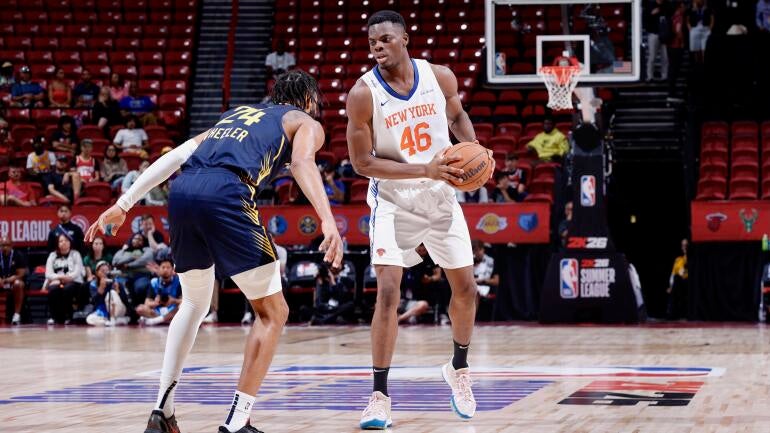
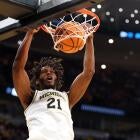
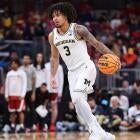
On Christmas Eve, Baylor's basketball program announced a figuratively (and, uh, literally) big holiday surprise: 7-foot center James Nnaji, the No. 31 overall pick in the 2023 NBA Draft who has played the last four seasons in the EuroLeague, has signed with the school and is eligible to play for the Bears immediately.
The midseason addition of a player with immediate eligibility is unusual, though not unique, to college basketball. However, the midseason clearance of a men's player who was previously drafted by an NBA team has no precedent. And it raises plenty of questions, such as: How did this happen? Will situations like this happen with increasing frequency in the future? And through which loophole did the Bears sneak this deal?
All valid questions -- and ones that coaches and college personnel themselves are asking. CBS Sports polled college coaches anonymously on the topic to gauge reaction across the sport. Their answers -- and the answers to these questions -- are below.
College coaches and general managers react
Reactions ranging from pragmatism to envy and anxiety echoed across the landscape over the weekend. One Big East coach told CBS Sports he has "no problem" with what Baylor did because it is doing what it can to improve its roster. Another coach in the Big Ten said what Baylor did was simply within the rules.
"They were creative enough to find a situation that fit into a narrow interpretation like all of us try to," said the Big Ten coach.
Added a high major head coach, "I don't fault Baylor for doing it. If the NCAA clears a kid, then it clears a kid. For us, if you ask me, do I think that a player should be able to be added after being drafted? No. It's not the process we're all into. A kid puts his name into the draft and gets drafted, his college life should be over."
Still, others seem less enthused about the deal -- namely, about what the precedent portends for the future in the sport.
Said one Big 12 coach: "[It's] up to Baylor to decide if exploiting a rule is within the culture of their program. Just because something is currently permissible doesn't make it best for the game."
That coach seemed to echo what Michigan State coach Tom Izzo said over the weekend about the situation.
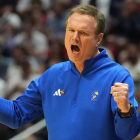
"I mean, if that's what we're going to do, shame on the NCAA," Izzo said. "Shame on the coaches, too. But shame on the NCAA, because coaches are gonna do what they gotta do, I guess."
Izzo said he has a call in to Bears coach Scott Drew and wants to talk with him about the situation.
A major conference general manager acknowledged to CBS Sports that Baylor made a move to try and better its roster, which is the ultimate goal. Baylor just went to a place others hadn't yet gone. The interpretation of whether it was morally right or wrong, they seem to argue, is less relevant than whether moves such as this will be net-positives.
"Motherf****** will go anywhere to find someone that can help them win a basketball game right now," said the GM. "I don't think it's something we will do because these guys are pros. How will they handle how a college coach coaches? That's been my thought process.
"Pros don't worry about winning like you expect to win in college," the GM added. "You've got to really dig into the character traits and then pressure down these traits into these grown men coming back who haven't played college basketball. It's a different game than the NBA and a different game than the G League. This s*** is about winning; the NBA is about getting paid."
Overall, there seems to be a mix of both interest in how the situation at Baylor plays out and a desire among some in the college ranks from the NCAA to, at the very least, clarify the rulebook -- if not close the loophole entirely.
"A drafted player should forfeit eligibility," the Big Ten coach told CBS Sports. "And this also calls into question the draft withdrawal date and if it means anything."
The Big 12 coach agreed: "The [loophole] should be closed so that pros cannot return to college."
The college GM downplayed the significance of the signing and pointed to the tiny player pool from which these transactions may come as reason to believe this won't likely become a pipeline for college programs to pluck from down the road.
"I don't [think it will have a big impact on roster construction," the GM told CBS Sports. "I don't think the player pool is going to be large enough. [And] I think the NCAA or the NBA is going to clip this real quick. Whoever is going to do it, better do it now, because this won't be around too much longer.
"I'm interested to see how it plays out with how good he really is, how much he impacts and how much they win," the GM added. "Because they're going to be under scrutiny all year for it."
Nnaji's instant eligibility at Baylor at the midway point of the college basketball season opens another strange and unexpected can of worms in the ever-evolving world of college athletics.
"It's like when NIL started, if you had money, I wasn't mad at you. Certain teams had money right out of the gate and were ahead of the game in NIL. But everyone has a chance to do it," a high-major head coach told CBS Sports. "If the NCAA said it's a rule, you don't have to like it; you can just lean into it. I don't like the rule that if you get drafted, there's a loophole, but I don't fault Baylor for doing it."
How did this get cleared?
When Baylor learned transfer big man Juslin Bodo Bodo was likely to be out for the year because of a summer injury, Baylor general manager Jason Smith reached out to several contacts to see if any good midyear additions might make sense for the team as a replacement option, a source told CBS Sports. Nnaji, whose representatives signaled he was interested in coming stateside, came up as the best option.
So Smith worked in tandem with Nnaji's reps and the NCAA through the process to ensure he could be cleared at the midseason mark. (Nnaji's situation changed in recent months after mutually parting with Barcelona this summer, opening up the possibility of landing elsewhere.)
The NCAA cleared Nnaji to play college basketball because he is an international player still within his five-year window of what would be his high school graduation, given that he is still only 21 years old. That clearance comes despite being drafted to the NBA by the Detroit Pistons in 2023. His rights were traded to the Hornets on draft night and later to the New York Knicks in 2024 as part of the deal to acquire Karl-Anthony Towns.
How much college eligibility does Nnaji have remaining?
The NCAA's official rule on eligibility and its five-year clock allows for players to complete four years of athletic competition from their first full-time college enrollment. That means Nnaji's clearance affords him four years of eligibility. Under NCAA rules, Nnaji's qualification for eligibility is under the category of being an incoming freshman and having no previous full-time college attendance. Those qualifications come regardless of the time of year of initial enrollment.
Interestingly, several other former professional players joining the college ranks -- Thierry Darlan (Santa Clara) and London Johnson (Louisville) were given two years of eligibility by the NCAA. Darlan's clock began this year, and Johnson's will begin next year.
How House vs. NCAA helped Baylor (and others)
Schools that opted into the House injunction, electing to share revenue with athletes, are also required to have an available roster spot in order to sign a player midseason. That legislation also expanded the number of scholarships available per men's basketball team from 13 to 15. So even with no attrition at Baylor, it has additional space carved out to make just a move like the one it is making by adding Nnaji.
Nnaji's background
In 2020, Nnaji moved from Hungary, where he'd lived for several years, to Barcelona to join FC Barcelona's basketball team. That led to an escalating interest in his skill set internationally as he developed and made the A Team in 2021. He also had stints playing on loan with Girona in the Spanish Liga ACB and with Merkezefdeni, a Basketball Super League team in Turkey.
Nnaji was considered a potential first-round prospect in the 2023 NBA Draft but slipped to the No. 31 overall pick on draft night -- the first selection of the second round -- after the Hornets made a draft-night trade up the board to acquire him.
Despite being selected high, Nnaji never played in the NBA or G League, only in the NBA Summer League before retreating back overseas.
A precedent set, and similar cases
Nnaji's signing on Christmas Eve ruffled feathers and, in one case, even drummed up commotion on the player front after On3 reported -- and subsequently retracted its report -- that former undrafted guard and current Chicago Bull, Trentyn Flowers, was drawing interest from 12 college teams. CBS Sports' Matt Norlander contacted numerous schools reported to be interested in courting Flowers, and six refuted the report.
FWIW, while some might be sniffing around, at least three programs named in this report tell CBS Sports they've shown "zero" interest in pursuing Flowers. One adds: "Not even sure how we got on that list. No one on our staff has had any contact with anyone associated with him." https://t.co/F5QZuZA5jN
— Matt Norlander (@MattNorlander) December 28, 2025
Flowers' situation is similar to Nnaji's in that he did not play college basketball -- he initially committed to Louisville before opting for a pro career -- but dissimilar in that Flowers has played in eight NBA games the last two seasons. Despite that background, Flowers is still believed to be drawing interest from college teams, though the list does not include a dozen at the moment.
Other similar situations have played out in recent years involving former professional athletes, including the aforementioned Johnson, who has played professionally since 2022 and committed to Louisville earlier this year, and Darlan, a former G League guard now playing with Santa Clara. Johnson will have two years of eligibility beginning in 2026-27 after playing three years in the G League, and Darlan has two years of eligibility.