March Madness 2026: Future NBA stars who could take over the NCAA Tournament
A loaded freshman class headlined by AJ Dybantsa, Cameron Boozer and Darryn Peterson brings rare NBA-level star power to the 2026 NCAA Tournament.

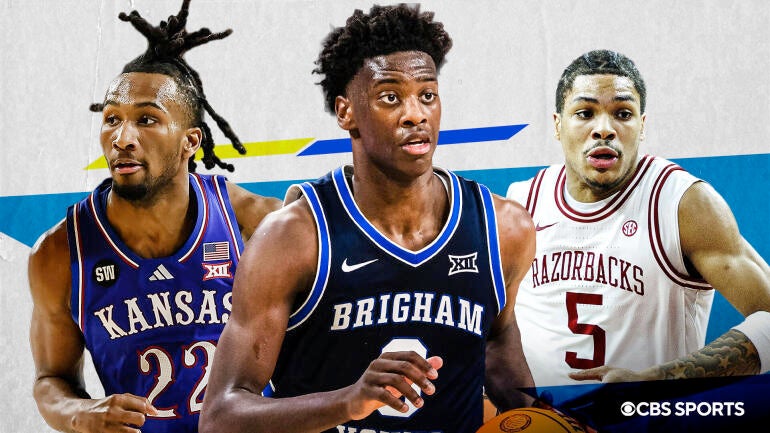
March Madness is about to double as an NBA showcase. In a rare convergence, a historically loaded freshman class — one that could dominate the top of the 2026 NBA draft — has already taken over college basketball. Now, those same players will take center stage in the 2026 NCAA Tournament, with a chance to shape both the bracket and the future of the league.
Just how good is college basketball's freshman class this season?
Well, consider this. The first 11 picks in our most recent mock draft were all freshmen, and not only are they the best long-term prospects, but they're also able to drive winning right now. All 11 have played significant roles in helping lead their teams into this week's tournament field.
With NCAA Tournament games around the corner and the NBA draft providing a glimmer of hope to tanking franchises, here's a look at some of the most pressing draft topics heading into the Big Dance.
Can Kansas' Darryn Peterson play his way back to No. 1?
The short answer is yes, and it may not even have to come in the next three weeks. While AJ Dybantsa has taken over the top spot on our most recent mock, as well as the betting markets, this race is a long way from over.
Dybantsa has been the more impressive prospect this year (more on that below), while Darryn Peterson's season has been characterized primarily by concerns about his durability and availability. Just a few days ago though, the mystery revealed itself when a previously unreported pre-season incident finally came to light, illustrating what Peterson has been battling from both a physical and mental standpoint in recent months. You can bet that NBA teams will dig into both, as they do for any potential top prospect, during the pre-draft process, but it does shed some light on why he would ask out of games at times.
As for Peterson's sheer talent, there are very few questions among NBA scouts and decision makers, almost all of whom realize that we rarely got to see him at 100% this year. What we did see from the Kansas guard was shot-making that had grown dramatically since high school, where he still finished as the top prospect in the 2025 recruiting class. Peterson currently ranks in the 94th percentile on catch-and-shoot attempts per Synergy Sports after shooting 43% from behind the arc this year, which includes numerous attempts on the move and with incredibly high degrees of difficulty.
Now in March, you take Peterson's incredible and consistently improved shot-making and much more explosivness than what we saw last year, and combine it with what we alresdy knew he was as a high school propsect — a budding lead guard who combined size (6-foot-5), length (6-foot-10 wingspan), physicality, an effortless ability to make plays — and you have the makings of one of the best on-ball creators we've seen in several drafts.
Missing out on that type of prospect is something that can, and should, terrify every NBA decision-maker. That's exactly why you don't hear anyone ruling out Peterson as the top pick in the 2026 NBA Draft just yet, regardless of what has happened this season.
What is AJ Dybantsa's floor and ceiling?
Give Dybantsa credit. He spent his entire high school season as the top-ranked prospect in his class, until the very last update, when he was overtaken by Peterson. The truth, though, is that Dybantsa lost it as much as Peterson took it. His senior season of high school was a disappointing one. The game became more of a show than a competition. He would play to the cameras, dramatically protest calls, and headlined a team that underachieved relative to their talent. Simultaneously, there were no signs of real growth in Dybantsa's game or skill set. So, what was once almost unthinkable, that he would not finish atop the class rankings, became a reality.
This year at BYU, we saw real signs of growth and maturation from Dybantsa. Right away, it was clear that he was playing through contact and finishing at a new level. Kevin Young built his offensive system around his freshman star, in a way that allowed Dybantsa as much volume as he needed with the ball in his hands. As the season went on, his reads and passing grew with increased reps, as did the consistency of his shooting. The bottom line is that there was no more reliable scorer in college basketball this season, and yet there were times when his overall impact on winning still wasn't what it should have been for someone with his talent. Dybantsa never lost interest in scoring, but defense, rebounding, and body language were less consistent at times.
What does that mean for Dybantsa's range of outcomes at the next level? The ceiling is still extremely high. Jumbo wings who play with bounce, elasticity, court coverage, and length don't exactly grow on trees. When they can create their own shot on demand, there's the potential to be truly great. As for the floor, I would argue we saw it at times this season, someone who is always going to put up his numbers, but may not always do it in service of winning.
The reality is that Dybantsa has still never won a major championship at any relevant national level. Questions about how he would acclimate to being anything other than option 1A are also fair, because, quite frankly, we've never seen it, including this year at BYU.
Can Cameron Boozer have a Paolo Banchero-like rise to No. 1?
It's almost ironic that Cameron Boozer doesn't get more consideration, at least in public platforms, to be the number one pick. He's come up the ranks with Dybantsa and Peterson, and all he's done is deliver winning at truly historic levels. He's the most successful high school basketball player of the modern era, and it's been more of the same at Duke.
The Boozer file:
— Adam Finkelstein (@AdamFinkelstein) March 15, 2026
4 Florida state championships
3 Nike EYB championships
2 gold medals
1 high school national championship
And now…
ACC regular season & tournament championships
Has won every championship he’s competed for since entering high school.
Truly historic stuff. https://t.co/fyQvdnxgpd
The typical rationale is that Boozer doesn't have the same upside as either of the aforementioned two, Peterson and Dybantsa. Candidly, that is accurate. If all three players become the best version of themselves, then both Dybantsa and Peterson would likely be better NBA players. However, what is also accurate, in my opinion, is that Boozer's chances of becoming the best version of himself are higher than either Dybantsa or Peterson. Obviously, no one is questioning his impact on winning. Nor is anyone questioning his durability.
What the dialogue is really about is whether or not he is suited to be the offensive hub of an NBA system. That's what makes the Paolo Banchero comp so intriguing. Behind the scenes, this is actually the comparison that Boozer reportedly preferred over more typical ones like Kevin Love or even his father, Carlos Boozer. Cam may not have the same athletic pop as Paolo, nor the same ability to rise and fire. But what he does have is an unmatched overlap of physicality, intellect, and versatility. He's got great hands, is an elite rebounder, and a terrific passer. Boozer has made real strides with his shooting, is going to be able to punish mismatches in the post, and be incredibly malleable in offensive actions. I'd even argue his defense is better than advertised.
In short, I don't think he necessarily needs to be like Paolo to have a chance to be the best player to come out of this draft. I actually think he needs to lean more into being that ultra-versatile and efficient guy who does nothing but win. That's why I believe he is very much in the conversation to go No. 1. If Duke wins a national championship, that opinion may not sound like a hot take in a few weeks.
Can Darius Acuff Jr. crack the top 4?
There has been no better freshman guard in the country this year than Darius Acuff Jr. at Arkansas, which is exactly what we expected coming out of high school, when he was the top-ranked point guard in the class of 2025. What has been a little less clear though is exactly how his game would translate to the NBA.
Acuff is sometimes labeled an undersized guard, which is a bit of an exaggeration since he most recently measured at 6-foot-2 without shoes on, has a better than 6-foot-5 wingspan, not to mention real strength and balance. By NBA standards, though, those measurements don't stand out. As for his role, as an on-ball creator and scorer, it's a potentially more difficult one to translate to the NBA because the bar is simply so high.
What's been notable this year for Acuff isn't just his dominance; it's the gains in his game that will make that transition to the next level easier.
First and foremost, it's the growth in his shooting. Acuff made over 44% of his threes this year, taking almost 5.8 attempts per game, and ranking in the 100th percentile as a catch-and-shoot player. That's critical to his value off the ball as he inevitably will be surrounded by more playmaking at the next level.
The other notable progression has been with his passing. Acuff averaged 6.5 assists per game with a roughly 3:1 assist-to-turnover ratio. That decision-making and the precision with which he delivers the ball have also been elevated within the last year. The biggest remaining question for Acuff is on the defensive end. It's never been his focus, and at his size, there's going to have to be more consistent emphasis at the next level. That having been said, with Caleb Wilson and Mikel Brown both joining the durability discussion, the top four now seems like an attainable outcome for Acuff.
Could injury concerns move Mikel Brown Jr. down?
For all the people who have speculated about Peterson's potential durability this year, he's actually played in more games this season than Louisville's Mikel Brown Jr. has at this point. Brown missed over a month in the middle of the season and most recently missed the ACC Tournament. That will inevitably be a topic that decision-makers dive into during the upcoming pre-draft process.
Simultaneously, while Peterson and Acuff rank in the 94th and 100th percentiles in catch-and-shoot attempts, Brown was in the 45th. That would have been considered almost impossible coming out of high school, when Brown's shooting and overall skill set were viewed as superior. While I still contend Brown is a better shooter than most realize if they only watched him this season, his catch-and-shoot numbers compared to other elite guards and the high turnover percentage are quick counterpoints for those who believe he's potentially the most skilled lead guard in the draft.
Is Keaton Wagler sliding?
Conversely, we have Keaton Wagler, who made a meteoric rise throughout the season at Illinois. It was the 46-point outburst at Purdue that truly catapulted his draft stock. While Wagler is still a clear lottery pick, many are asking if some of those projections were a bit too reactive after those Mackey heroics. Wagler only scored 20 points in one of Illinois' last seven games. More concerning, he's just 8-for-33 from behind the three-point line in his last seven games, with creation that is largely based around his shot-making since he lacks elite strength or athleticism. Context is important, and most scouts recognized that even when Wagler was putting up huge numbers, he was a longer-term stock than most others in the class. The most relevant question then isn't how he measures up today, but how he might three or four years down the road.
The bottom line for both players is that Acuff and Kingston Flemings seem to have more momentum right now, and all four are hoping to leave scouts with a positive lasting impression.
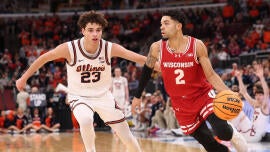
What upperclassmen should we be paying more attention to?
The freshmen may be the story in this draft, and should dominate a lot of the storylines in the NCAA Tournament, but that just means there could be upperclassmen hiding in plain sight. Here are some elder statesmen who could spearhead deep runs this month and simultaneously help their draft stock in the process.
Thomas Haugh (Florida) – Haugh had NBA decision-makers intrigued a year ago, coming off Florida's 2025 National Championship. He spurned the chance to be a first-round pick to return to the Gators and has since proven himself to be a legit big wing who can now play and defend multiple positions. This year, Haugh is a first-round lock with a chance to play his way into the lottery.
Yaxel Lendeborg, Aday Mara, Morez Johnson (Michigan) – Michigan's dominant frontcourt could all hear their name called in the first round of June's draft. That was the expectation for Lendeborg, who withdrew from last year's draft to accept a big offer from the Wolverines, but neither Mara nor Johnson were on many draft boards when the season first started. Lendeborg is a projected mid-first round pick, while Mara and Johnson both project somewhere in the 20-40 range, meaning they are playing for a guaranteed first-round spot in the coming weeks.
Labaron Philon (Alabama) – Philon is another player who helped his draft stock by returning to college this year. Last season, he made a name for himself with his defense first and foremost. This year, he's blossomed into one of the best on-ball creators in college basketball, doubling his scoring, making huge strides with his shooting, and simultaneously creating for others in the process. He's now a first-round lock that is hoping to play his way into the lottery.
Bennett Stirtz (Iowa) – In a draft that is loaded with freshmen lead guards, it may be easy to forget about Stirtz. But the Iowa point guard is a big-time shooter with a significant basketball IQ to match. From the D2 ranks to Drake to Iowa, he's starred everywhere he's gone, and has led a Hawkeyes team without an elite supporting cast back to the NCAA Tournament. He looks like a lock to be a first-round pick and may even be in the mix as early as 12.
Braden Smith (Purdue) – He's two assists away from being the all-time leader in D1 basketball. He's also the MVP of the Big Ten Tournament and has been to a Final Four. What he isn't is a prototypical NBA prospect, at least from a measurables perspective, but I believe there's a place for him in the league, and I suspect there are plenty of decision-makers who feel the same. Whether it's the late first-round or second, I expect he'll stick and prove to be the exception to the rule.