CBS Sports spent over a month talking to over 100 sources to discover how much every power-conference college basketball team is spending this season on their respective rosters. The findings from CBS Sports college basketball writers Matt Norlander and Isaac Trotter were fascinating, with 11 programs projected to spend more than $20 million on their rosters during the 2026-27 campaign.
Ten of those 11 teams (Texas Tech, Kentucky, Illinois, Texas, Florida, St. John's, Louisville, Duke, Tennessee and Michigan) were ranked in the preseason AP Top 25 poll earlier this week. The lone team in Tier 1 of spending that wasn't ranked in the first poll of the season? North Carolina.
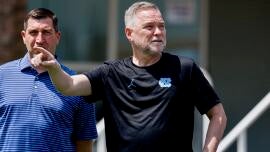
The Tar Heels are entering a new era with Michael Malone at the helm of the program. The longtime NBA coach is a first-time college head coach who got a late start on the recruiting trail after being hired in early April. Malone took in six transfers, including former Virginia Tech star Neoklis Avdalas, and finished ranked No. 9 in the 247Sports team transfer rankings.
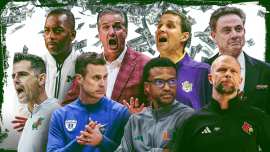
It should come as no surprise that the biggest spenders in the sport make up a majority of the top teams in the AP Top 25 poll. However, several programs are doing more with less, while the inverse — as with Kentucky last season — could prove true.
Here are the six biggest takeaways from college basketball's NIL arms race that will remain a talking point throughout the season and again this offseason when teams flip their respective rosters and a new batch of players enter the transfer portal.
UNC's 2026-27 roster costs how much?!?
Entering this season and the first for coach Michael Malone at the helm, North Carolina is unranked in the preseason AP Top 25 poll. The Tar Heels received the fifth-most votes of teams that were unranked, which essentially rates Malone's squad as the 30th-best team in the sport entering the season. In the ACC poll, North Carolina was projected to finish behind Duke, Virginia, Miami and Louisville. In short, the amount North Carolina is spending on this 2026-27 roster doesn't match the preseason projections. Carolina is not a Tier 1 national title contender.
Could things change? Absolutely. Malone was one of the best coaches in the NBA and helped the Nuggets win the title in 2023. However, college is a completely different game. Malone himself doesn't have much experience at this level, aside from serving as an assistant coach in the late 1990s.
And there is important context to know here with UNC's roster. Malone is a first-year college head coach and was hired the day the transfer portal opened. He had to play catch-up on roster-building and retention, while hiring a staff and getting acclimated to running a college basketball program.
Unsurprisingly, North Carolina had significant turnover this offseason. Jarin Stevenson is the lone returner from last season who played consistent minutes. The Tar Heels spent big to land transfers such as Avdalas, Matt Able and Terrence Brown. Additionally, UNC landed four-star big man Maximo Adams and five-star center Sayon Keita out of Spain.
Compared with the other 10 rosters that ranked in Tier 1, UNC has less talent on paper. There is hope that Malone can elevate the roster and make the Tar Heels one of the season's surprise teams.
What is the "Duke Discount" and is it real?
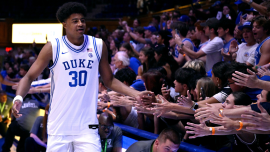
When the roster spending tiers hit the internet, one of the major talking points from the story was the "Duke Discount" that my colleagues wrote about. Almost anything about Duke basketball will get a reaction, good or bad. The Blue Devils are a lightning rod in the sport. So what is the "Duke Discount?" Here is the excerpt from the story that explains it.
For those who think Duke is No. 1 or 2 in player spending, a twist: Jon Scheyer's program obviously pays extremely well, but it's not at the top of the pyramid. (We know, we know: Some of you will scream this isn't true.) Duke benefits from something increasingly referred to as the "Duke Discount," a catchphrase many believe is legitimate, while some others roll their eyes. The Blue Devils offer a brand/marketing setup that's 1-of-1 in college basketball. Multiple programs that had to recruit against Duke either for blue-chip high school players or high-end transfers in the past couple of years admitted, on background, that they lost out on those players despite offering a substantially higher number than they were told the player took to go to Duke.
The Blue Devils still had to put up big cheddar to land the likes of John Blackwell (Wisconsin) and 17-year-old phenom Joaquim Boumtje-Boumtje this year, but the marketing upside of wearing that uniform remains such a tempting draw and easy moneymaker for guys who prove their worth. Duke's NIL outlook right now will likely wind up growing by a couple more million come March if the Devils are as great this year as they've been the past two.
Let's take a deep dive into what that means. Duke hasn't exactly been the biggest player in the transfer portal the last five years. Blackwell, who was one of the most coveted players available in the transfer portal, is by far the biggest fish Scheyer has landed in the portal. Last offseason, Duke received a commitment from Cedric Coward out of the transfer portal before he decided to remain in the NBA Draft. Before that, Duke hit on the margins by landing names such as Mason Gillis and Maliq Brown.
Both are valuable players for a title run, but not on the same level as some of the elite players to hit the transfer portal in recent years.
Duke has maintained its success throughout Scheyer's tenure by building elite high school recruiting classes and retaining those players, outside of the obvious one-and-done players such as Cooper Flagg and Cameron Boozer. Since Scheyer took over Duke, here is where the Blue Devils rank among high school recruiting classes.
- 2023: No. 2 (Jared McCain, TJ Power, Sean Stewart, Caleb Foster)
- 2024: No. 1 (Cooper Flagg, Kon Knueppel, Khaman Maluach, Patrick Ngongba II, Darren Harris)
- 2025: No. 1 (Cameron Boozer, Cayden Boozer, Nikolas Khamenia, Sebastian Wilkins, Dame Sarr)
- 2026: No. 1 (Cameron Williams, Joaquim Boumtje Boumtje, Deron Rippey Jr., Bryson Howard, Maxime Meyer)
While yes, Scheyer has done an elite job at acquiring said talent, it's also been impressive how he has been able to get those blue-chip players to play at Duke beyond just one season. Here are the notable names Scheyer has brought back since 2023.
- Kyle Filipowski (two seasons)
- Tyrese Proctor (three seasons)
- Caleb Foster (four seasons)*
- Isaiah Evans (two seasons)
- Patrick Ngongba II (three seasons)*
- Cayden Boozer (two seasons)*
- Dame Sarr (two seasons)*
(*Players who are on Duke's active roster)
It's also important to note that Joaquim Boumtje Boumjte, who already looks like one of the best players in the sport, will have to play two seasons of college basketball because of the NBA's draft age requirement. Boumtje Boumtje is the projected No. 1 pick in 2028 because of his elite two-way presence and will be the biggest name returning in college basketball next season.
Why the Big East is the second-highest average spender
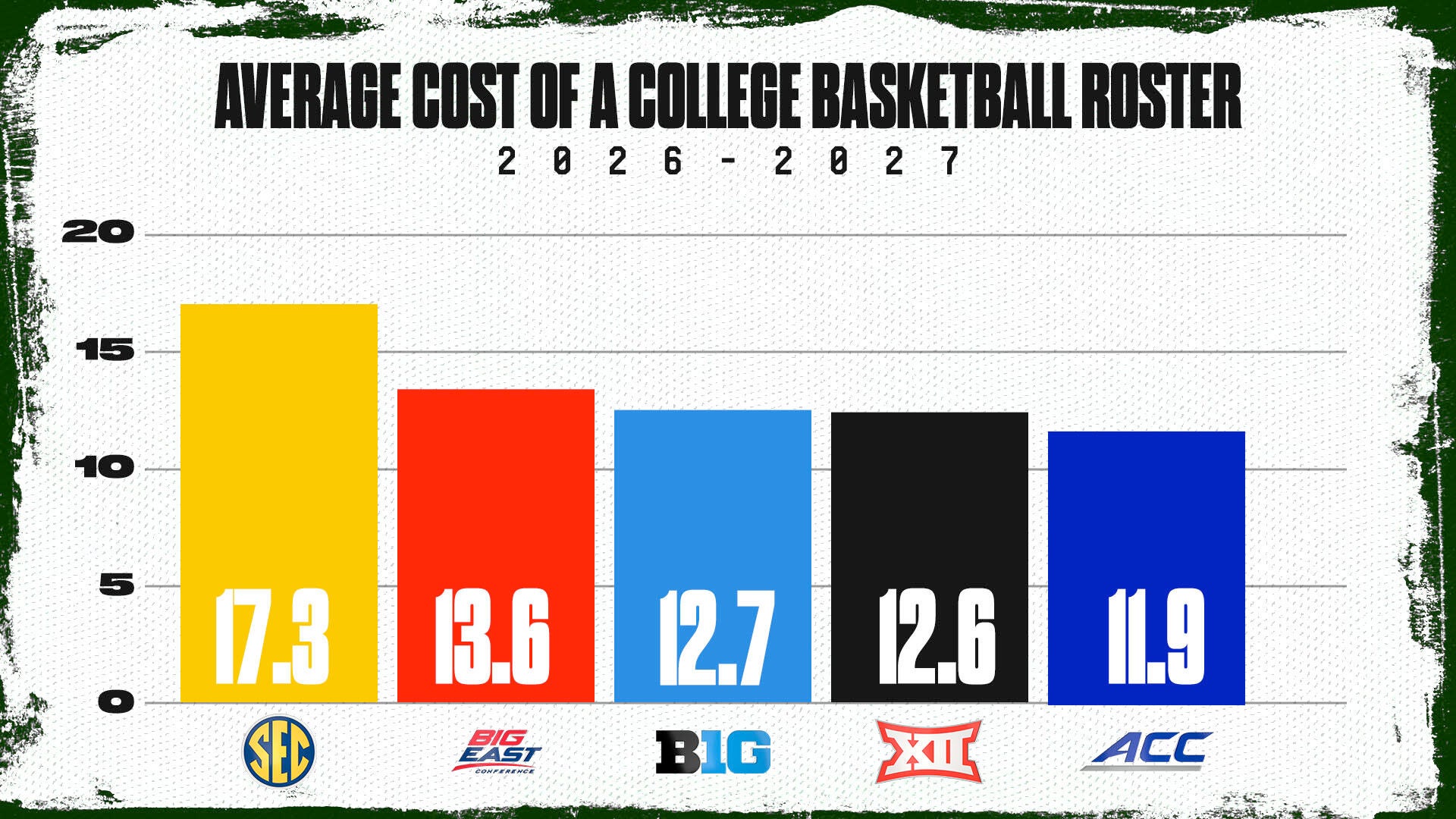
It should come as no surprise that the Big East is spending big on hoops. The Big East, which is the only power conference without football, has one team in Tier 1 (St. John's), one team in Tier 2 (UConn) and six teams in Tier 4 (Creighton, Georgetown, Marquette, Providence, Villanova and Xavier.)
So how do these smaller Big East private schools have the money to go toe-to-toe with teams in the Big 12 or Big Ten?
Not having to worry about football revenue sharing is a unique advantage the Big East has over a lot of other schools in college basketball. St. John's doesn't even have a football program, which makes the basketball team at the forefront of revenue share. The Red Storm were extremely active in the transfer portal and finished as the top-ranked class in the 247Sports team transfer rankings.
Georgetown and Villanova have football teams that compete at the FCS Division I level, while Creighton, Marquette, Providence and Xavier, like the Johnnies, don't have football programs,
Notably, St. John's landed Tounde Yessoufou, Keyshawn Hall and Donnie Freeman. However, Freeman suffered a season-ending Achilles tendon tear this summer and will miss the entire season. Hall is one of dozens of players fighting for a fifth year of eligibility in court.
The Red Storm also brought in English point guard Quinn Ellis, who at 23 years old has already played in the Euroleague and is making over $4 million this season from St. John's as one of the highest-paid guards In the sport
UConn and St. John's were the only teams from the Big East ranked in the preseason Top 25 poll.
Alabama's Tier 4 status doesn't align with the Crimson Tide's consistent, high-level winning in the SEC
During Nate Oats' first six seasons at Alabama, the Crimson Tide have won 170 games, two SEC regular-season titles and two SEC Tournament titles. They have reached the Sweet 16 four times and went to the Final Four in 2024 for the first time in program history under his watch.
Still, Alabama ranks near the bottom in roster budget among its SEC peers. The only teams in Tier 4 and below with Alabama? Mississippi State and Georgia: two teams that haven't come close to the amount of success Alabama has had in hoops in recent years. However, Georgia has one of the most expensive rosters in college football.
Oats is doing way more with less resources than most college basketball coaches. The Crimson Tide has been one of the best and most consistent programs since Oats took the job. However, the spending doesn't reflect that.

The biggest surprise? The SEC's worst projected team is in Tier 3
Speaking of the SEC, the biggest surprise in these spending tiers was that South Carolina, the team projected to finish at the bottom of the SEC this season, is in Tier 3 with a budget between $15.1 million and $17.5 million. South Carolina did not land a single top-50 transfer and features a ton of unproven players at the high-major ranks.
"I don't know that there was one new player that we got to come here that we ended up the second-highest payer," South Carolina coach Lamont Paris told reporters in June. "I don't think that ever happened. We were always the highest payer. So, I mean, that's where we are. That's what it is."
After going 11-21 in his first season at South Carolina, the Gamecocks won 26 games — the most since the program went to the Final Four in 2017 — and reached the NCAA Tournament for only the third time this century. However, Paris enters this season on the hot seat because South Carolina has won just 25 games over the last two seasons. The Gamecocks are 62–68 (.477) In four seasons under Paris.
With a high-priced roster that ranks above average in the average amount spent ($13.5 million), this will be a make-or-break year for Paris and the Gamecocks.
Is there a trend at the bottom of the NIL tiers?
There are eight power-conference programs ranked in Tier 7 of CBS Sports' findings: Wake Forest, Kansas State, Notre Dame, Washington, Boston College, Georgia Tech, Colorado and Stanford. Is there a trend among those teams? Kind of. Here's a snapshot of why each team is at the bottom.
- Notre Dame: Football is King in South Bend. The Fighting Irish have one of the highest-priced rosters in college football, which leaves less of the pie for basketball. Furthermore, Notre Dame's women's program is one of the best in college basketball and features one of the sport's best in Hannah Hidalgo. Notre Dame's men's program got hit hard in the transfer portal this offseason and lost its top three scorers during the opening week. It also doesn't help that Micah Shrewsberry is 41-56 at Notre Dame with a 19-39 record in ACC play. His seat has gotta be one of the warmer on college basketball.
- Washington: Danny Sprinkle's seat also might be warming up after going 29-35 during his first two seasons at Washington. Sprinkle led Montana State to back-to-back NCAA Tournament appearances before taking the job at Utah State, where he won 28 games in his lone season. The resources invested in Washington's football program put the basketball program on the back burner.
- Wake Forest: The athletic department just doesn't have the money. The football program is overachieving in Year 2 of Jake Dickert's tenure, but he is set to be one of the top coaching candidates in the upcoming football coaching carousel. In six seasons, Wake Forest basketball coach Steve Forbes has yet to get the Demon Deacons to the NCAA Tournament despite winning 20 or more games in three of his first six seasons at the helm. An example of the financial issues is highlighted by star guard Juke Harris transferring to Tennessee this offseason. Forbes and company have developed good players, but without a top-end budget, they haven't been able to keep them. Wake Forest's NCAA Tournament drought is approaching a decade, and Forbes' seat is warming up.
- Colorado: Retirement watch is something to keep an eye on with Tad Boyle. Colorado is projected to be one of the worst teams in the Big 12 this season. The Buffaloes had a great team during the 2023-24 season, during the final year the school was a member of the Pac-12. However, Colorado has 31 wins over the last two seasons. Colorado's roster lacks the juice to keep up in the Big 12.
- Kansas State, Boston College and Georgia Tech: All three programs have first-year coaches. The most intriguing team of the group is Boston College, after the program plucked away Luke Murray from UConn. Murray helped UConn become one of the sport's elite offenses. The resources should be coming. Casey Alexander (Belmont) and Scott Cross (Troy) are coming from the mid-major ranks, where they both had success with much smaller budgets than their new programs.
- Stanford: Stanford coach Kyle Smith has done more with less throughout his coaching career, highlighted by finding a hidden gem last season in Ebuka Okorie, who went on to be a first-round pick after a standout freshman season. Smith helped Washington State reach the NCAA Tournament for the first time in 16 years before taking the job at Stanford.