Trotter's Trends: Building a game plan to try and stop Michigan, explaining Duke's slipping defense
Plus, let's dive into the 10 best offensive players, according to the nerd stats


You can learn something about the perceived strengths and weaknesses of a team when it has to play USC. Trojans coach Eric Musselman is one of the top tinkerers in college basketball. Maybe it's his NBA game-planning roots, but the Muss Bus isn't afraid to tweak almost everything with his rotations or schemes to win one game. It's probably why he's advanced to the second weekend in four of his last five NCAA Tournament appearances.
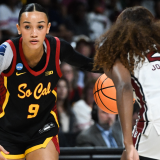
It's also what made Friday's matchup against behemoth Michigan so fascinating. USC basically had two weeks and two days to rest up and sink its teeth into this matchup. Musselman used a Division III tuneup with UC Santa Cruz on Dec. 21 as a trial run for a new starting lineup that he inevitably wanted to throw at Michigan. USC chose to match Michigan's supersized frontcourt with its own version of gargantuan, inserting 7-foot-5 center Gabe Dynes into the first unit next to 6-10, smallball, 5-man Jacob Cofie and bowling ball 6-9 forward Ezra Ausar.
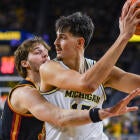
And yet, even on a night when Michigan 7-footer Aday Mara sat for 12-plus minutes in the first half with foul trouble and Michigan shot just 6-30 from 3-point range, the Wolverines still romped USC 96-66.
USC had the size to matchup. It had time on its side and the tenets of a plan. It had Chad Baker-Mazara, who is capable of hitting some crazy shots on his own. It caught Michigan on a cold-shooting night. Lendeborg, Michigan's All-American hopeful, looked like he has a bum wheel and was out of sorts for long chunks. And the Trojans still got crushed by 30? Mercy.
USC just isn't talented enough right now due to a barrage of injuries, but May and Michigan deserve so much credit for building a team that looks like the Death Star. If the season ended today, Michigan would have the second-best adjusted net rating in KenPom history, trailing just 1998-99 Duke.
So, what would it take to beat this Michigan team? If you're concocting a strategy to beat the No. 2 Wolverines, it starts with three tentpoles:
1. Play Mara off the floor: USC accomplished this thanks to the ferocious Ausar, who went right through the shot-blocker to draw two fouls in the first half. This just has to be Step No. 1. Michigan's defense is other-worldly when Mara is on the floor, holding top-100 teams to 84.6 points per possession. Opponents shoot just 38% at the rim which forces teams to shoot jumpers so it doesn't get swatted which then kickstarts Michigan's absurdly-good transition attack. When Mara sits, Michigan's defense drops from one of the best units we've seen in the modern era, to just really, really good.
Whether it's foul trouble, giving him fits with a stretch 5 or coaxing him into mistakes, finding ways to get Mara on the bench is shaping up to be an essential aspect of beating Michigan. It feels eerily similar to how dominant UConn became when Donovan Clingan was on the floor on its way to the 2024 national title.
Michigan doesn't magically become toothless when Mara sits, but it's much more manageable to find cracks in the armor when Michigan's biggest guy on the floor are 6-9, not 7-3.
2. Clamp this transition attack: Michigan is scoring 25.7 points per game in transition. That's fourth-best nationally, per Synergy. Georgia is the lone high-major team who is averaging more transition points, and that's against a strength of schedule that rates 322nd nationally. Michigan is doing this against the eighth-best slate.
There are levels to this, and Michigan's transition attack is better than any team I can remember. The strength is in the unselfishness. The ball is flying across the floor like a pinball machine. Mara is throwing seam routes after corralling defensive rebounds. Cadeau is zipping bullets across the floor for open shots before the defense can get set. Lendeborg was an outstanding transition playmaker at UAB, and that has absolutely translated at Michigan. The ball just does not stick and has oxygen. Every single player has embraced that philosophy and is reaping the rewards. Michigan is averaging 1.35 points per possession in transition against top-100 teams. To beat them, you have to blanket transition by any means possible.
Every bad shot or live-ball turnover is like blood in the water for Michigan's sharks. A team that can push Michigan better have the size, determination and grit on the glass coupled with just excellent decision-making offensively because May's crew is frying any miscues.
3. Make it Elliot Cadeau Time: May took real heat for choosing to target Cadeau and risk letting incumbent Tre Donaldson hit free agency. So far, that bet on Cadeau has aged beautifully. The UNC transfer has been a pest defensively. He is stronger, tougher and smarter. His much-maligned jumper has improved by leaps and bounds. Cadeau is shooting over 44% from downtown on 4.0 attempts.
But Michigan is at its best when it plays "we, not me" basketball. Besting Michigan requires finding ways to get this halfcourt offense into late-clock scenarios where Cadeau has to become a scorer, not a distributor. Staying out of rotation and clogging passing lanes to limit ball reversals feel like essential aspects of the plan. Oh, and you better have a good point-of-attack defender who can stay in front of Cadeau.
Which team could stop Michigan?
Michigan will be favored by double-digits in at least 12 of its 18 games to close the regular season. That's almost mind-boggling. Big Ten play is a grind, and Michigan will also have to fight those whispers of complacency and safety. But basketball is a matchup-based game, and there aren't many teams left on the schedule that appear to have what it takes to go toe-to-toe with Michigan for 40 minutes and emerge on the right side.
Who would be the most likely options?
1 Michigan State: It's ironic that the defending, rebounding and running that Michigan is doing just so happens to be the ethos of its hated rival. Michigan is more talented than No. 12 Michigan State, but let's not kid ourselves, these two games will be 40-minute fistfights. Tom Izzo's got a double-big lineup of Jaxon Kohler and Carson Cooper who will not be intimidated by Michigan's front line. Coen Carr can hang with Yaxel Lendeborg, too. MSU will limit transition, stuff the gaps and force Michigan's shooters to drain contested jumpers. Michigan State has the horses, toughness and identity to try and beat Michigan at its own game.
2 Purdue: Braden Smith is a supercomputer who could easily play Mara off the floor by torturing him in drop coverage. If that happens — game on. Trey Kaufman-Renn and Oscar Cluff have enough bricks in their britches to hang with Michigan's big dawgs. Michigan is a good 3-point shooting team. No. 5 Purdue can be a great one. For one night, that could certainly tilt the scales, although if I was Matt Painter, I'd be worried if Michigan's speed and power could be a bit overwhelming. This may be the matchup where Purdue's lack of an athletic wing haunts the Boilers, but there's a real avenue for Purdue to win this one.
3 Illinois: Michigan has not played a high-level, stretch 5-man yet. That's Illinois' game. The No. 16 Illini are giant and all of their big men can fire from downtown. Mara would have to play further away from the rim than ever, and Illinois has multiple capable creators who can mismatch hunt at all times. Plus, Illinois' offensive-rebounding has started to tick up, which is an area Michigan isn't fantastic at this year. Illinois can also be sneaky-efficient in transition because its bigs can grab-and-go off the defensive glass. Michigan has totally overwhelmed teams with its offensive rebounding, and it is unafraid to send four to the glass, even at the risk of weakening its transition defense. USC tried (and failed) to use its bigs to bust out in transition after corralling a defensive rebound and got a few 3-on-1 opportunities, with Michigan forced to trail the play. Not many teams have the personnel to do that. Illinois does.
Wild card: Washington. I don't think the Huskies are good enough to pull it off, but they have a Hannes Steinbach-Franck Kepnang frontcourt that can physically withstand the onslaught. UW also has a barrage of guards, namely Desmond Claude and Zoom Diallo, who can hit those tough twos that Michigan coaxes.
The Wolverines face Penn State on Tuesday before their game Saturday vs. Wisconsin on CBS and Paramount+.
Duke's defense is drifting
Duke was the No. 4 defense in America through the first 10 games of the season, holding Kansas, Arkansas, Florida, Texas and Michigan State under wraps with excellent team defense.
But the No. 6 Blue Devils have eroded lately on that end. Texas Tech (1.16 points per possession), Georgia Tech (1.09 points per possession) and most recently, Florida State (1.24 points per possession) have eviscerated a Duke defense that has now dropped to 16th nationally in effectiveness.
The Florida State showing was the third-worst defensive game of the Jon Scheyer era. Duke's coach has vowed to get it fixed, but there's a good chance that Duke is closer to the 16th-best defense, not the 4th-best in America.
Florida State's pace-and-space gameplan stretched Duke out a bit and highlighted that the Blue Devils just don't quite the same defensive personnel on that end as a year ago.
- Going from Tyrese Proctor to Caleb Foster is probably a wash defensively.
- Going from Kon Knueppel to Isaiah Evans is a slight downgrade defensively.
- Going from Sion James to Cayden Boozer is a real downgrade defensively.
- Going from Cooper Flagg to Cameron Boozer is a real downgrade defensively.
- Going from Khaman Maluach to Patrick Ngongba is a slight downgrade defensively overall, even though Ngongba's defensive processing and rim protection has been encouraging lately.
Duke's team defense has to be more connected, like it was in the early going, because it doesn't have the ridiculous defensive personnel that it enjoyed last year.
GIMME THAT!
— CBS Sports College Basketball 🏀 (@CBSSportsCBB) January 3, 2026
What an incredible block by Robert McCray V 🤯 @FSUHoops pic.twitter.com/YvDBjcoAQn
No. 20 Louisville looms Tuesday. Even though the Cardinals are without future lottery pick Mikel Brown Jr., Louisville can spread it and deck it with anybody. Duke has to find answers in a hurry. The re-emergence of Dame Sarr would certainly help. He's the most athletic wing on the roster and has excellent defensive tools.
10 best offensive players
These players have the most significant offensive impact for their teams, according to the terrific Evan Miya.
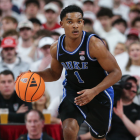
1. Cameron Boozer, Duke: Duh. The dude is inevitable.
2. Braden Smith, Purdue: Checks out. He is shredding in pick-and-rolls this year. His counting stats would look far more impressive if Purdue would chill out and quit winning by 30.
3. Yaxel Lendeborg, Michigan: I've called him Dusty May's 6-9 version of Alijah Martin. I'm sticking with it. Only a slight calf injury can slow down the Yax Attack.
4. Aden Holloway, Alabama: Alabama doesn't miss Mark Sears at all because of how good Holloway has become. He's up to 47% from downtown and plays such clean basketball. Holloway is a professional net-shredder.
5. Bruce Thornton, Ohio State: I think every jumper is going in.
6. AJ Dybantsa, BYU: Cheat code. Fadeaway midrange jumper is unguardable.
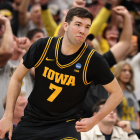
7. Bennett Stirtz, Iowa: Stirtz moved up a level and got better. Stupid-good offensive processor.
8. Christian Anderson, Texas Tech: JT Toppin is Texas Tech's All-American, but I think Anderson may have been the Red Raiders' best player. Remember when people questioned if he could play point guard?
9. Ja'Kobi Gillespie, Tennessee: Gillespie is such a warrior. Night after night, you will get his absolute everything.
10. Labaron Philon, Alabama: Philon is college basketball's version of Shai Gilgeous-Alexander. He moves differently, bending, twisting and pirouetting like a slinky to get where he wants to go on the floor.
Just missed the cut: Tyler Tanner, Vanderbilt; Milan Momcilovic, Iowa State; Joshua Jefferson, Iowa State, Nijel Pack, Oklahoma