How Utah State became college basketball's most influential mid-major job for future power conference coaches
Utah State has served as a springboard for several coaches on their way to jobs in the power conferences

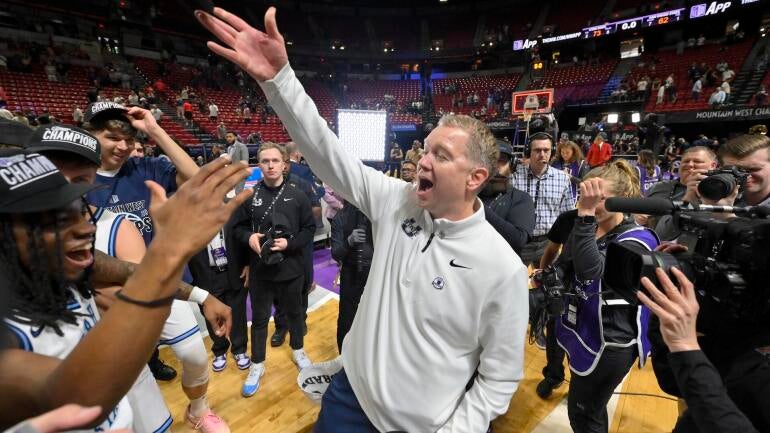
The Utah State job has become the most predictable stop in college basketball: win fast, leave faster. It keeps happening to the point where it's not even surprising anymore. And yet, this small program in Logan has quietly become one of the most influential coaching jobs in the sport. Jerrod Calhoun is the latest to follow the script. Two seasons with the Aggies, two NCAA Tournament appearances, and then off to Cincinnati.
Before him, Danny Sprinkle lasted one year before leaving for Washington. Ryan Odom turned two seasons into a move to VCU -- and then quickly into Virginia. Craig Smith needed three years before rival Utah came calling.
Four consecutive coaches exiting in a six-year span.

Since 2021, Utah State leads all mid-major programs with three coaches hired away by high-major schools. Charleston, Drake, North Texas and VCU all have two each.
At this rate, Utah State is less a stepping-stone program than it is a conveyor belt for rising mid-major coaches chasing the next rung on the ladder. And yet, somehow, the machine keeps running.
Utah State has reached six of the past seven NCAA Tournaments and had punched its ticket in 2020 before the postseason was canceled due to the pandemic. The Aggies just wrapped their fourth consecutive 25-win season, won both the Mountain West regular-season and conference tournament titles and were the league's lone NCAA Tournament team in a down year before losing to No. 1 seed Arizona in the second round.
There's no drop-off. No rebuilding phase. No identity crisis when a coach leaves. That consistency is precisely what makes the job so appealing. It's not what those in Logan want to hear, but with associate coach Eric Haut departing for Tarleton State, another outside hire will almost certainly step in, continue the winning ways, and, within a few years, likely move on.
Utah State coaches since 1993
| Coach | Record | NCAA Tournament appearances | Next job |
|---|---|---|---|
Jerrod Calhoun (2024–2026) | 55-15 (.786) | 2 (2025, 2026) | Cincinnati |
Danny Sprinkle (2023–2024) | 28-7 (.800) | 1 (2024) | Washington |
Ryan Odom (2021–2023) | 44-25 (.638) | 1 (2023) | VCU → Virginia |
Craig Smith (2018–2021) | 74-24 (.755) | 2 (2019, 2021) | Utah |
Tim Duryea (2015–2018) | 47-49 (.490) | None | -- |
Stew Morrill (1998-2015) | 402-156 (.720) | 8 (2000, 2001, 2003, 2005, 2006, 2009, 2010, 2011) | -- |
Larry Eastachy (1993-1998) | 98-53 (.649) | 1 (1998) |
Each recent hire has followed a familiar profile: an upward-trending coach with proof he can win at a lower level. Calhoun built a winner at Youngstown State. Sprinkle stacked consecutive NCAA Tournament teams at Montana State. Odom became a March Madness legend, leading No. 16 seed UMBC to a historic upset of No. 1 overall seed Virginia. And Smith engineered a rapid turnaround at South Dakota.
The pattern stretches even further back, too. Larry Eustachy arrived from Idaho in 1993 and laid a strong foundation before moving on to Iowa State in 1998. Stew Morrill came from Colorado State and turned Utah State into a model of sustained success over 17 seasons, finishing with eight NCAA Tournament appearances and the program's all-time win record (402). Both were external hires who proved the formula works.
The one internal hire in the modern era, Tim Duryea, couldn't sustain the momentum after Morrill retired in 2015. He posted a losing record over three seasons and remains the only Utah State coach in more than three decades not to reach the NCAA Tournament.
What Utah State's move to the Pac-12 could mean
Starting next season, Utah State will compete in a conference with more national exposure, greater resources and a stronger emphasis on basketball than the Mountain West ever provided. In theory, the move to the resurrected Pac-12 should help the program retain a coach longer by narrowing the gap between the high-major jobs it typically feeds.
But the same forces that fueled the conveyor belt remain. Utah State's recent history shows that success at the mid-major level almost always leads to bigger opportunities, and the allure of more money and the chance to compete on an even bigger stage is difficult to resist. Even a stronger conference affiliation may not overcome the gravitational pull of programs that can offer everything.
Still, the Pac-12 move offers potential. A stronger conference schedule, more television exposure and improved recruiting visibility could make Utah State -- and its new conference peers in Boise State, Colorado State, Fresno State, Gonzaga, Oregon State, San Diego State, Texas State and Washington State -- a more attractive destination for coaches willing to plant roots. If the Aggies can combine their winning culture with the visibility and resources of a major conference, they might begin to slow the conveyor belt, or at least make it a little less predictable.
And yet, whatever the future holds, the bigger picture is unmistakable: Utah State has built a program that wins consistently, regardless of who's on the sideline. Over the past three decades, it has become one of college basketball's most reliable producers of coaches -- and one of its most predictably successful programs.