

The newly expanded 76-team men's NCAA Tournament will feature an additional site for the next two years: Wichita, Kansas. The men's selection committee convened this week in San Diego and voted on Wednesday to designate Wichita as the sister host, along with longstanding First Four site Dayton, for the opening round beginning in 2027 and extending into 2028, the NCAA announced on Thursday.
Wichita beat out seven other finalists, sources told CBS Sports, including Albuquerque, New Mexico; Des Moines, Iowa and other cities west of the Mississippi River.
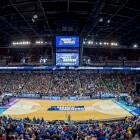
The games will be held at the city's downtown venue, InTrust Bank Arena, which can house up to 15,004 people — approximately 5,000 more than Wichita State's on-campus gym (Koch Arena).
Wichita's geographically central location was a major selling point for the committee as it prepares for a major change with the expanded 76-team field. The city's hotel capacity and passionate local fan base were also major selling points, sources said. Dayton has hosted all pre-field-of-64 games on the men's side since 2001 because of the arena's size, location and the fan base's year-after-year dedication to buying tickets.
The vision is that Wichita will be just as reliable in the next two years as the tournament's format will expand out on the Tuesday and Wednesday after Selection Sunday, including games in the late afternoon instead of solely being primetime viewing. Next year's men's and women's tournaments will feature 12 opening-round games split between two sites on the men's side, with Dayton hosting six and Wichita hosting the other six.
The two sites will both host automatic qualifiers (No. 16 and No. 15 seeds) and at-large candidates (the final eight at-large teams selected to the field).
"We were pleased but not surprised by the number of cities from around the country that very much wanted March Madness to begin in their market," outgoing committee chair Keith Gill said. "Like Dayton, Wichita is a basketball-crazed community that we expect will embrace the reimagined start of the tournament. Having a city in Middle America will be advantageous for getting teams from various points around the country, many of which won't be known until Selection Sunday, to the opening round and subsequently first-round sites."
Wichita's InTrust Bank Arena is no stranger to the March Madness stage: It hosted first and second round games of the men's NCAA tourney in 2018 and 2025.
The NCAA approved expansion of the men's and women's tournament from 68 to 76 teams in early May; the men's tournament had been at 68 teams since the 2010-11 season, and expansion had been extensively explored over the last four years.
The bid process was competitive, sources said, with several finalists putting on a big push in recent weeks for the chance to host the NCAA Tournament. But Wichita's proximity and location in the Central Time Zone were ultimately critical.
"As a secondary consideration, the committee will weigh moving opening round teams along the same seed line to optimize their travel to opening round and first-round sites," the NCAA said in Thursday's statement. "The men's basketball committee also voted to remove the provision that prohibited a school from playing at a site at which it is serving as the tournament host."
The selection committee also recalibrated the NCAA's Wins Above Bubble metric moving forward. With more teams in the tournament, the average bubble team will drop in the hierarchy of teams competing for bids. In a 68-team field, that cut line is in the general vicinity of the 45th team in Wins Above Bubble. In a 76-team field, it will fall to 55.
This will be a critical new data point moving forward, as teams in the high 50s or better will be considered much more likely than not to make the NCAAs (and teams 53rd, 54th, 55th and so on will face more scrutiny). There was no change in the NCAA's NET formula. The committee continues to use and rely on other metrics as well, such as KenPom.com, BartTorvik.com and ESPN's Strength of Record, which is similar to WAB.
"The WAB is an important factor for selecting teams, so the bulk of our time on this topic focused on that," Gill said. "The quadrants help us organize the team sheets but sometimes receive too much focus, especially given that very different outcomes can fall within the same quadrant. The WAB addresses that because you get more credit for beating better teams and even more so if you do it away from home. The overall and nonconference strength of schedule will continue to impact results-based metrics like the WAB."
One other bit of news: West Coast Conference commissioner Stu Jackson was elevated to vice chair for the 2026-27 season, meaning he should be the chair of the men's NCAA Tournament for 2027-28. Jackson has decades of experience as a head coach, an executive in the NBA, a coach in the NBA, associate commissioner of the Big East and has run the WCC for the past three years.