

CHICAGO — Bret Bielema hired a new defensive coordinator in February, and the explanation he gave from the podium at Big Ten media days was about installing a different kind of scheme that might catch the rest of the league by surprise. Bobby Hauck would bring pressure, disguise and movement with atypical body types — something the rest of the league hadn't spent a week preparing for.
Sitting off to the side later that day, Bielema framed the hire differently.
"The reason I had to make a change on defense was I couldn't afford to pay the numbers," he said. "I had already gone after an offensive line and had to put money out that I needed to get done for that, and then I knew I could kind of buy, in a way, kind of patch together a new defensive scheme that wouldn't require as big of players. But some of those big D-linemen, those guys are going for an ungodly amount of money, and you just can't have them at the number we were at."
You didn't mishear Bielema. He's won 19 games in the last two seasons, but he was forced to redesign his defense around what he could afford at defensive tackle, not what type of player fit the 3-3-5 defensive alignments he used in previous seasons.
A stark reality has settled over the sport as NIL contracts and revenue sharing have separated teams into competitive tiers. Coaches must balance recruiting wants with financial limitations, sometimes at the detriment of their win-loss record.
One conference, three tiers
The Big Ten is 18 teams, but it is not one league. It has instead transformed into two or three leagues stacked on top of each other, and the gaps between them are widening by the season.
At the top: Ohio State and Oregon, both identified by CBS Sports this month — after a poll of more than 50 athletic directors, general managers, cap experts, agents and boosters — as spending north of $40 million on a football roster, with Michigan just underneath. At the bottom: Purdue, which went 0-9 in the Big Ten for the second consecutive year in 2025. Maryland, which went 1-8, is two tiers below the $40 million crew, spending just over $20 million. Wisconsin, which went 2-7 and then, in April, failed to have a single player drafted for the first time since 1978, is in the $30 million tier after some restructuring led to a bump this offseason.
The revenue-sharing cap meant to organize all of this sits at $21.3 million per school this fall, but the cap is hardly a limit. It's more like a floor with a ceiling painted on it, and everyone above it has figured out how to keep climbing outside the system via players' NIL contracts.
Bielema remembers thinking the number would save him. At the time, he believed a $5 million gap — $15 million for Illinois and $17 million to $20 million for Ohio State, Penn State and Michigan — was manageable.
"You can give them $20 million," Bielema recalled telling his athletics director, Josh Whitman. "If I'm within $5 million of those guys, I can go to bed every night, and I'll feel good. I think I can make that difference."
But now?
"But now you start talking about teams that are double, two-and-a-half times that number. It just can't happen. It won't happen."
At least seven major FBS football programs are spending more than $40 million on rosters this season through combined NIL and revenue-sharing efforts, according to CBS Sports sources.
The teams at the top want more
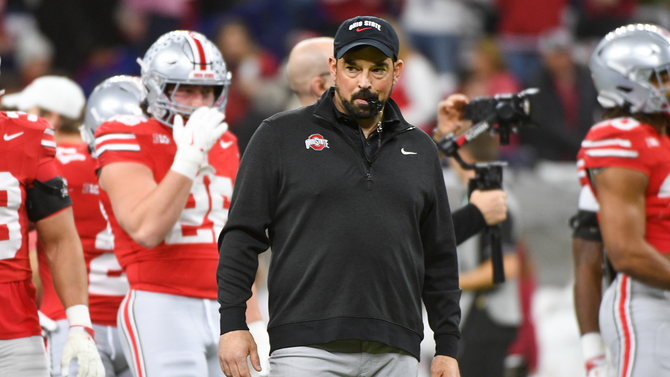
Among those big spenders, the number will keep growing. Ohio State coach Ryan Day wants clarity on the cap, including NIL dollars, and favors increasing spending.
"Do I think the cap should be higher? Absolutely," Day said. "I can tell you right now, we want to pay our players, and we would like to see that cap much higher."
It's much easier for Day than many others to make that statement, of course. Ohio State is among the small group of elite who can afford – and will – to pay more than $40 million to players.
Ohio State's athletic director Ross Bjork describes Columbus as "a college town in a big city" of 2 million people, with a corporate base most of the league can't touch. It's a fact Ohio State hit over the heads of their rivals by announcing JPMorganChase as the first jersey-patch partner across all 36 of its varsity programs. The $17 million in annual payments is among the most lucrative jersey patch deals in college athletics, sources told CBS Sports.
The Buckeyes are not coy about their deep pockets, either. It's part of their message.
"We talk about that in recruiting," Bjork said. "We talk about the activation opportunities. We talk about the number of fans. That's all part of the equation. Other people just don't have it."
But Ohio State still has issues with the system at large. Costs continue to rise across all sports, but the lack of clear rules around outside NIL— and the blatant pay-for-play schemes used by schools—has everyone upset.
"Everybody in our industry, we're OK with costs increasing," Bjork said. "But when you can't forecast that, and you have no certainty — people use the word cost containment. I think that's the wrong word. I want cost certainty."
Critics would argue Bjork wants both. After all, the rich get richer in this system while the poor remain poor, and even less effective on the football field. Bjork was on the other side of the fence, albeit in a different era, a decade ago, when he was the athletic director at Western Kentucky.
"We had a $21 million budget, but we played Kentucky when I was there, and we were trying to beat them," he said. "We played Louisville, and we tried to beat them. But I knew walking in what their numbers were, what our numbers were. You always gave yourself a shot."
That was a $21 million department. In 2026, it is roughly the revenue-share cap for a single school.
A bigger cap doesn't help the bottom
Whether clearer regulations arrive is the $50 million question. The legislation meant to settle this is on hiatus until at least September, when the Senate is expected to vote on the Protect College Sports Act. The bill, if it passes the Senate and then the House, would provide limited antitrust exemptions to conferences, enforceable eligibility rules, and, in theory, the teeth to punish schools that exceed the cap.
The bill would also raise the revenue-share cap from $21.3 million to $48.8 million, including a $22.5 million retention pool aimed squarely at keeping players from transferring to other schools.
That creates a new problem for most schools: an enforceable cap levels the playing field only if everyone can afford it. Raising the ceiling from $21.3 million to $48.8 million lets Ohio State do what it was already doing, while Purdue gets a bigger number it cannot reach.
"I'm concerned. I'm concerned," said Iowa coach Kirk Ferentz, who enters his 28th season leading the program. "To me that's our single biggest issue right now."
Ferentz fears money will further divide the conference, comparing today's transition to what the Big Ten looked like in the 1970s. Michigan and Ohio State were the only Big Ten teams to reach the Rose Bowl in 13 consecutive seasons, a streak Iowa snapped in 1981.
"If we're not careful, we could go down that road again as a bigger enterprise – college football," Ferentz said.
The big dogs will survive, and so will the middle of the conference. The fear is everybody else will be playing for their annual paycheck worth nearly $80 million from the Big Ten while getting their teeth kicked in on Saturdays.
The view from the bottom
Greg Schiano has been on both ends of this at Rutgers. He built the Scarlet Knights in the 2000s into a program capable of reaching the top 15 nationally. When he returned to Piscataway in 2020, the program had been lapped. For most of his second stint, he says, the same people who were supposed to be focusing on coaching were also raising the money.
"For four or five years it was just the people in our building raising money for NIL," Schiano said. "That's hard, especially in the Big Ten Conference. You can't do it."
He said that changed with president William Tate and athletic director Keli Zinn. Now, he says, there is "vertical alignment" at the university.
"We have resources that are starting to match expectations," he said. "And that's being able to keep a guy like (All-Big Ten receiver) KJ Duff. We decided there were three or four guys that we could not afford to lose."
Rutgers is not in the arms race, but they are playing the same money game.
"We don't need to be the top of that food chain," Schiano said. "We just need to have enough to go in there. We've always done more with less. It just can't be that much less."
Down I-95 in College Park, Mike Locksley is making the same argument, though he enters 2026 firmly on the hot seat. Maryland went 4-8 in back-to-back seasons, with one win in the Big Ten last season. The athletic department has reported $32.7 million in losses over five years. Firing Locksley last year would have cost $13 million. In November, newly hired athletics director Jim Smith announced Locksley would return in 2026 with more money and a mandate built around roster retention.
"We've been able to do more with less at Maryland," Locksley said. "You have to be super creative, you have to think outside the box, and these are all things for me that come naturally because I didn't grow up with a lot of haves and means as a kid. So for me, all I've ever asked is, hey, put us in the middle with the resources."
But …
"Are we there? Probably not."
It's a harsh reality, yes, but coaches still believe in their blueprints and abilities to identify diamonds in the rough.
"We've shown that we have enough resources to attract the right kind of kids, and now that we can improve the coaching, improve the execution, improve the discipline, we'll have the type of year we want," Locksley said.
The portal made the gap permanent
The transfer portal has only added to the stresses. It turns every good player at a bad program into a listed asset for the top-tier teams elsewhere.
In January, Purdue's Barry Odom said agents accidentally sent his staff a list of potential portal players that included his own players. "As crazy as that sounds, that's just part of the game now," Odom told reporters at the time.
Purdue lost 21 players to the portal after a 2-10 season. The best of them went to South Carolina, Florida State, Kentucky and Pitt. Odom replaced them with 32 transfers, 20 high school signees and a junior college player. That's 53 newcomers in his second offseason on the job. In his third year and beyond, he's seeking continuity, not acquisition.
"There's great value in getting a guy in your program that has multiple years left and a chance for continuity," Odom said.
But it's impossible to lean on development when you don't maintain possession of those assets you developed and turned into stars.
Maryland lost 17 to the portal and signed eight, while all three starting receivers left.
The other way(s) to build
Even so, two men in the Big Ten have proven it's possible to maintain winning programs without elite financial resources.
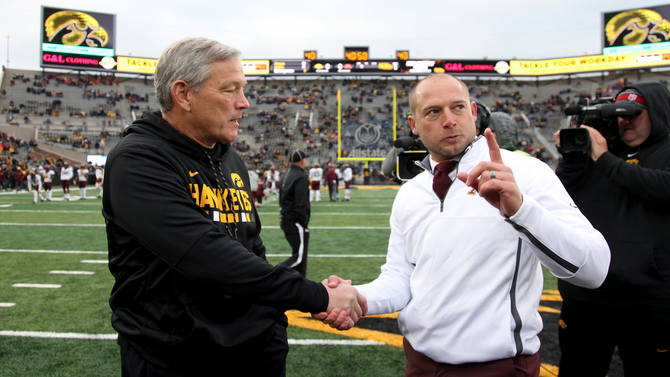
Iowa went 9-4 last season and has not had a losing record since 2012. Minnesota went 8-5, and P.J. Fleck is 66-44 there across nine seasons. Neither is close to the top of the league in spending, but both keep most of their players on campus.
"There are a lot of different ways to build a good team," said Ferentz. "There's no one set blueprint that works for everybody, and you just have to assess where you're at, what the situation is and try to do what's best for you at that given point."
Ferentz, a former offensive line coach, starts in the trenches. He finds the best blockers he can attain and builds out from there. The plan has worked with incredible success — a 62% winning percentage that includes nine 10-win seasons, two Big Ten titles, six Big Ten Coach of the Year awards and five national coach of the year awards. Forty-three offensive or defensive linemen from Iowa have been selected in the NFL Draft since 2000, ranking fourth in the Big Ten.
The trenches are the source of an incredible 42.6% of Iowa's draft representatives under Ferentz.
"As fundamental as that sounds, it's a great starting point," he said. "I just know from experience, our years where we've been stronger up front, the better off we are. We're more apt to have success. When we're not there, you've got to get creative. You can only be so creative."
Fleck focuses on maintaining what Minnesota has. Strength coach Dan Nichol has coached alongside Fleck for the last 14 seasons; player personnel director Marcus Hendrickson has been on campus since 2017. Minnesota is also the only Big Ten team to return its head coach, offensive and defensive coordinators, and starting quarterback from last season.
"We have a product of a developmental life program that people want," Fleck said. "... Now, you might have to work a little harder, cast a wider net, to find those people that fit and want that, and value that, but I think that's very doable. Maybe we've proven that piece.
"Of course, you always want to do it better, you want to do more, you want to have more, you want to accomplish more, but I think the cultural sustainability matters."
The model itself isn't complicated, but executing it is difficult with well-funded programs willing to poach other rosters: recruit high school kids, keep them four years, win the one-possession games, don't reinvent the program every January. Ferentz brought in roughly 30 newcomers this offseason, about half of them transfers. It's the most active he has ever been in the portal, but he also hasn't changed his blueprint in the trenches since 1999.
For Ferentz and Fleck, their plans work, even in this new age.
"Nothing lasts forever," Ferentz, 71, said. "There's ups and downs of what you do. That's one thing that makes our situation unique, I would say: I've worked in an environment where they aren't reactionary. Forty-seven years, two (head) coaches. That will never happen again in major college football. We witness [changes] every fall now. People are really reactionary in this business.
"I don't think football ever changes. You can win a lot of ways."
'I was pretty naive'
Wisconsin is a fascinating test case this fall, and Luke Fickell is not pretending otherwise.
The Badgers are 16-21 under him, and he sits on the hottest seat in perhaps the country this fall. The administration has given him more resources, lifting the Badgers into the top two spending tiers in the Big Ten, according to CBS Sports' sources.
"I know it's a hot seat, and we've all talked about it," Fickell said.
He also admitted the thing most coaches won't.
"I think for a couple years, at least for a year and a half, I was pretty naive," he said. "That whole idea of sleeping on the game that Coach (Urban) Meyer used to always bring up to us. If you sleep on the game, you'll wake up one day and you'll be bypassed and you'll have forgotten what to do. And, like I said, that was always a scheme to me. If you continue to evolve in the scheme of things — the truth of the matter is it's not a scheme. It's recognizing what's going on within the landscape."
The landscape isn't flat. It's peppered with valleys, plateaus and mountains touching the sky. Roster budgets continue to rise, and playing keep-up is a necessity at Wisconsin, Fickell said.
"I'm not naive. I don't want to be naive. If it's growing to that, then it's growing to that. Well, we better get on board. And if that means we got to go do something else, we got to hire more, we got to go find more, then we do. Otherwise, you can't continue to grow and compete if you can't be in the realm of what everybody else is doing."
It doesn't mean you have to like it, Fickell said. It just means you better play the game rather than sit on the sidelines, complain and pine for the old days to return.
"And I hate that. And some would say, this isn't what you signed up for, is it? Well, no, it's not. But you know what? I don't like it. I don't love it. But you know what I hate a hell of a lot more? It's freaking losing and not being able to compete. And that drives me a hell of a lot more than not liking the money you got to raise or the amount of money you got to pay."
Coaching matters still, yes, but great players win games. Fickell spent part of the summer having his team study Wisconsin's 1998 Rose Bowl champions. Twelve of those 22 starters were selected in the NFL Draft.
"Just in case you guys are wondering, you ain't winning in this league unless you've got NFL players," Fickell said. "We've had four drafted in the last three years."
Four in three drafts. Zero in the last one, a first for the program since 1978.
The landscape is shifting, yes, but not all have-nots are left in the dust. A phoenix rose from Bloomington over the last two seasons under Curt Cignetti. He transformed the losingest program in the FBS into the first 16-0 national champion in history. The fairy-tale story is the touchstone for every program – from Purdue to Rutgers – that makes championship dreams seem achievable in this new age.
But Cignetti arrived at Indiana with a dozen-plus transfers who followed him from James Madison, his previous gig where he won and won big. He also did it before roster costs doubled. He capitalized with his talent – and, obviously, his obsessive film study – to win big as the business of college sports transitioned. Now Indiana is spending like a program that intends to remain in the club.
Still, money is the sport's ultimate stressor. It fuels dozens of lawsuits over player eligibility and clandestine moves behind the scenes to extend resources by offering third-party NIL contracts to artificially exceed the always-flexible revenue-sharing cap.
Nearly every coach will tell you that the model is not sustainable. Some argue that Congress and the Protect College Sports Act will bring stability. Others offer a new system based on collective bargaining. Then there are the few who just wish they could put the toothpaste back in the tube and return to the pre-2020 days.
If exorbitant spending and the select few dominating the sport don't coax stricter regulations, what will? Is there a right system? Schiano, an NFL veteran with two stints at Rutgers under his belt, points to the NFL and a "real salary cap," something that seems like a far-fetched dream for college football.
"I think the only thing that will make that happen is when the pain becomes more than can be handled," Schiano said. "At some point the pain may become where we can't afford to do this anymore and we have to. That may be the impetus to get it done. How it happens, I'm not an expert on that, but usually most things get pushed to a point where something has to be done."
He paused.
"We're getting close, I think."