Big Ten, SEC urge Congress to reject proposal that would consolidate FBS broadcasting rights
Saving College Sports says pooling FBS media rights could generate billions in new revenue. The Big Ten and SEC say the math doesn't add up and market-driven conference deals will outpace the proposal without federal intervention


The Big Ten and SEC have submitted a white paper to members of Congress urging lawmakers to reject a proposal that would consolidate college sports media rights under a federally supervised entity, arguing the plan would not deliver the promised revenue gains and could destabilize the conference ecosystem.
The nine-page report, obtained Thursday by CBS Sports, directly rebuts a proposal advanced last fall by Saving College Sports (SCS). The group called for pooling the media rights of all 136 Football Bowl Subdivision programs into a single entity, estimating the move could generate roughly $6 billion in incremental revenue through schedule optimization and collective negotiations.
The Big Ten and SEC dispute those projections, writing that SCS's claims "are not supported by any empirical evidence" and warning that the model would create "a dangerously unworkable" structure that introduces new legal and operational risks.
The SCS plan -- commissioned by billionaire Texas Tech booster Cody Campbell -- calls for an amendment to the Sports Broadcasting Act of 1961, which would allow FBS schools to negotiate media rights collectively. The plan also calls for the creation of a federally appointed body to administer media contracts and manage scheduling. Supporters argue that pooling rights would dramatically increase football revenue and provide significant financial support for Olympic and women's sports, projecting more than a 67% increase in revenue for those programs.
The SEC and Big Ten's counter
The two power conferences counter that media growth is already occurring under the current conference-based model. Recent conference renewals led to a 2.8-fold increase in average annual value, matching the NBA's most recent media cycle. The memo states that college football media revenue is projected to surpass SCS's forecast by 2033 without pooling rights or federal oversight.
The paper challenges SCS's assertion that the NBA's recent windfall proves aggregation creates value. It argues the league's gains stemmed from market competition and the sale of smaller packages to multiple distributors. Roughly 80% of NBA games are still sold through local agreements rather than a single consolidated package.
The Big Ten and SEC also question the logistics of federal administration. The SCS proposal calls for a 14-person committee to oversee negotiations, scheduling and revenue distribution across 136 schools, 26 sports and more than 32,000 games annually. The conferences describe that scope as unworkable and warn that it could erode institutional control over scheduling and rivalries, while imposing uniform national branding at the expense of individual traditions.
Another hurdle is the structure of existing contracts among the 10 FBS conferences and Notre Dame. Current media deals run through 2036 on staggered timelines. The white paper argues that breaking or materially altering those agreements to implement pooling would invite legal challenges and undermine long-term investment in the sport.
The conferences argue that centralized models have underperformed historically. The NCAA pooled television rights before a 1984 Supreme Court ruling struck down the arrangement. The subsequent College Football Association bundled rights for more than 60 schools in the 1980s but generated less revenue than later conference-level deals. The SEC's first conference-wide agreement in 1996 -- covering 12 schools at $17 million annually -- outperformed the broader CFA package valued at $43.6 million.
Under its current deal with ESPN, which runs through 2034, the SEC receives nearly $1 billion annually. The Big Ten collects about $1.1 billion per year in a multi-network agreement through 2030. Over the next decade, those two leagues are projected to roughly double the revenue of the ACC and Big 12 — and significantly outpace the Group of Six conferences.
The case for reform
SCS supporters argue that disparity underscores the need for reform. American Athletic Conference commissioner Tim Pernetti commissioned a study last year projecting that bundling FBS rights could more than double the current cumulative media value of approximately $3.5 billion annually.
"It's in no way designed to have certain conferences take from others," Pernetti told CBS Sports in July. "This is about creating a larger pie. If there was a way for all media rights revenue to be rolled up and then potentially doubled or tripled, I'm not sure what conference wouldn't sign up for that right now."
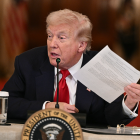
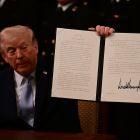
President Donald Trump installed Campbell to lead his Commission on College Sports in the summer. He appeared in television advertisements during college football games in the fall, urging stakeholders to consider Saving College Sports' proposal. In response to the Big Ten and SEC's white paper on Thursday, he reiterated that college sports are "broken and those who first made the mess and profit handsomely from the status quo do not want to fix it."
He also directly addressed Big Ten commissioner Tony Petitti and SEC commissioner Greg Sankey.
"The posture of these two commissioners indicates that they do not care about the fate of the other conferences or smaller schools, nor do they care about the life-changing opportunity provided to women and to athletes in our Olympic sports," Campbell said on X. "It seems they have chosen to disregard the directives of the President and the will of the American people. Change is difficult, I get that, especially when it means dismantling a long-held, broken, backwards system. My sincere hope is that, instead of throwing up roadblocks to our congressional momentum, we can work together on solutions that put the student athletes first and preserves (sic) the viability of the great American institution of college sports."
The Sports Broadcasting Act currently prohibits colleges from collectively pooling media rights. A proposal to amend the law gained traction in Washington last fall, though no congressional hearings have been scheduled.
Federal involvement in college sports has expanded in recent years, with conference and NCAA leaders visiting Washington to lobby for reforms -- including antitrust protections -- ahead of last year's House settlement requiring schools to share revenue with athletes.
The proposed SAFE Act would grant limited antitrust protections to allow collective media negotiations and establish a federally structured oversight model for certain aspects of college sports. The SCORE Act would create a national framework for NIL regulation and athlete compensation standards, further codifying the House settlement reached last year.