NCAA to discuss targeting rule changes, could make penalty 'less punitive' for 2026 college football season
One of college football's most highly scrutinized rules may be in line for adjustments

By
Carter Bahns
•
2 min read
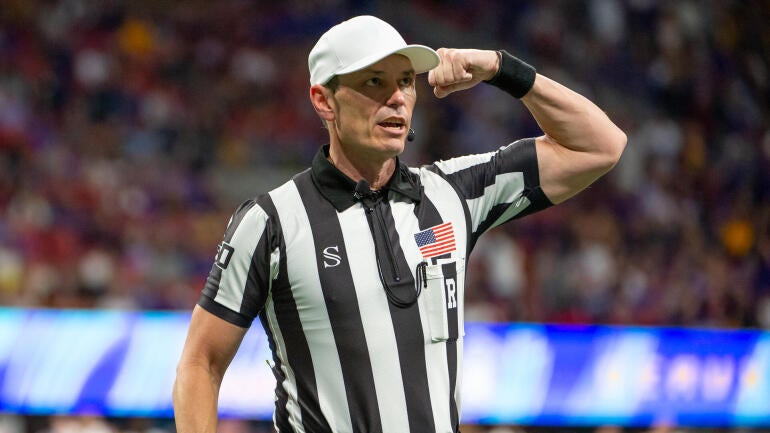
Changes to the college football targeting rule could be on the horizon. Flags for targeting are on the decline over recent seasons, but they remain heavily scrutinized and often controversial when thrown. The NCAA will take a closer look this offseason.
National coordinator of officials Steve Shaw, who also serves as the NCAA's secretary-rules editor, said to Yahoo Sports that decision-makers will analyze the targeting rule and potentially make penalties "less punitive."
"We're going to be having a discussion on targeting," Shaw said. "That needs to be an annual discussion. It will be a focus discussion."
The NCAA introduced the targeting rule in 2008 as a player safety measure, and it became stricter throughout the years. While the rule always resulted in a 15-yard penalty, it was changed in 2013 to also carry an automatic ejection for the guilty party. If the player called for targeting is ejected in the second half of a game, the penalty also stipulates they must sit out the first half of the ensuing contest.
The ejection and suspension elements of the targeting rule could be the first to receive adjustments as part of the NCAA's discussion.
"What targeting has driven in terms of player behavior change has been really good and the numbers reflect that," Shaw said. "But how can we continue this trend of taking out more of these hits we don't want in the game while being less punitive?"
Those aspects of the rule are highly contested. Opponents of the targeting penalty often argue that forcing a player to sit the remainder of a game and potentially part of the next is too strict of punishment. Miami coach Mario Cristobal took exception with the rule when an untimely call forced one of his top defenders to miss the first half of the College Football Playoff National Championship.
When cornerback Xavier Lucas launched himself into Ole Miss wide receiver Cayden Lee and made forceful contact with Lee's helmet on a tackle in the CFP semifinals, he drew a flag and was forced to sit the first 30 minutes of the Hurricanes' biggest game of the year. Cristobal argued that the rule needs to be revisited.
"We feel it was unjustly administered, and now it impacts the last game of the season," Cristobal said. "We do have the ability, again, as an officiating crew and the powers that be to revisit that to give every team due process and their best ability to compete in this game."
Among the ideas that targeting opponents have presented is the creation of different penalty classifications. Less severe infractions could fall under a Level I categorization and carry just a 15-yard penalty while more egregious offenses may warrant a Level II call with a yardage penalty and ejection. Lucas' penalty would be an example of a lower-tier offense.