This Week in Offseason: College football 'Super League' slowly taking shape as potential NCAA breakaway looms
Tom Fornelli also dives into other news from this week, such as the Big Ten urging the NCAA to halt tampering investigations

The word offseason has become a misnomer in college football, as the sport truly never stops these days. But just because the sport rages on through the winter, spring and summer months, that doesn't mean every fan is as locked in. This Week In Offseason is for the college football fan who can't pay attention to everything that's going on. Every Friday, TWIO fills you in on everything you may have missed but need to know, and a few things you probably didn't need to know, too.
It was a rough week for yours truly. I got my hopes up last week. I was so confident that all of college football's problems would be solved by the collection of our nation's brightest minds at the White House, but it turns out even our best aren't enough to solve everything in 90 minutes.
I've been in a fog ever since. I don't know that I can ever trust or believe in good again.
Still, I owe it to you, my dear reader, to continue fighting through the darkness and keep you informed about everything that happened this week in the offseason. We'll start by looking into our crystal ball.
😵💫 pic.twitter.com/XeGO8qXno8
— Tom Fornelli (@TomFornelli) March 6, 2026
The Super League isn't here ... yet
Listen, I'm an idiot, but it doesn't take a genius to see what's coming to college football. There are a lot of problems -- or things called problems by people who don't want to deal with them -- that need to be solved and no clear way to do so. The part of this that's rarely discussed loudly in front of microphones, though, is that one of the biggest obstacles facing the sport is that there will be 138 schools competing at the FBS level next season, with North Dakota State and Sacramento State making the move up from FCS.
How in the hell are you supposed to get 138 schools, with their own personal interests, to agree on everything? My wife and I need 25 minutes to figure out what we want to have for dinner, and there are only two of us!
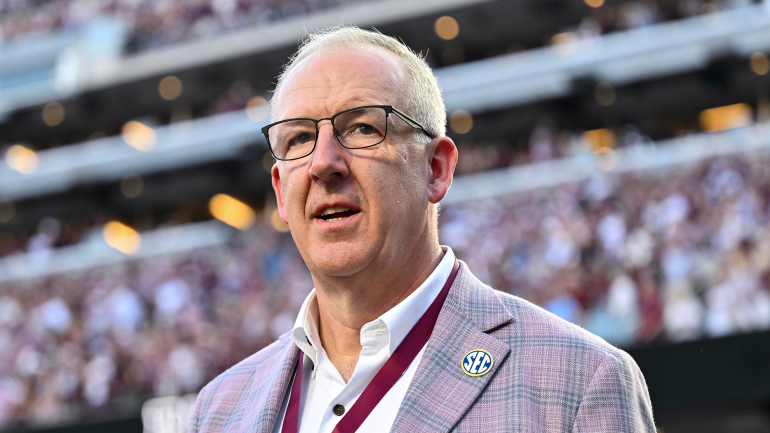
So, logically, the most likely path to agreement between like-minded individuals is to get rid of a lot of other individuals. Which means the breakaway from the NCAA you've heard so much about will arrive at some point, but not immediately. SEC commissioner Greg Sankey was on "The Paul Finebaum Show" this week discussing this very topic, and while Sankey said he doesn't think it's a good idea right now, he didn't dismiss the idea entirely, either.
"I'll just tell you, there is great frustration in my league that we've not been able to work collaboratively through some of the challenges and opportunities that we face," said Sankey. "There's great frustration that, as we go through the economic transition with our student-athletes, that we haven't been able to better define the boundaries and guardrails and held people to those. We have a responsibility in that, so I'm not just casting blame. I think that's where our focus should be. How do we work with colleagues and solve problems collectively? If there's a point in which we cannot do so, I think that conversation -- Is there something that you do alone? -- I think that starts to generate more and more interest."
In other words, "not yet."
I've long felt the Super League (or whatever nomenclature you prefer) is destined to arrive in the 2030s when the current television deals expire. When the ACC settled with Florida State and Clemson last March, agreeing to unequal revenue distribution in the league and to lower the penalty for leaving the league significantly, that feeling only grew stronger.
Come the 2030-31 season, if any school wants to leave the ACC, it'll cost them $75 million, and they get their media rights. SEC schools each received roughly $72.4 million in revenue for 2025. Imagine what that number will be by 2030. Suddenly, paying $75 million to leave the ACC for the SEC (or the Big Ten) doesn't seem so punitive, does it?
This is important because while the SEC and Big Ten could separate right now and float it financially, logistically, there are things they need to work out. They would need some help from the government, and legislators in states that make up the leagues probably won't be much help if schools like Florida State, Clemson or other large state schools are left behind.
Tampering with tampering
Everybody involved with college sports these days seems to be interested in enforcing stricter penalties for tampering. You find any college football coach and ask him, and he'll tell you, right after he gets off the phone with a player on another team, that tampering has gotten out of hand and somebody needs to do something about it.
However, the Big Ten was hoping the NCAA could hold off on those enforcements for a little while. No need to dive right in!
The Big Ten sent a letter to the NCAA this week asking the organization to put a halt to "investigations and infractions proceedings" related to tampering, according to a copy of the letter obtained by ESPN.
The letter states that the "current framework" for tampering rules "cannot be credibly or equitably enforced," pointing out the rules for tampering were designed before a modern era that includes paying athletes and essentially unlimited transfers.
"These rules were not designed for a world in which student-athletes are compensated market participants making annual decisions with significant economic consequences," the letter reads. "The collision between the old rules and new reality is producing outcomes that harm the population that the rules were designed to protect."
Honestly, on the surface, there's plenty about this letter that makes sense. Tampering has changed quite a bit in this day and age. We haven't always had unlimited texting, after all. Unfortunately for the Big Ten, its appeal for patience was denied.
The NCAA said, "nah, we're cool. We're gonna keep on keepin' on and see what turns up."
What we don't know is if any of this will lead to anything in the long run. It's important to remember that, like the NCAA violations of old, it's hard for the NCAA to prove anything without evidence, and it's harder to acquire that evidence unless someone provides it.
Players aren't likely to, and the coaches doing it aren't going to tell on themselves, either. As for other coaches, well, again, everybody's doing it (OK, maybe not everybody, but everybody who is trying to win is doing it) and you don't really want to start ratting on your fellow coaches because they may rat on you some day too.
Nebraska breaks the CSC litigation seal
When people start talking to me about the College Sports Commission (CSC), my brain eventually shuts off entirely, or it all starts sounding like background music as my attention turns to other, more pressing matters, like "what do I want for lunch?" or "where did my pants go?" As I've told you, I'm an idiot, and I'm OK with that. It took me a long time to accept who I am, and now that I have, I'm finally free to live in ignorance.
Anyway, the CSC's NIL Go clearinghouse is basically the body that decides which NIL deals are good and which aren't. How they do that, I'm not sure. I don't know that they could tell you with any real clarity.
I mean, there does seem to be some disparity!
For example, UCLA's Jordan Chiles got $250,000 from a sparkling water company for "social media." She has 1.6 million Instagram followers.
— David Covucci (@DavidCovucci) March 11, 2026
A football player got $450,000 from the NIL collective for "social media." The biggest Insta following for a player on the team? 37,000 https://t.co/Ps0YUYLttA
That disparity can be challenged, though, and a group of 18 athletes from Nebraska has become the first to do so. The athletes had NIL deals rejected by the CSC and consolidated those deals into one and appealed the CSC's decision.
Odds are they will not be the last, especially if they're victorious. While we don't know what the ruling is yet, if the arbitrator rules that the CSC was correct, they have to decline the compensation received from the NIL deal or return the money if they have already received it. If they refuse to do so, they will be ruled ineligible.
Of course, this is college sports in 2026. If the players lose their appeal, it's possible the state of Nebraska could come to their rescue, as the state has a law that "prohibits an association or institution from penalizing athletes from participating in NIL or receiving compensation."
The law there isn't always the law here.
Our latest NIL Deal Flow Report is out. Highlights since the launch of NIL Go include:
— College Sports Commission (@theCSCommission) March 10, 2026
- 21,025 deals with a total value of $166.50M have been cleared.
- 711 deals with a total value of $29.30M have been not cleared.
- Since the launch of the NIL Go platform, 70% of deals that… pic.twitter.com/b5RkrDCafI
Ohio State/Michigan rivalry has reached new levels
Michigan fired Sherrone Moore in December after learning of Moore's inappropriate relationship with a staff member. Ohio State responded this week when school president Ted Carter announced his resignation.
"For personal reasons, I have made the difficult decision to resign from my role as president of The Ohio State University," said Carter while breaking the news.
The personal reasons he referenced were an inappropriate relationship with a woman who was seeking public resources to support her personal business. The woman is a podcast host who hosts a podcast Carter has appeared on.
I don't know what a Michigan employee will do to respond, but if we've learned anything, it will be inappropriate.
As for the Sherrone Moore case that started it all, Moore was in the news again this week, too. He reached a plea deal in the home invasion case related to his dismissal at Michigan.
Oh, and about that other Michigan scandal
I'm starting to wonder if lawyers make more money from cases related to college football than they do from criminal work. The latest lawsuit to be filed against a school or the NCAA is by former Michigan assistant Chris Partridge. Partridge was caught up in the Conor Stalions sign-stealing scandal of 2023.
Partridge now works for the Seattle Seahawks and says despite having nothing to do with the Connor Stalions situation into advanced scouting, he was made a "scapegoat" after Big Ten commissioner Tony Petiti allegedly "presented (Michigan athletic director Warde) Manuel with uncorroborated, second-hand, inflammatory information" per the lawsuit and said Partridge told a former Wolverines player to "not be forthright with information" ahead of an interview with the NCAA.
Partridge claims he simply told the Michigan player to "get a lawyer" and that Petiti's alleged "threat" to Michigan was aimed at "embarrassing" the Wolverines, had it come to light during a pending injunction hearing associated with then-coach Jim Harbaugh's three-game suspension.
It was also reported at the time that Partridge had "destroyed evidence" related to Michigan's sign-stealing operation, allegations he denied at the time. The NCAA agreed, clearing Partridge of any wrongdoing.
Now, Partridge is taking Michigan to court, and I assume he's looking for at least enough in damages to get the bus tracks dry-cleaned off the back of his clothes.
Useful information for later
CBS Sports colleague Cody Nagel underwent the heroic task of figuring out how many returning starters every FBS team will have in 2026, and considering how many teams there are, not to mention the number of transfers, I would argue Cody deserves a raise.
TEAMS WITH MOST RETURNING STARTERS IN 2026 🏈
— Cody Nagel (@CodyNagel247) March 11, 2026
USC — 15
Georgia — 14
Maryland — 14
New Mexico — 14
Notre Dame — 14
Oklahoma — 14
Oregon — 14
Virginia Tech — 14
Boise St — 13
BYU — 13
Fresno St — 13
Tennessee — 13
Texas Tech — 13
Full FBS breakdown (min. 6 starts in 2025) ⬇️ pic.twitter.com/QFkTQHAYh6
You can read the list in its entirety here. While it's certainly worth noting that playoff contenders like USC, Georgia, Notre Dame, Oregon and others have so many players back, I'm more interested in what I saw at the bottom of the list.
There will be three teams that don't have a single returning starter next year: Iowa State, Memphis and North Texas. The thing all three have in common is that they all lost their head coach to another job this offseason, and that coach took a large chunk of their remaining eligible players with them to their new gigs.
Furthermore, six other programs will enter 2026 without at least one returning starter on a side of the ball (offense or defense): James Madison, San Jose State, Southern Miss, Toledo, UConn and West Virginia.
This sport is expensive
The Athletic's Bruce Feldman conducted a survey of college football coaches asking them for their thoughts on this offseason's coaching carousel, and while there are plenty of interesting answers and no shortage of shade thrown, there was a tidbit from one coach that caught my eye.
When asked about buyouts and how they think the carousel will change in the next five years, one SEC coach had this to say: "The appetite for paying buyouts (will be) cyclical, like we saw a couple of years ago when the only P4 jobs open were West Virginia, North Carolina and UCF, so I think we're going to see some years where we have lower turnover. ... Because what really needs to matter is, can you pay your roster $40 million? The new number in our sport right now is $40 million."
The new number is $40 million! Remember, folks, the revenue sharing cap schools are allowed to share with all their student athletes -- not just football -- is set at $20.5 million, and the going rate for (I assume) a playoff caliber roster is nearly double that, according to one SEC coach who is probably coaching a $40 million (or close to it) roster!
And if you think that's a lot of money to pay a college football team, wait until you find out how much Miami Ohio paid its roster last year. It just might blow your mind.