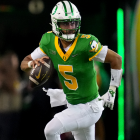
Dante Moore's NFL Draft decision: Is Oregon QB ready and what are the transfer portal ripple effects?
Moore projects as a top-five pick if he decides to declare, but the past decade of first-round QBs suggests he could benefit from another year

By
Cody Nagel
•
5 min read
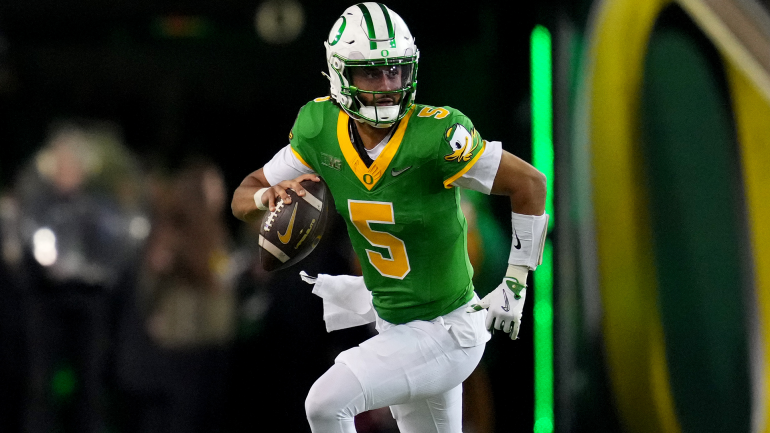
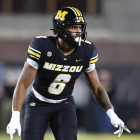
Dante Moore's pending choice to declare for the 2026 NFL Draft -- where he projects as a potential top-five pick in CBS Sports Mock Drafts -- or return to Oregon will not only shape his own professional future, but it'll also determine the Ducks' quarterback room and ripple through the transfer portal. With a potential vacancy at the position, several top quarterbacks are already expected to circle.
All of this is unfolding as Oregon prepares for its College Football Playoff quarterfinal against Texas Tech in the Orange Bowl on New Year's Day, giving Moore another high-profile stage to showcase his skills in front of scouts as he weighs a career-defining decision.
A former five-star recruit in the 2023 class out of Detroit (Michigan) Martin Luther King, Moore entered college surrounded by high expectations. He began his career at UCLA, starting five games as a true freshman in 2023 before being benched. Moore then transferred to Oregon in 2024, redshirting that season before emerging in 2025 as one of the nation's top quarterbacks:
- 72.4% completion rate (t-3rd in FBS)
- 170.08 passer rating (5th in FBS)
- 28 touchdowns (t-8th in FBS)
- 9.0 yards per attempt (t-10th in FBS)
His patience sitting behind veteran Dillon Gabriel last year paid off, allowing him to transition seamlessly into Oregon's efficient offense and quickly establish himself as a steady, central piece for the Ducks.
That move, combined with his continued development and consistency, has vaulted him near the top of many NFL Draft boards heading into 2026.
But with only 18 career starts ahead of Thursday's CFP quarterfinal, questions naturally arise about whether Moore has enough game experience to maximize an early jump to the NFL. Sources tell CBS Sports that Moore is weighing his options roughly 50-50, though this is a weak draft class and he would immediately vault into the No. 2 quarterback spot if he were to declare.
Moore's decision is best viewed through the lens of recent first-round quarterbacks and the experience they carried into the NFL. Since 2016, 35 signal callers have gone on Day 1 with wildly different résumés -- from multi-year starters to one-year projections. Even if Oregon reaches the national championship game, Moore would enter the draft with no more than 21 career starts, a level of experience historically tied to the most volatile outcomes for first-round quarterbacks.
That context frames the stakes. Declaring early could make Moore a top-five pick in April, but staying would give him an extra season to accumulate starts, add polish and reduce risk. At the same time, his choice will immediately shape Oregon's quarterback room and ripple through the transfer portal, where several high-profile signal-callers are already positioning themselves for potential openings.
Renner's 2026 NFL mock draft 5.0: College Football Playoff talent dominates the top of the board
Mike Renner
Draft‑ready talent vs. draft‑ready résumé
The modern first-round quarterback doesn't come from a single mold, but the past decade has drawn a clear dividing line between projection and stability. When first-round quarterbacks since 2016 are grouped by how much they actually played in college, one range stands out -- not for ceiling, but for reliability.
Quarterbacks who entered the NFL with 25 to 34 college starts have produced the strongest returns. As a group, they are 421-266-2 (.613) in the regular season, own a 35-21 (.625) playoff record and account for five of the last nine NFL MVP awards. That band includes franchise quarterbacks like Patrick Mahomes, Josh Allen, Lamar Jackson, Joe Burrow, Jordan Love, C.J. Stroud, Bryce Young, Caleb Williams and Drake Maye.
Once you move below that threshold, volatility takes over.
Quarterbacks drafted in first round since 2016
| FBS/FCS starts | NFL regular season record | NFL playoffs record | NFL MVPs |
|---|---|---|---|
45+ | 116-114 (.504) | 4-5 (.444) | 0 |
35-44 | 248-240-2 (.508) | 7-10 (.412) | 0 |
25-34 | 421-266-2 (.613) | 35-21 (.625) | 5 |
| <25 | 264-285-2 (.481) | 0-10 (.000) | 0 |
Quarterbacks drafted with fewer than 25 college starts are 264-285-2 (.481) as NFL starters and winless in the playoffs. Nearly all were asked to grow up on Sundays. Some never did.
At the other end, sheer volume hasn't been a guarantee either. Quarterbacks with 35 or more college starts hover around .500, suggesting that experience alone doesn't elevate a prospect -- but a lack of it can sink one.
That's where Moore's decision sharpens.
Even with a deep playoff run, Moore would enter the 2026 draft with only 21 career starts, placing him below the threshold that correlates with the most consistent NFL outcomes for first-round quarterbacks in the past decade. Declaring now would mean asking an NFL franchise to spend premium capital while still projecting significant development.
Returning to Oregon would do something simple and historically valuable. One more season would push Moore into the 25-start range where first-round quarterbacks have historically converted talent into NFL success.
That's the trade-off at the heart of his decision -- not whether he's good enough, but whether he wants to enter the NFL as a polished prospect or as a potential project.
The portal dominoes if Moore leaves
Should Moore declare, Oregon's quarterback room immediately becomes a hotspot in the transfer portal. The Ducks have become one of college football's premier destinations for quarterbacks looking to reset or elevate their careers. Both Bo Nix and Dillon Gabriel arrived with questions and left with improved draft stock as Heisman Trophy finalists.
If Moore exits, Oregon would be aggressive but selective in targeting its next quarterback. Names like Dylan Raiola, Sam Leavitt (if he enters the portal) and Josh Hoover would immediately surface as potential fits. The Ducks offer something few programs can: a proven pathway to statistical production and NFL credibility.
Moore's decision would also trigger a chain reaction across college football. With several high-profile programs expected to be in the market for starting quarterbacks -- from CFP contenders like Indiana, Miami and Texas Tech to LSU, Florida State, Auburn and even Clemson -- Oregon could potentially land its top choice early, setting off a cascade of moves as other teams adjust their plans.
The quarterback market rarely moves in isolation, and Moore's choice could be the opening domino that shapes the top tier of transfers this offseason. Ironically, if he chose to leave, his departure could strengthen Oregon's portal leverage, reinforcing the program's reputation as a quarterback launchpad.
One factor complicating the "run it back" argument is Oregon's shifting offensive structure. Coordinator Will Stein, who helped engineer the Ducks' offensive efficiency, is leaving for Kentucky. That change doesn't diminish Moore's tape, but it does alter the environment for both him and the quarterback who follows.
Ultimately, Moore's decision is about more than draft position -- it's about timing, leverage and shaping his own narrative. He has the talent to compete at the next level, but another season at Oregon would give him extra reps, refine his game and align him with the experience that historically produces more consistent outcomes for first-round NFL quarterbacks.