Hat in hand: How Demond Williams' $6 million gamble collapsed and led him back to Washington
The day after his audacious announcement to break his contract and transfer, Williams sobered up to the reality he may need the Supreme Court's help to actually pull the move off

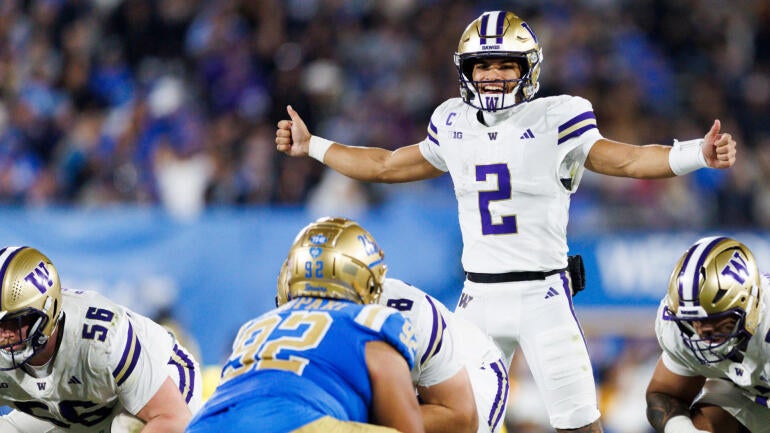
Amid a 48-hour college football firestorm that could be felt everywhere from Seattle to Baton Rouge, Demond Williams Jr. came upon a moment of clarity.
He had messed up.
The talented 19-year-old quarterback expressed as much upon rejoining the Washington football program, coming just one day after the bombshell post that he planned to enter the transfer portal.
"I think the kid realized it immediately," a source close to the situation, speaking anonymously, told CBS Sports.
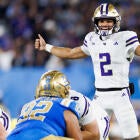
The Jan. 6 news of Williams' decision to enter the portal set off a college football circus; it was a brazen attempt to flout an executed agreement and transfer to another school. Days earlier, Washington had signed Williams to one of football's priciest tags at up to $4.7 million a year. Williams threw for 25 touchdowns and over 3,000 yards in 2025 for 9-4 Washington and is set to enter the 2026 season as one of college football's best quarterbacks.
In the hours after Williams expressed his intention to transfer, Williams' father told someone his son had an offer on the table for $6 million. Sources indicate the schools of interest to the family were Alabama, LSU, Miami and Oregon.
That transferring was an option at all was a surprise to his agents at powerhouse West Coast-based agency Wasserman Sports. His two point persons at Wasserman, including Doug Hendrickson, were caught off guard by the decision and it led them to part ways with Williams, which Hendrickson announced Thursday. Wasserman also represents Washington head coach Jedd Fisch, placing the agents in an almost impossible position after Williams went rogue.
Washington and Williams negotiated for months putting together a new deal. The Huskies were always committed to pay Williams his value, and the deal they struck made him one of the highest paid players in the sport, per multiple sources.
Washington and Williams engaged in a months-long negotiation process before their announced Jan. 2 deal. In the final week or so leading up to it, the industry had begun teeming with rumors that Williams could instead enter the portal. Those in his large camp, outside of his agents, had been hearing from other schools for weeks.
Williams signing with Washington on Jan. 2 did not stop the noise. Other schools instead seemed to push harder. And as one source close to the situation theorized: The dollars went up and a deadline was given.
Williams hopped in the portal.
The timing was poor. When Williams announced his intention to leave the program, most of the Huskies football team was at a memorial for soccer player Mia Hamant, who died after a battle with kidney cancer. The timing of the post sparked outrage in the Husky community, including from Fisch's wife, Amber, who posted in an Instagram comment: "How disgusting!"
Williams told people he didn't know about the timing of the memorial when he made his post. As one source put it: "It was the worst coincidence you could ever sign yourself up for."
The firestorm only grew from there.
The Big Ten athletic directors met Wednesday about the Williams situation. They agreed they'd support Washington in fighting to enforce Williams' contract, which came with a significant buyout. A year after Xavier Lucas left Wisconsin for Miami, the Big Ten leaders were worried about another potential precedent setter.
Meanwhile, Williams and his family sought out new representation.
There were reports that Cordell Landers, a former assistant personnel staffer at Florida who works with several players, including playing a central role in Nico Iamaleava's transfer process last year, was involved in Willaims' decision to transfer. He does know the family. He did give them advice. But he pushed back on the idea he steered Williams in any direction:
"I'm not working with Demond at all," Landers told CBS Sports. "Do I know Demond? Yes. I've known him for a long time. Did I help him find receivers at Washington? Yes. Did I tell him to get up and leave? No."
Other sources indicated that Landers was part of a small group the family consulted with outside of his agents. Once Wasserman opted to part ways with Williams, the family sought out representation from other agencies, per multiple sources. The family also hired lawyer Darren Heitner, a sports and NIL attorney who represents Lucas in his case against Wisconsin, to represent them as they attempted to break the contract with Washington.
Meanwhile, schools had to sort out if they were willing to even pursue Williams.
As one source at a prominent QB-needy school told CBS Sports: "I'm trying to stay out of all of that."
Sources have indicated there were potential tampering issues that could have been tripwires for schools that were in pursuit of Williams.
As one source familiar with the situation put it: "Whatever school he thought he was going to, it was going to get too hot for them to touch it."
Williams' attempted entry into the portal – Washington refused to officially enter him based on his contract – may have impacted the direction of the 2026 quarterback carousel. The No. 1 player in the transfer portal, Arizona State quarterback Sam Leavitt, was on LSU's campus for a visit when the news broke that Williams intended to enter the portal. CBS Sports immediately linked LSU and Williams together. And that may have caused issues with Leavitt and the Tigers, a source said.
Leavitt left for a visit to Tennessee shortly after. He is also in play for Miami.
As for Williams' decision to return Washington, that dialogue began Wednesday.
With schools wary of getting caught up in a lawsuit, Williams' options narrowed. He even had people telling him he had two feasible paths having signed the contract: Go back and play for the Huskies or go to the Supreme Court.
So even though Williams' dad indicated to people Wednesday that his son would never play for Washington again, per a source with direct knowledge of the situation, momentum began to pick up for a reunion.
Washington never closed the door.
While the Huskies did engage Missouri quarterback Beau Pribula for a visit shortly after the Williams news broke, Washington's brass was clear with Pribula's camp that the Huskies hoped to bring Williams back.
Ultimately, Washington and Williams reengaged.
Williams kept the line of communication with Fisch open throughout the process. Those around Washington do not consider Williams a bad kid. He is regarded as an excellent student and a driven athlete. They say he just made a rash choice in the face of potentially life-changing money.
And when Williams experienced the pushback and backlash that came with the decision, he began to reverse course.
"I think it was the backlash and realizing you'd have to pay that money back potentially," a source said. "Most people have a really hard time with people publicly criticizing them, when that happens it can change people's viewpoints."
Williams will have to return to Washington with his hat in hand, but there's not expected to be a long-term fallout from the move. Sources expect Williams to apologize to the team. Yet he will obviously retain his post as Washington's QB1 and is, even now, a key selling point for the program when recruiting transfer receivers. The terms of his contract will not change.
Williams' bizarre 48 hours under the microscope is a microcosm of the current unregulated environment of college football.
And, at least in this rare circumstance, schools and coaches see it as a welcome change in leverage — an actual example of a player running into a roadblock via his contract he couldn't manage to get around.
"I think it was a great learning experience for the industry," a source said.