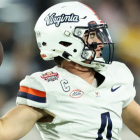
Excitement, swarm, violence: Once a liability, Miami's aggressive defense now powers CFP run
Led by an aggressive scheme revamp and the quiet, fiery leadership of Reuben Bain, Miami has transformed last year's weakness into one of the most feared units in college football


SCOTTSDALE, Ariz. -- Reuben Bain commands attention on the field, but in the locker room, he usually fades in the background.
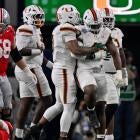
That's why Miami players went silent when the All-American defensive end spoke up during the ventual 24-14 victory against Ohio State in the College Football Playoff quarterfinals. Bain isn't a speechmaker by habit, so in the rare moments he talks, people listen.
"Thirty more minutes, we get everything we worked for," Bain told the Hurricanes. "Them boys ain't work how we work. They ain't feel how we feel. They ain't cry how we cry. You can see they don't got the energy we got. They don't want it how we want it."
The clip quickly landed in Miami lore, joining Ed Reed's iconic "I'm hurt, dawg!" halftime plea against Florida State during the Hurricanes' 2001 championship run. Bain's words resonated clearly, hitting with the same raw force.
"There's weight behind that," quarterback Carson Beck said. "That's something that's coming from the heart, something that he needs to say to the team. Shoot, it had me juiced. I was ready to roll out there and go die for those boys."
Like Reed before him, Bain has become a cornerstone of Miami's championship push. A homegrown South Florida product, he anchors a defense that has evolved into the most destructive pass-rushing unit in college football. The Hurricanes (12-2) enter Thursday's CFP semifinal against Ole Miss (13-1) with a nation-leading 46 sacks, including 12 in two playoff games.
Miami's transformation on defense has been dramatic.
A year ago, the Hurricanes' season ended with the defense surrendering 42 points in back-to-back losses, wasting a generational offense led by quarterback Cam Ward that finished No. 1 nationally. Ward routinely had to outscore defensive breakdowns, dragging the Hurricanes to wins, including four straight games in which opponents scored at least 34 points. The imbalance finally broke Miami's back, turning a 9-0 start into a 1-3 finish and leaving the Hurricanes one win shy of the ACC Championship and likely the CFP.
"In my 19 years coaching college, it was the most frustrating and disappointing season ever," offensive line coach Alex Mirabal told CBS Sports in April.
Excitement, swarm, violence
The defense was a mess of missed assignments and miscommunication. The Hurricanes employed odd-numbered fronts for a roster built to run a four-man defensive line. The scheme, and a lack of execution from the secondary, limited the pass-rushing abilities of Bain and fellow defensive end Akheem Mesidor.
So, coach Mario Cristobal fired defensive coordinator Lance Guidry and tabbed Minnesota's Corey Hetherman, a disciple of Rutgers coach Greg Schiano, to tear it down and rebuild. His task was to shift the philosophy and give the already-stout defensive line more sack opportunities while rebuilding the secondary, which he did by bringing in four transfers in the offseason.
"Our style is launch technique," Hetherman told CBS Sports in April. "We're not a read-and-react defense. It's not even stay in your gap: it's get reach, get vertical."
Hetherman calls it "ESV" -- excitement, swarm, violence.
The results are unmistakable. Miami has allowed just 9.7 points per game during its current six-game winning streak, including 8.5 points per contest in the playoffs. A year after ranking 70th nationally in scoring defense, the Hurricanes enter the semifinals ranked fourth.
Offensive coordinator Shannon Dawson said he has never seen a turnaround like it. The Hurricanes are capable offensively, though not as explosive as the record-breaking group from a year ago, but it hasn't mattered that they have scored only 34 points across two playoff games.
"I'm trying to complement them, to be quite honest with you," Dawson said. "They're an elite group, and Corey does a heck of a job.
" … Ultimately, you do kind of conform to who the team is. There's no ego with me. Look, I just want to win the game, and I know that our defense is playing at an extremely high level. So there are situations in the game where I'm cautiously aggressive, because I don't want to put those guys in a tough situation, and I do trust those guys with everything."
One-two punch
It all starts with Bain and Mesidor manning the edges and terrorizing opposing quarterbacks. The duo has combined for 19 sacks, and Mesidor's 33.5 career sacks leads the country over his six-year career. They combined for three sacks in the first half of the quarterfinals, and their presence has opened the floodgates for linebackers and tackles to pile up TFLs and QB pressures.
"Those two guys right there," said running back Mark Fletcher, "I don't feel like anybody can block them. This is probably me speaking as humbly as possible. I just don't see how they can get blocked. Those guys really take pride on what they do. They're always getting in extra work. Best leaders on the team."
Beck equates the Sack Brothers as "game wreckers."
"Even just having one of those guys would be a huge impact to any defense, but to have both of them has completely changed the course of the season and the way our defense plays."
Cristobal sees the impact extending beyond the front seven.
"It's not just the front seven; it's also the perimeter guys.," he said. "I think the physicality and the dog mentality of our secondary, their willingness to run the alley, fit certain gaps in the run game, be the extra hat, and sometimes just flat-out make a play in space. I just think our technique, our willingness has gotten better, and just the understanding of the defense and where your help is allows you to leverage the ball. Those things are showing up a bunch on tape."
Indeed, Miami averages more than one interception a game and has returned three picks for touchdowns, including Keionte Scott's game-breaker against Ohio State on New Year's Eve.
The defense hasn't been flawless. Virginia Tech ran for 194 yards against Miami, even as the Hurricanes countered with five sacks. Hetherman said fatigue was the culprit. After 70 plays and a lack of substitutions, the defense wore down.
"We've learned from that, and that's where you see some of the rotations since that point," he said. "We've been playing a lot more guys as we continue to go."
A stiff test
That lesson looms large against Ole Miss, which runs one of the fastest no-huddle offenses in the sport while averaging 74.4 plays per game. Quarterback Trinidad Chambliss has been a revelation, throwing for 300 yards in eight games after transferring from Division II Ferris State. He threw for 362 yards in the 39-34 upset of No. 3 Georgia in the quarterfinal game at the Sugar Bowl.
"This guy is different," Miami saefty Jakobe Thomas said. "He extends a lot of plays. The big thing for us is protecting 'Cane Nation and staying deep. Making sure nothing gets behind us. It's a challenge for our guys up front. I think they're up for it, but it's a challenge. He's a very, very evasive guy. Keeping him in the pocket, keeping him contained, easier said than done."
One could argue that Miami boasts the most physical, unrelenting team in the trenches. It has defined the Hurricanes' postseason run on both offense and defense. The offensive line paved alleys for running backs to pick up 328 combined yards against Texas A&M and Ohio State. Fletcher, emerging from injury and a brief recalibration, has rushed for 262 yards in the postseason, averaging 7.3 yards per carry.
It's that physicality, a tone set by Hetherman's revamped "ESV" defense led by Bain and Mesidor, that has the Hurricanes one win away from their national championship appearance in 23 years.
"We want to be the most violent team in everything that we do," Fletcher said. "We take pride in that."