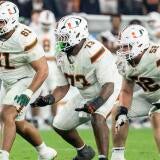

Curt Cignetti's process fueling Indiana's rise is upending college football -- and rivals are taking notes
Indiana's rise isn't about stars or spending sprees. It's about experience, evaluation and a transfer portal blueprint that has turned the Hoosiers into the national title favorite

•
11 min read
When Aiden Fisher called his mother earlier this week to talk about life, football and Indiana's looming trip to the national championship game, he heard a familiar voice.
It wasn't hers.
It was Curt Cignetti's.
"I don't even remember what we were talking about. I was just like, 'Yeah, I hope somebody doesn't get complacent,'" the senior linebacker said. "And I was like, Wow, I have been with Cig way too long. It's funny when you've been with somebody for so long, you start talking like them a little bit."
That's how completely Cignetti has seeped into Indiana football. Two years were enough.
In Year 1, he rewired the program's DNA, importing 13 veteran players from James Madison and flooding the roster with experience. In Year 2, he doubled down by mining the transfer portal for 10 immediate starters and elevating Indiana from a pleasant postseason surprise in 2024 into a full-fledged national title contender.
On Monday night against Miami, Indiana (15-0) will find out whether Cignetti's plan reaches its ultimate conclusion. Win, and the Hoosiers complete one of the most stunning turnarounds in modern college sports. Lose, and the blueprint still stands, studied closely by rival coaches and personnel executives already trying to replicate Indiana's overnight rise and create their own Hoosier Magic.
"Curt knows exactly who he is," one Big Ten general manager told CBS Sports. "He knows how he wants to build his roster. It gets harder and harder every year to stick to your guns in the transfer portal in a win-now world. That's where you obviously commend them for what they're doing. They know the type of guys they want to bring in that locker room, and they've found a way to identify that -- and they're still rolling."
Cignetti's road here was anything but linear. The wily, stoned-face coach's 18-year journey from the pinnacle at Alabama included a detour into Division II football before resurging as a head coach at James Madison and now Indiana. Along the way, he coached multiple positions, served as Nick Saban's top recruiter and helped assemble two national championship teams.
Now, he may be authoring the most improbable title run of the modern era. He's doing it by drawing from a career shaped by reinvention, discipline and an unshakable belief in process.
"College football's changed a lot, obviously -- still changing," Cignetti, 64, said. "You've got to adapt, improvise, be light on your feet if you're going to survive. And that's where I think all that recruiting coordinator experience I had in the past, too, as well as coaching, probably benefited me."
But how has Cignetti turned Indiana, the losingest program in college football until Northwestern surpassed them in November, into a national powerhouse just by adding a few dozen transfers? It's the question so many rival athletic directors and coaches have been asking the last two seasons.
Production and experience over youth and potential ... for now
When Cignetti arrived in Bloomington in December 2023, fresh off a remarkable run at James Madison, the message was clear: This rebuild would not be slow, and it would not be theoretical.
Many didn't believe Cignetti, choosing to chuckle when he told reporters, "I win. Google me."
"It was a quick process, a three-day hiring process," Cignetti said. "When I got here, we had 10 offensive starters in the transfer portal, and we had one returner on defense. So we were down to 40 scholarships by Day 3. We needed to hit the portal hard, and we signed 22 guys who have been two- or three-year starters with consistent production.
"I knew we had flipped the roster."
The Hoosiers entered the summer of 2024 with 31 new transfers, but only six were from power-conference programs. The backbone was the 13 players who followed Cignetti from James Madison. Five of them remain on this year's Big Ten championship team chasing the national title. Receiver Elijah Sarratt, the nation's leader in receiving touchdowns, is the only holdover on offense.
The philosophy was simple and unwavering: proven production over theoretical upside. Veterans whose ceilings hadn't yet been reached and their resolve unimpeachable. Players who could absorb coaching immediately, tweaking small mistakes to transform into machine-like players obsessed with fundamentals.
Cignetti ran point on every decision.
Indiana superfan Mark Cuban, the billionaire alum and NBA executive, saw the vision early.
"As Cig has said, he wants performance, not potential, which is exactly what he focused on," Cuban told CBS Sports. "He put together a team where players knew their roles coming in, a coaching staff that could take those experienced players and mold them quickly, and an organization that understood exactly how to get the pieces they needed."
The baker's dozen from James Madison was charged with setting the tone, holding their new teammates to the standards they already knew.
"It's a very veteran group," said center Pat Coogan, who transferred from Notre Dame before the 2025 season. "It's a mature group. It's a group that's been around the block, played a lot of football, and a group that knows how to take (Cignetti's) messages and put them on the field,"
Stars vs. system
The result of two seasons of building is the oldest roster in the College Football Playoff. Indiana's 22 starters on offense and defense average 4.3 years of college experience. Seven players have played five-plus seasons. Four are in their sixth year.
"Hands down, older people are better," Miami offensive coordinator Shannon Dawson said. "I mean, that goes without saying, right? The more you play the game, the better you're gonna be. If you look across the board, typically older teams win championships. There's a reason for that. They don't make young kid mistakes."
Said Cignetti: "There's no question about it that a 22-year-old is a little wiser, older, bigger, stronger."
Miami isn't far behind, averaging 4.1 years of experience.
But experience alone doesn't explain Indiana's dominance.
Otherwise, the Hoosiers wouldn't be steamrolling veteran rosters stocked with more stars by the second-best point differential (plus-473) in the last 50 years of FBS football.
The average star rating assigned by 247Sports for Indiana's starters is only 2.95. Miami's average is 3.7. Every playoff opponent Indiana has beaten had superior recruiting rankings.
"Whenever you're structuring a pro environment, you have to get a coach that's hungry, that wants to be in the office every day," an SEC general manager said. "That permeates throughout the building. You're going to have a bunch of three-star guys, but they're going to overachieve because there's a system in place that's worked. There's a lot of buy-in. Everybody's pulling in the same direction.
"You have to be intentional about the characters you bring. You have to build."
Only two Indiana starters were blue-chip recruits out of high school or from the transfer portal, and both joined the program in 2025. They also happen to touch the ball most -- Coogan at center and Heisman Trophy-winning quarterback Fernando Mendoza.
"You've got to have a blueprint, a plan in process. You've got to have the right people on your staff and the right people in the locker room," Cignetti said.
He pointed to the continuity provided by coordinators Bryant Haines and Mike Shanahan, who have been with him for more than a decade, and to the leadership of an older locker room that polices itself. Cignetti's face is as meme-able as any coach on the sidelines, his annoyed grimace rarely cracking, but he's also not the rah-rah coach who overwhelms players with pre-game instructions and locker room speeches.
"It's all about people, and then you've got to have a blueprint and a plan. There's no question about it, that's what's gotten us to this point."
Indiana's Seniority Breakdown
Offense
| Player | Position | Experience | Originally Signed | Recruiting Ranking |
|---|---|---|---|---|
| Drew Evans | OL | 4 years (RS Jr.) | Wisconsin | 2 stars |
| Carter Smith | OL | 4 years (RS Jr.) | Indiana | 3 stars |
| Kahlil Benson | OL | 6 years (RS Sr.+) | Colorado | 3 stars |
| Bray Lynch | OL | 4 years (RS Jr.) | Indiana | 3 stars |
| Zen Michalski | OL | 5 years (RS Sr.) | Ohio State | 3 stars |
| Pat Coogan | OL | 5 years (RS Sr.) | Notre Dame | 4 stars |
| Fernando Mendoza | QB | 4 years (RS Jr.) | Cal | 4 stars |
| Roman Hemby | RB | 5 years (RS Sr.) | Maryland | 3 stars |
| Riley Nowakowski | TE | 6 years (RS Sr.+) | Wisconsin | 3 stars |
| Elijah Sarratt | WR | 4 years (Sr.) | James Madison | 4 stars |
| Charlie Becker | WR | 2 years (So.) | Indiana | 3 stars |
Offense averages: 4.5 years of experience · 3.2-star average · 8 of 11 starters are transfers
Defense
| Player | Position | Experience | Originally Signed | Recruiting Ranking |
|---|---|---|---|---|
| Isaiah Jones | LB | 4 years (RS Jr.) | Indiana | 3 stars |
| D'Angelo Ponds | DB | 3 years (Jr.) | James Madison | 3 stars |
| Louis Moore | DB | 5 years (RS Sr.) | Navarro College | 3 stars |
| Devan Boykin | DB | 5 years (RS Sr.) | NC State | 3 stars |
| Jamari Sharpe | DB | 4 years (RS Jr.) | Indiana | 3 stars |
| Mikail Kamara | DL | 6 years (RS Sr.+) | James Madison | 3 stars |
| Dominique Ratcliff | DL | 6 years (RS Sr.+) | Texas State | 3 stars |
| Tyrique Tucker | DL | 4 years (RS Jr.) | James Madison | 3 stars |
| Mario Landino | DL | 2 years (So.) | Indiana | 3 stars |
| Aiden Fisher | LB | 4 years (Sr.) | James Madison | 3 stars |
| Rolijah Hardy | LB | 2 years (So.) | Navy | 0 stars |
Defense averages: 4.1 years of experience · 2.7-star average · 8 of 11 starters are transfers
Total starters: 22
Average experience: 4.3 years
Average recruiting rating: 2.95 stars
Transfers: 16 of 22 starters
The separator: Elite coaching
If simply stockpiling veteran three-stars with productive careers at lower-tier schools were the answer, everyone would be doing it.
Indiana has separated itself by squeezing every last drop out of the players. As many as 16 Hoosiers in April are projected NFL Draft picks, including Mendoza, the likely No. 1 overall selection. Six projected top-five-round picks entered college with grades of 86 or lower -- players not viewed as future NFL talent by 247Sports' recruiting evaluators.
"They've done a great job of evaluating the low type of talent," an SEC player personnel director said. "The next part of that is developing the talent and giving those guys confidence to produce at a high level."
The Hoosiers are as efficient as any team in recent history. The results are staggering. Indiana ranks top-three nationally in eight major categories, including No. 1 in pass efficiency, turnover margin and third-down conversions. The Hoosiers are the first team since 2013 to rank second or better in both scoring offense (42.6 ppg) and defense (11.1).
Mendoza, who transferred from Cal in 2025, has been surgical in the playoff, throwing eight touchdowns against just five incompletions.
And then there's the plus-21 turnover margin.
"They just play more fundamentally sound," a Big Ten general manager said. "They play a little bit tougher than everybody else. That still goes a long way. I know stars mean everything, but when you get a team on the same page playing the way those guys do, you're gonna have a chance to beat anybody."
Few teams make fundamental football look sexy, but Indiana has done it by pairing a high-flying offense with a defense built on confusion. An opposing Big Ten coach said Indiana's game-day edge often starts early. When the Hoosiers jump out to a double-digit lead, defensive coordinator Bryant Haines opens up the playbook, dialing up aggressive pressures and hard-to-read fronts designed to obscure opponents' pre-snap keys.
Normally, a center identifies and calls out the middle linebacker before each snap, helping set protections across the line. Indiana's exotic looks disrupt that process, forcing opposing offenses to guess at assignments and protections.
"What they do is wild," the GM said.
What follows is usually a barrage of points.
According to the Big Ten coach, that approach shifts in tighter games. When the margin is slim, Indiana leans more heavily on its base defense, which allows opponents to identify assignments more clearly, but even that still demands precise execution to crack.
Sustainability through evolution
Indiana's recruiting plans are already evolving. The portal class has shrunk each year, from 31 to 23 to 17, while the talent has climbed.
Two years ago, power-conference players accounted for only 19.4% of the haul from the transfer portal. This year, the number has jumped to 70.6%, and the Hoosiers' portal class ranks No. 6 nationally.
NIL growth, aided in part by Cuban, has helped, as has the proof-of-concept Cignetti provided with a 26-2 record heading into Monday's national championship game.
"Every year, as your high school recruiting builds up, you kind of start to wean down a bit from the portal," Cignetti said.
Indiana isn't chasing stars. It's chasing fit. Many coaches believe they're incredible evaluators, but very few can develop three-star players into superstars. Cuban believes Indiana has "absolutely" exposed an inefficiency in college football's talent and spending model.
"If Polymarket put an over-under on wins for the team that paid the most for their quarterback, I'm taking the under," he said. "And I have no idea who the highest-paid players are."
What's next for Indiana is another reload. The Hoosiers will lose at least 12 starters, including seven on offense. Several more upperclassmen could enter the NFL Draft. Every remaining James Madison transfer is gone after this season.
"That's why I'm curious with some of the bigger-name guys they're bringing in that are obviously a bit pricier," a Big Ten general manager said. "It'll be interesting to see if they stay the Indiana that plays with their hair on fire — that fundamentally sound, plays hard as s***, high-motor type of football team. All it takes is one or two guys to ruin s*** real quick in that locker room."
Cignetti will turn again to the rising veterans who remain on the roster, including his first high school signing class, to set the culture for the newcomers arriving from the portal.
"In college football, nowadays, you've got to win every year," Cignetti said. "With social media the way it is, the pressure to be successful, you've got to put together a team that's ready to compete for championships every single year.
"Now, the more success you have, the better you're going to recruit from the high school ranks. And those guys will develop, and most of them will redshirt, but some of them will play as freshmen."
Across the country, athletic directors are actively stealing pages from Indiana's blueprint. Group of Six coaches are being hired to lead power programs and bringing their star players with them.
This offseason was the most active yet. Auburn hired USF's Alex Golesh, and 13 of his players followed him to the SEC. North Texas' Eric Morris brought 17 players with him to Oklahoma State. Arkansas' Ryan Silverfield also snagged seven Memphis players.
And all three coaches brought their star quarterbacks.
"As a coach, you're thinking you have to win now, as opposed to building for the next three or four years so you can win in Year 4," an SEC general manager said. "It's not possible. Universities are not going to wait that long to have that level of success in this world."
Indiana didn't wait.
Now, it's one win away from rewriting what's possible.