
Indiana's national championship isn't a fairy tale. It's a warning for college football's old order
Indiana's championship wasn't a miracle or a fluke. It was a message to a sport still clinging to old excuses in a new world

MIAMI — The morning after a national championship is usually reserved for the snooze button. Not for champions.
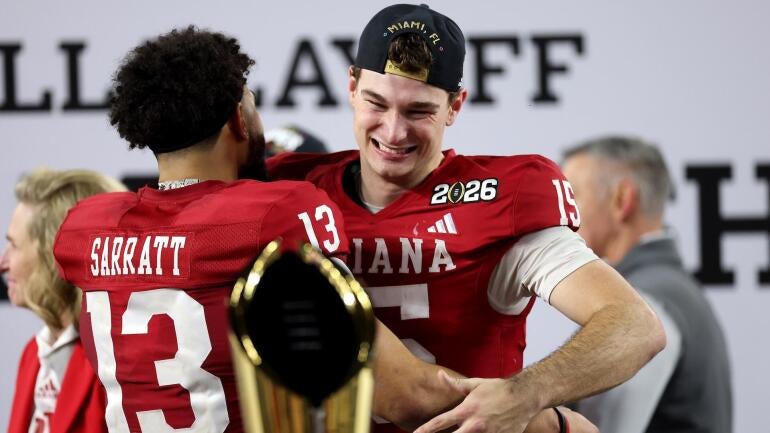
Success comes with obligations, and Indiana met them Tuesday morning, newly introduced to life as college football's New Blood. Four upperclassmen stars -- some clearly worse for the wear -- strolled onto a stage of bright lights and fresh questions, asked once again to explain how a program long synonymous with losing had become the first 16-0 champion since the 1890s.
The night had been long. It began with cigar smoke in a jubilant locker room and likely detoured through a few celebratory adult beverages around Miami. The residue lingered.
"I heard one of them didn't even get to bed yet," Indiana coach Curt Cignetti deadpanned. "Great day yesterday. Good to be here today at the winner's podium. Every day brings new things that need to be done and new challenges."
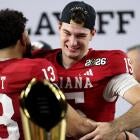
The only empty seat belonged to the biggest star of them all. Heisman Trophy winner Fernando Mendoza arrived a few minutes later, sliding in beside his teammates, fashionably late but, as always, reliable after his battered-and-bruised night was highlighted by a 12-yard touchdown run for the ages on fourth down.
Indiana can get used to this.
The harder question is whether college football is ready for it.
The fairy tale of Indiana's rise from losingest program in the FBS to undefeated champion will fade quickly. Soon, we'll ask Indiana if it can do all of this again.
Oh, actually, that's already been asked. Life comes at you fast when you're the champ.
"Perfection is impossible to attain on a consistent basis," Cignetti said. "We'll continue to take it one day at a time, one meeting at a time, one practice at a time and just keep improving and committing to the process and showing up prepared, trying to put it on the field and see where it takes us."
How we view Indiana has to change, if only because Cignetti's uncharted climb from Division II to FCS to FBS to a 27–2 start in Bloomington now demands to be taken seriously, not sentimentalized.
"I think that's called a paradigm shift," Cignetti said. "It's kind of like people can cling to an old way of thinking, categorizing teams as this or that or conferences as this or that. Or they can adjust to the new world, the shift of the power balance in the way college football is today."
In other words: stop making excuses.
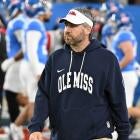
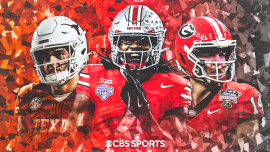
The sport has changed. Money entered the chat last fall, and it is not leaving. NIL spending pulled mid-tier programs like Ole Miss and Texas Tech into the playoff. Indiana, armed with a one-of-a-kind coach, a ruthless eye for evaluation and a new financial backbone, won the national title.
Funny how many of us once doubted this day would ever arrive. Parity, we were told by the multi-million-dollar coaches with police escorts and plush lifestyles, would make perfection impossible. Unlimited free agency. Deep-pocketed boosters everywhere. A system too chaotic to survive unscathed.
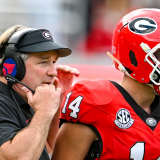
Some embraced that logic. Others weaponized it into weakness, perhaps unknowingly, to lower the bar at places where perfection is still demanded inside an imperfect system. Eight months ago, Texas' Steve Sarkisian made his own forecast in this new system of revenue-sharing and rapid player transfers.
"The idea I think we've all gotta wrap our brain around -- I don't know if we'll ever see an undefeated national champion again," Sarkisian said at the SEC's annual spring meetings. "If we do, that's a really good team. Because it's just so difficult."
No one said it would be easy. That's why Sarkisian is sitting at home in January rather than playing for a title, which would be his first of any sort since winning the Big 12 in 2023, while leading one of the richest programs in major college sports.
His reasoning is sound at first glance. It is difficult to maintain a healthy roster, but Indiana did just that this year after losing Stephen Daley, the nation's No. 2 player in tackles for loss, after the Big Ten Championship Game.
What increasingly rings hollow is how often coaches choose to rail against the system they helped build rather than learn to exploit it. Indiana and Cignetti did the latter. The rest will have to, too. Others need to "wrap our brain around" that development.
"I think to look back at what happened to Indiana previous to us coming, 10, 20, 50 years ago, strictly lacked a commitment from the top," Cignetti said. "That's it, plain and simple. Nothing else. And we have a commitment."
That starts with an athletics director willing to invest. It helps to have Mark Cuban in your alumni base. But the whispers of a top-tier payroll in Bloomington always felt like a convenient crutch for blue-blood whiners, a way to explain away failure after decades of coasting on inherited advantages.
Not anymore. Not in this world of fast-rising Indiana and Ole Miss and Texas Tech -- previous mid-tier programs that reached the College Football Playoff.
"We described it as a sleeping giant when we got here," said linebacker Aiden Fisher, one of the seven last transfers from Cignetti's James Madison team. "Indiana fans and the culture around Indiana were just hungry for a winner, and they just needed the right coach and the right players to come in and flip this thing around."
That flip began with 13 James Madison transfers last season and culminated with a roster that featured only seven former four-star recruits -- the fewest ever to win a national title in the modern recruiting era.
Indiana keeps breaking the templates.
How the rest of the sport responds is the next chapter.
As for Cignetti, there will be little time to linger. He gave his staff Tuesday off. They return Wednesday. He flies to Houston for the Bear Bryant Award, then back to Bloomington. There is already a checklist waiting for him in his office Thursday.
"Get through the month, take a little vacation in February, go down to some nice hot-weather island about a week, and then when I come back, I'll figure out a few film projects that I think might fit next year's team and help me grow," Cignetti smiled.
Champions don't get much time to sleep. The old blue bloods need a wake-up call.