
The argument for (and against) selecting Jeremiyah Love as top-five pick in 2026 NFL Draft
While the NFL has stopped spending top-five picks on running backs, Jeremiyah Love might change that trend if one team can justify the tape and the scheme fit

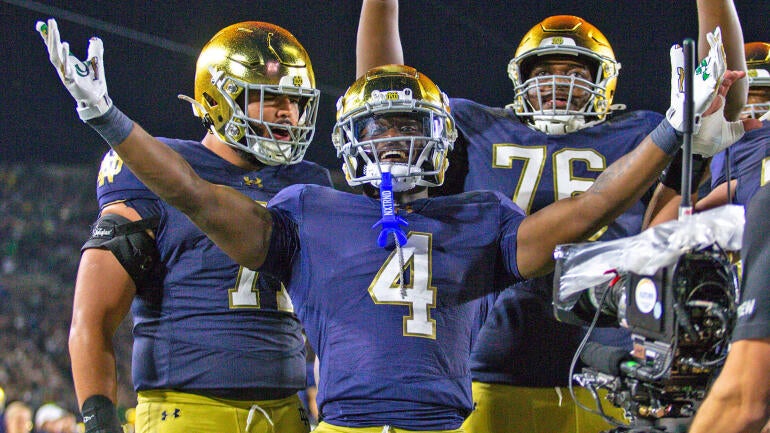
The NFL hasn't drafted a running back in the top five since Saquon Barkley went No. 2 overall in 2018. That draft marked the third-straight year where someone selected a running back in the top five, following Leonard Fournette and Ezekiel Elliott in 2017 and 2016, respectively. In the seven drafts since then, though, only two running backs were top-10 picks -- Bijan Robinson and Ashton Jeanty.
That dry spell could very easily end this year with Notre Dame's Jeremiyah Love. He's not only in the realm of prospects that have gone top-five historically, but it's also a relatively weak top of the class at the positions that historically go early. At such a hotly debated position in recent years, I steelmanned the arguments for and against franchises bucking the recent trend and selecting a running back.
For: The tape
The key here is not simply that Love is a special running back prospect. He is special in the exact ways that NFL offenses are evolving through trends. Every offense wants big-play potential at running back. Modern defenses are content letting bigger backs grind out short runs on them. What they don't want are chunk plays. With 4.36 speed, Love is a walking chunk play. Forty-four of his 433 career rushing attempts went for 15+ yards, and Love's 6.9 yards per carry are tied with Jeanty for the highest of any player with 300+ carries the past two seasons. Add to that a large catch radius, soft hands and stupidly good route-running ability. You have everything you could want in a modern back.
Be terrified. Because every awesome thing about Jeremiyah Love as a runner is also awesome as a downfield receiver.
— JetPack Galileo (@JetPackGalileo) March 27, 2026
Scratching the surface. pic.twitter.com/bzXXlrsUFu
Against: Positional value
We don't have to beat this dead horse too much, but it's worth repeating. In terms of the success of any given run play, the talent of the running back is often the third-most important variable. The called run vs. the defensive front and the quality of run blocking are both stronger predictors of a rushing play's success, historically. It's why over Barkley's tenure in New York, the Giants only ranked 12th in rushing Expected Points Added per play and 19th in rushing success rate. Obviously, the results would have been worse with a lesser back, but the data outside of that anecdote is clear that running backs struggle to make a running game on their own.
For: Two-high safeties
While the positional value argument above still holds, the pendulum is swinging back in favor of running backs in recent years for one big reason: 2-high shells becoming the norm. That shift caused a predictable reaction from offenses that only makes running backs more valuable.
What is the biggest scheme story in football right now, per Kevin Stefanski?
— Kevin Clark (@bykevinclark) April 3, 2026
"Immediately my mind goes to split safety zone. I give coach Fangio all the credit...it's putting an umbrella up on a lot of offensive schemes."
How has that changed offenses? This was AWESOME. pic.twitter.com/aKVi0yPSuf
NFL offenses ran the ball at the highest rate since 2011 (40.8%), had the highest rushing success rate on RB runs since 2004, used 2 or fewer WRs at the highest rate since 2014, and people will still tell you that how a Edge prospect defends the run doesn't matter.
— Nate Tice (@Nate_Tice) April 6, 2026
Precisely this is why I said Love was perfect for the modern game. Two-high shells don't make your offensive line better at run blocking, but they do present your running backs with more space. It's precisely the running backs that can thrive in space like Jahmyr Gibbs, Bijan Robinson and James Cook that are dominating throughout the NFL. Love very much belongs in the same conversations as guys like that.
Against: Contract cost
In the NFL, everyone must make the most with the same amount of dollars. With suppressed rookie contracts fixed by pick slot, certain positions represent larger "underpays" than others. For example, the No. 5 pick in last year's draft, Mason Graham, signed a four-year guaranteed deal at a $10.2 million per year average. That represents a difference of $21.55 million in savings versus the highest paid player at defensive tackle (Chris Jones). The next pick, Ashton Jeanty, signed a four-year guaranteed deal at $8.98 million a year. That represents a difference of only $11.62 million versus the highest-paid running back (Saquon Barkley). For $3 million more than Love will make this year if drafted in the top-five, a team could just sign Super Bowl MVP Kenneth Walker. That kind of option doesn't exist at other positions.
Here's where the top of the market stands for other positions across the NFL:
- Edge: Micah Parsons ($46.5m)
- Wide receiver: Jaxon Smith-Njigba ($42.15m)
- Defensive tackle: Chris Jones ($31.75m)
- Cornerback: Trent McDuffie ($31m)
- Offensive tackle: Laremy Tunsil ($30.1m)
Hitting on those more valuable positions represents massive cap savings in a way that hitting on a running back does not.
For: Intangibles
Love has pretty much everything you could want in this regard. Notre Dame coaches rave about his work ethic. He's said himself, you don't have to worry about him going out once he gets to the league - all he cares about is football. Oh, and he's not even 21 old yet. If you draft a running back in the top five, it's to be the face of your franchise and move jersey sales. This is exactly the kind of human being you want to do just that.
Against: Career Length
The shelf life of the pick represents the final argument against Love. Every top-five pick comes with the expectation that they become a franchise cornerstone. That means if they hit, you aren't even thinking about letting them hit free agency until their play starts to seriously deteriorate.
For running backs, unfortunately, that deterioration often comes a lot earlier than other positions. Over the past decade, only four backs went for 1,000 yards after turning 30. Only one went beyond 1,100 yards. Derrick Henry's past three seasons of 1,595 (2025), 1,921 (2024), and 1,167 (2023) are the insane outliers to this rule. You have to go back to 2009 to find a running back other than Henry to exceed 1,200 rushing yards after turning 30 (Thomas Jones).
Unless Love matches one of the freakiest running backs in NFL history, who's 30 pounds heavier than him, he's looking at approximately eight years of useful life in the NFL. Compare that to positions like offensive tackle or defensive end, where playing into their mid-30's is becoming the norm for top talents.
So, will it happen?
Yes. The stars are aligning between Love's high-end production, perfect fit for the modern game and re-emergence of running game value across the NFL. Love will be the first top-five pick at the position in eight years.