
The NCAA's new age-based eligibility rule, which will grant all Division I athletes five years to complete five seasons, will bring major changes to roster management in basketball and football over the years ahead. It's only the latest significant shift in the college sports landscape amid a period of upheaval for America's intercollegiate athletics enterprise.
Gone are medical redshirt years and traditional redshirt rules that allowed players to stick around for more than four years. Now, everyone will get five years, regardless of how many games they appear in during an injury-plagued or developmental season. This should help simplify roster math for coaches and eliminate abuses of the old redshirt system.
College basketball players won't be able to "shut it down" after seven games and take a medical redshirt year because of a twisted pinky, simply because they wish to preserve a season of eligibility and earnings potential. Similarly, college football players unhappy with their situations won't gain another season of eligibility as a redshirt by simply deciding to sit out after appearing in four games.
Everyone will be granted five years of eligibility to be completed within five years of high school graduation or an athlete's 19th birthday, whichever comes first. There will be limited exceptions for factors like religious missions, maternity leave and military service.
As with every major change in college sports, there is significant fallout for a variety of stakeholders. Here is our look at the winners and losers from the NCAA's new eligibility rules.
Winner: QBs who didn't redshirt
More time, more money for those who wait
For current college football players who didn't redshirt as true freshmen and are unlikely to be selected early in the NFL Draft, this is huge. It gives them an additional year of earnings power -- and a longer developmental runway -- that they weren't going to get after foregoing a redshirt year.
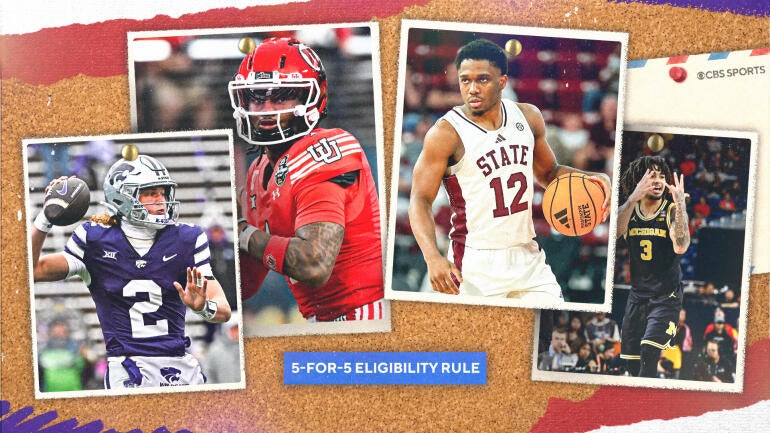
A handful of high-profile quarterbacks are among those set to benefit. Kansas State's Avery Johnson and Utah's Devon Dampier are examples of established Big 12 starters who were previously on track to play their final season in 2026. Now, they are eligible to play in 2027 as well.
Those are just two examples from a long list of quality quarterbacks who could stick around in college football for longer than previously expected, if they so choose.
College football’s QB market will be impacted significantly by the NCAA’s new 5 for 5 eligibility rule in the years ahead.
— David Cobb (@DavidWCobb) June 26, 2026
These guys, who did not redshirt as freshmen, now get an additional season they wouldn’t have been afforded under the old rules. pic.twitter.com/MSHhZFLZja
Loser: College basketball freshmen
A tougher climb for newcomers
The contributions of true freshmen dipped significantly in college basketball during the post-COVID years as veterans received extended eligibility, which made the sport older than ever before. That finally changed in the 2025-26 season as players with pandemic-era extended eligibility cycled out of the sport.
The upshot was that a highly talented high school Class of 2025 got the chance to shine. The group made a significant imprint on the sport, and college basketball was better for it. Even players from outside the top 100 of the 2025 class, such as Stanford's Ebuka Okorie and Illinois' Keaton Wagler, made huge impacts on the high-major level and were subsequently selected in the first round of the 2026 NBA Draft.
Moving forward, that won't be the norm. For one thing, the high school classes of 2026 and 2027 don't have the star power that defined the Class of 2025. Additionally, there won't be as much room on high-major rosters for freshmen to make an impact. Expect coaches to prioritize recruiting fourth- and fifth-year players via the transfer portal over freshmen.
Winner: Football coaches can do less math
The end of redshirt gamesmanship
The old rule allowing football players to appear in up to four regular-season games while redshirting led to complications for coaches. Often, players would be hesitant to burn their redshirt by appearing in a fifth game because doing so would cost them a season of pay and development.
In other situations, key players unhappy with their playing time or compensation would choose to "shut things down" after appearing in four games in order to preserve a season of eligibility that they would often use elsewhere.

Managing the unintended consequences of the four-game redshirt rule often meant navigating thorny dynamics in the middle of the season for coaches. It will all be much simpler now. It doesn't matter how many games you appear in during the course of a season; it will be one of the five you are allowed. This will make roster math a bit simpler for the coaches and general managers.
Loser: Classes of 2021 and 2022
Players caught between two NCAA rules
Anyone who was on a roster during the 2020-21 season, which included the high school Class of 2020, got a bonus year due to the pandemic. Now, anyone from the Class of 2022 or after will get five years because of the rule change.
But the classes of 2021 and 2022 only got to play four non-redshirt seasons. They came too late to benefit from the extended eligibility granted during the pandemic but too early to benefit from the new eligibility rule.
This is why players from the Class of 2022 on the basketball side are mounting legal challenges to the rule. They are arguing that it should apply retroactively to players who exhausted their eligibility in 2026. If they gain traction in court, it could open the door for dozens -- maybe even hundreds -- of seniors from the 2025-26 season to run it back in 2026-27.
Loser: 2027 NFL Draft depth
College football keeps its stars
A significant chunk of college football seniors in 2026 are players who redshirted and will be playing their fifth and final year. They will be forced to exit college football after the upcoming season and should ensure a baseline level of talent in the 2027 NFL Draft.
But the depth of the 2027 NFL Draft will take a hit because of this new rule.
There are now a ton of fourth-year seniors who could return to college football for a fifth season in 2027 because of the change. This will almost certainly weaken the 2027 NFL Draft pool, especially on the second and third days.
We covered the quarterbacks above. But take BYU running back LJ Martin, for example. He covered 1,305 yards on the ground as a junior last season and caught 36 passes. Despite being draft-eligible, Martin opted to return for his senior season in 2026. He could theoretically now make the same decision yet again in 2027 because of this new rule. That would be great for BYU, but less great for an NFL franchise seeking a quality running back on Day 3 of the NFL Draft. The same applies to Miami's Mark Fletcher Jr., among others. If sticking around in college football for 2027 is financially appealing to this year's crop of fourth-year seniors, they now have that option.
High-end receivers such as Duce Robinson (Florida State), Nyck Harbor (South Carolina), Eric Singleton (Florida) and Amare Thomas (Houston) also fall under the same umbrella. They will be fourth-year seniors in 2026 and could now choose to play in 2027. There is a chunk of NFL Draft prospects at every position group who could take advantage of a fifth year. If they do, it will leave the 2027 NFL Draft noticeably light on depth.
Loser: 2027 NBA Draft depth
The second-round squeeze's impact
The same dynamics will be at work in basketball, where the 2027 NBA Draft is already expected to be light at the top. Now, it could end up being light at the bottom. Most players who were expected to be in their final seasons of eligibility in 2026-27 will now be able to return for a fifth year in 2027-28. If their options are to be compensated well to play another year of college basketball or to fight for a two-way contract as a second-round pick in the draft, many will spurn the draft.
In 2026, the draft's second round was filled with college players who had exhausted their eligibility and had no choice but to enter the draft pool. Take Purdue stars Braden Smith and Trey Kaufman-Renn, for example. They could have easily cleared seven figures in college basketball if eligible for 2026-27. But they exhausted their eligibility after four years. They were automatically entered into the NBA Draft and will be fighting hard to establish themselves in the league after getting taken in the second round.
Players in their fourth seasons in 2026-27 won't be forced into the draft. Could Michigan get Elliot Cadeau back in 2027-28? What about Duke's John Blackwell or Kentucky's Milan Momcilovic? They are big-time college talents who could choose to stick around, thus weakening the depth of an already suspect 2027 draft pool.
Winner: The upcoming portal cycles
Stronger transfer classes ahead in both sports
By contrast, the upcoming transfer portal cycles will be stronger. Players who would have exhausted their eligibility under the old rules will have an additional season to maximize their potential for playing time and NIL earnings. Ultimately, many of them will choose to do so via the portal. While the depth of upcoming drafts might suffer, the depth of the 2027 portal should only improve, leading to strong "free agent" classes in both basketball and football during the offseasons ahead.