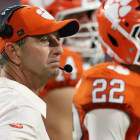


Dabo Swinney has every reason to be proud of what he has built at Clemson, even if the trajectory has leveled off in recent years. The Tigers peaked in 2019 after a fourth national championship game appearance in a five-year span that cemented them as one of the sport's premier programs.
Since then, Clemson's performance has been more uneven -- flashes of elite play mixed with stretches that fall short of that standard. And after last year's abrupt letdown, Clemson enters the 2026 season outside the national spotlight.
Swinney says the lack of attention suits his program. After all, this is a group that has often played catch-up in the NIL era, operating with fewer resources than some of its biggest competitors.
"At Clemson, we always have to have a chip on our shoulder," Swinney said during an interview with ESPN this week. "It just is what it is, we don't have the same alumni base that some places have, we don't have some of things that some of the things that some of the schools have that we've played over the years. That's just the way it is.
"We're 3-1 against Ohio State. We're 4-2 against Notre Dame. I mean, Notre Dame has their own TV station. They make their own rules. They print their own money. They got like their own money machine in the backyard or something."
Swinney's Tigers are outside the top 20 of most preseason rankings following spring practice, largely due to personnel losses after tying a school record with nine NFL draft picks last month. Miami, SMU and Louisville all have better odds to win the ACC after reloading in the transfer portal.
There is a different feel around Clemson this offseason -- and that appears to be intentional for Swinney. No preseason hype, no national playoff expectations, just a program trying to rediscover the edge that once made it a college football standard-bearer.
"It's not about what people write," Swinney said. "It's not about what people are predicting. If it was about those things, we would've won the national championship last year. And if it was about those things, I would've been gone 15 years ago. It's just about what you do. The work you do, and you start over every year. We're a developmental team."
Clemson falling behind in NIL era
Swinney enters his 18th season with the Tigers as the ACC's active leader in wins (41) and winning percentage (.594) against top-25 teams. However, he has not won a playoff game since 2019 and has little postseason success to show beyond three conference championship appearances during that time.
Clemson's 7-6 finish last fall was the program's worst under Swinney in 15 years and left the Tigers unranked after opening the season as a national championship contender.
Swinney's recruiting edge has also slipped by program standards. The Tigers' 2027 class currently has seven verbal commitments and ranks 31st nationally, according to 247Sports, which would be Clemson's lowest mark under Swinney since 2009, his first full season.
"The more things change the more they stay the same," Swinney said. "Now, it is just different (in how it is done). We do not have the same NIL budget as some places have. We do not have some of the same built-in resources from an alumni base and all of that type of stuff.
"We don't, but guess what? We never have. But you know what we do have? We have enough. We got enough. We just have to be good with what we have."
Clemson's dip under Swinney is not about a sudden collapse in capability -- it is about the standard he established now working against him. The program once lived in the playoff conversation annually, signed elite recruiting classes and developed quarterbacks who consistently performed at the highest level.
That version of Clemson has not shown up consistently in recent years.
The issues begin on offense. Quarterback play has been inconsistent, explosive plays have declined and the Tigers have not fully adjusted to a more wide-open, transfer portal-driven era.
The talent gap has narrowed, and the on-field effects are showing in the ACC. In an NIL-driven landscape, Clemson is not matching the spending of SEC and Big Ten powers, and even a few ACC programs are investing more in roster construction each offseason.
Dabo Swinney's record at Clemson by year
| Year | Overall | Conference | ACC finish | Bowl/Playoffs | Final AP ranking |
|---|---|---|---|---|---|
| 2008 | 4–3 | 3–2 | T–3rd (Atlantic) | L Gator | — |
| 2009 | 9–5 | 6–2 | 1st (Atlantic) | W Music City | 24 |
| 2010 | 6–7 | 4–4 | T–4th (Atlantic) | L Meineke Car Care | — |
| 2011 | 10–4 | 6–2 | 1st (Atlantic) | L Orange† | 22 |
| 2012 | 11–2 | 7–1 | T–1st (Atlantic) | W Chick-fil-A | 11 |
| 2013 | 11–2 | 7–1 | 2nd (Atlantic) | W Orange† | 8 |
| 2014 | 10–3 | 6–2 | 2nd (Atlantic) | W Russell Athletic | 15 |
| 2015 | 14–1 | 8–0 | 1st (Atlantic) | W Orange†, L CFP NCG† | 2 |
| 2016 | 14–1 | 7–1 | 1st (Atlantic) | W Fiesta†, W CFP NCG† | 1 |
| 2017 | 12–2 | 7–1 | 1st (Atlantic) | L Sugar† | 4 |
| 2018 | 15–0 | 8–0 | 1st (Atlantic) | W Cotton†, W CFP NCG† | 1 |
| 2019 | 14–1 | 8–0 | 1st (Atlantic) | W Fiesta†, L CFP NCG† | 2 |
| 2020 | 10–2 | 7–1 | 2nd | L Sugar† | 3 |
| 2021 | 10–3 | 6–2 | T–2nd (Atlantic) | W Cheez-It | 14 |
| 2022 | 11–3 | 8–0 | 1st (Atlantic) | L Orange† | 13 |
| 2023 | 9–4 | 4–4 | T–6th | W Gator | 20 |
| 2024 | 10–4 | 7–1 | 2nd | L CFP First Round† | 14 |
| 2025 | 7–6 | 4–4 | T–7th | L Pinstripe | — |
Clemson recruiting class ranking since 2015
According to 247Sports
| Year | Recruiting Class Rank |
|---|---|
| 2015 | 9 |
| 2016 | 11 |
| 2017 | 16 |
| 2018 | 7 |
| 2019 | 12 |
| 2020 | 3 |
| 2021 | 5 |
| 2022 | 14 |
| 2023 | 15 |
| 2024 | 15 |
| 2025 | 28 |
| 2026 | 26 |
What happens next?
Despite a slip in talent acquisition, the Tigers' roster still has pieces. It starts with a defense that projects as one of the ACC's most reliable units, led by linebacker Sammy Brown and experienced reinforcements in the secondary. Clemson's defensive identity -- length, speed and a disruptive front -- remains intact.
The bigger questions are again on offense. Will the return of offensive coordinator Chad Morris -- the man who led the Clemson offense through its glory days -- bring back the swagger and scheme advantage that led the Tigers to success in the 2010s? Can first-year starting quarterback Christopher Vizzina emerge as a difference-maker? Can receivers T.J. Moore and Bryant Wesco Jr. stretch defenses and help push the offense back into national relevance?
Swinney's approach remains the central storyline. Clemson has been slower than most programs to fully embrace the transfer portal, choosing instead to build through high school recruiting and internal development. That model worked during the program's peak, but the margin for error is now much thinner in an NIL era where rosters can change quickly.
Swinney's track record suggests a rebound is possible in 2026, but the formula that built Clemson into a powerhouse is being tested like never before.