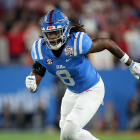


Jersey patches and advertisements are coming to even the most traditional uniforms in college football. You can take that to the bank.
Literally.
Ohio State announced Tuesday that it struck a partnership with JPMorganChase to place a circle Chase Bank logo on the jerseys of all 36 Buckeyes varsity sports. It's a landmark deal reportedly worth $ 15 million-plus a year, according to Yahoo Sports, easily the most lucrative sponsorship announced this year in the wake of an NCAA rule change that permitted on-uniform advertisements.
The Buckeyes didn't need to create a new revenue stream. They wanted one -- which is what makes Tuesday's announcement so significant. If even one of the richest brands in college football is willing to sell space on its jersey, then there's no sacred space remaining as teams battle with the economic reality of modern college athletics.
Jersey patches are a somewhat uncomfortable yet understandable way for cash-strapped schools to generate revenue. In just a few short years, the cost to fund a premier college football team has jumped from around $10 million to $35 or $40 million. Basketball teams have experienced the same explosive, unsustainable growth in expenditure. Rev share and NIL demands have seeped into other sports, too.
That's why the Big 12 chasing $20 million from Monster -- a widely mocked partnership -- makes some sense. The Big 12's revenue is dwarfed annually by the Big Ten's. It needs to generate as much additional cash flow as it can to stay competitive.
This is a want, not a need
Ohio State, on the other hand, did not need to chase -- pun intended -- more money.
The Buckeyes are arguably the most valuable college athletics brand. They generated a record-setting $336 million in revenue during the 2025 fiscal year, shattering the program's $280 million high-water mark.
Nobody, perhaps outside of Texas, is richer and better positioned to thrive during this money-first era of college athletics.
Ohio State's scarlet, gray and white jersey combinations are an iconic piece of college football lore. They're the paint on the canvas of history: Eddie George runs, helmet stickers and November matchups with Michigan.
Now they're also a vehicle for selling you a credit card.
The patch is a reminder of what college athletics has become. Schools spent decades relying on unpaid athletes to subsidize lavish facilities and ballooning coaching salaries. Now that players are finally sharing in the revenue, every new dollar seems to be worth chasing.
What's disappointing is that Ohio State could have been a holdout. It could keep the idea up that, at least for 60 minutes on Saturdays, some things about the sport are untouchable.
Buckeyes athletic director Ross Bjork would surely push back on that idea. He'd point out that despite $336 million in revenue, the program generated only $16 million in profit. He'd likely argue that he's not breaking tradition; he's just embracing what's necessary in the sport's current landscape. He'd say the Buckeyes partnered with a local brand and added the patches in a tasteful way.
But Ohio State still didn't have to go this direction.
Of course, it could use an extra $15 million a year. Every athletic department could. But Ohio State didn't need it. The Buckeyes are one of the few college athletic programs capable of chasing a national title without selling space on their uniforms.
The latest blow to tradition
As of the spring, Alabama wasn't planning to add advertisements to its jerseys, per a source. Penn State and Florida were entertaining the idea but hadn't moved yet. In February, Texas athletic director Chris Del Conte said of the idea of placing an advertisement on the Longhorns' uniforms: "Why would I want to put Sonic on my jersey?"
And if Texas can afford to keep an advertisement off its jerseys, Ohio State can too.
That's the thing about the current era of college athletics -- tradition isn't worth much. Adding $15 million a year to Ohio State's coffers allows it to maintain its edge, history be damned.
The Chase Bank logo won't alter Ohio State's ability to beat Michigan. It won't affect the Buckeyes' championship push. After a time, the logo will likely fade into obscurity for most fans.
That's almost the point.
College football's slow transformation hasn't happened at once. It's been one compromise or forced change after another. It's an extra TV timeout. It's another round of realignment as teams chase a few extra million a year.
On Tuesday, Ohio State peddled a few inches of fabric.
What it sold was the idea that anything is off limits in modern college athletics.