Attention Fantasy Football managers: Senior Bowl spotlight on Mike Washington Jr., Malachi Fields, more
Dave Richard breaks down the key Fantasy takeaways from the Senior Bowl

The 2026 rookie class is phenomenal – if you play in IDP leagues.
Defenses dominated the week's Senior Bowl practices, leaving offensive highlights fairly sparing by comparison. It meant for an underwhelming week, which may very well be par for the course in a draft cycle where people across the league believe that there is far more talent on defense than on offense, especially among skill-position players.
Last year there were 17 rookies taken within the first 12 rounds of redraft leagues according to CBS Sports Average Draft Position. Of the 17, five averaged a selection within the first six rounds.
Expect those numbers to slide a little bit with the 2026 class. Simply put, the talent pool isn't as deep, and it would be criminal to try and sell you on this year's rookie class as if it were as rich as last year's.
That being said, there were some skill-position players who differentiated themselves through the Senior Bowl practices. Don't think of them as rising to the point where they'll be first-rounders, but rather rising above the average-level prospects. They'll have a chance to be good for Fantasy if they can find the right spot – which is always the case but especially important this year given the lack of high-level talent.
Here's a look at the players who stood out during the week – strictly based on what I saw this week and not taking into account anything they or anyone else did during the college season.
Quarterbacks
Cole Payton, North Dakota State: I thought Payton was the most accurate and anticipatory thrower all week who also made a handful of off-schedule plays. Not until the third practice did he start showing some flaws in his passing, and even then he still made some quality throws. He was known just as much for his rushing as his passing playing at the FCS level but really let his arm do the talking this week. That's a good thing since both factors can eventually make him a potential Fantasy option when and if he gets the chance to play.
How about the southpaw North Dakota State QB Cole Payton getting his hips and feet right on this throw rolling to the right!? Excited to see him compete today. #TheDraftStartsInMobile pic.twitter.com/adQbSTZ2jG
— Steve Muench (@yougoodmuench) January 28, 2026
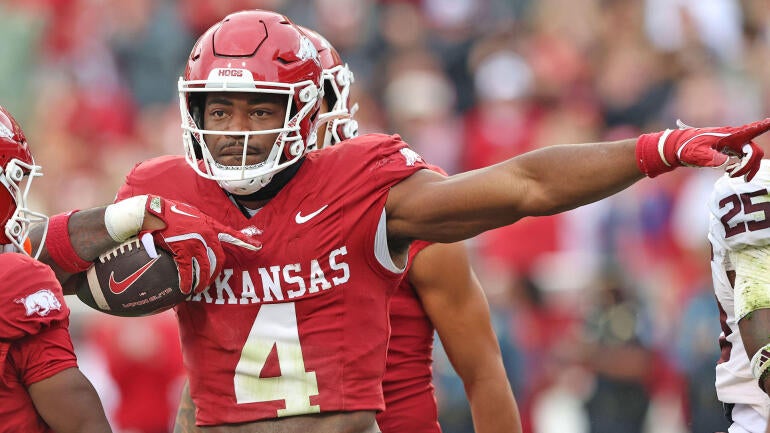
Taylen Green, Arkansas: Green is tall, lanky and lean with a big arm and real good mobility. As project-QBs go he's great, but he doesn't have the consistency needed to be an NFL starter anytime soon. A team will draft him for his traits and put him on a pathway to be a starter in a year or so if he improves. Fantasy managers can hope for such a thing because if he does then his aggressive throwing and rushing combo will yield some nice stats.
This is just one of the reasons why Taylen Green is my favorite mid-round QB target of 2026. I can't find the video, but two plays later, he sprinted through the entire defense for a 30+ yard gain.
— Matt Infante (@MattInfante) January 29, 2026
Raw but a skill set that should make NFL teams drool.pic.twitter.com/l0t355y5HZ
Running backs
Mike Washington Jr., Arkansas: It was Washington's acceleration that separated him from the rest of a decent running back group. That quick speed will translate to the pro game, and his thicker-than-most frame will create problems for defenses that can't wrap him up at first contact. Washington's receiving skills were also on display throughout the week and even his pass protection wasn't bad (he told CBS Sports he was working on it for the combine). If there was a RB in Mobile who had a chance to be a three-down player at some point before the end of next season, it would be Washington.
#Arkansas RB, Mike Washington Jr. has had eye-opening reps at 6'0 1/2", 228 lbs.
— IanM (@IannmNFL) January 30, 2026
When he gets going I sure as hell don't think tackling him looks fun, he's ran some routes that completely lose the linebacker and the hands were under the spotlight too! pic.twitter.com/aIdkuJYOIW
Kaytron Allen, Penn State: I like Allen for his one-cut downhill running style and good speed. He can run with physicality, and he's not a finished product in pass protection but he's not bad at all. I wouldn't be surprised if he began his career getting around eight touches per game.
Kaytron Allen vision and burst on full display during the @seniorbowl #WeAre
— White Out Weekly (@whiteoutweekly) January 30, 2026
pic.twitter.com/Rifi0j9UaU
Wide receivers
Malachi Fields, Notre Dame: Tall and rangy with good footwork, Fields could compete for maybe a 50% route participation rate right away. His ball tracking skills were great and he had this nuance in his technique to know just how to separate from coverage at just the right time to make a catch. He won't win a lot of races with pure speed but that's to be expected from someone as big as he is.
This rep to end practice says a lot about Malachi Fields. Most 6’4” guys will try to go over the top of someone on a nine ball. Fields? 12-yard dig and showcase his ability to snap it off at that size.
— Ryan Fowler (@_RyanFowler_) January 28, 2026
Another excellent day for the Notre Dame product. pic.twitter.com/M5m51yG6Uf
Josh Cameron, Baylor: Cameron might have been the most versatile receiver at the Senior Bowl. He had the speed to blow past coverage, the quick feet to change directions and separate by a yard or two at will, the eyeballs to track downfield throws properly, the ability to adjust his body to off-target throws and the hands to reel them in. Built in the mold of A.J. Brown and Anquan Boldin, Cameron has the traits teams look for when they need a real good complementary receiver, but he might have just enough to become a No. 1 someday.
#Baylor receiver, Josh Cameron got BUSY on day 2 of the Senior Bowl!
— IanM (@IannmNFL) January 30, 2026
After a good Day 1, Day 2 was even better for Josh! He's carrying 223 lbs around and is making separation with the deep cuts and physical playstyle! Josh's got traits, good hands and surprising finesse! pic.twitter.com/At9emJZsaK
Caleb Douglas, Texas Tech: A little leaner than most would want from a 6-foot-3 receiver, but that lack of weight is what gives him a little more speed compared to other big men. I thought he had some real good hands and flashed some explosiveness in his breaks at times.
Biggest play of the first team session for the national roster at the Senior Bowl.
— Christopher Carter (@CarterCritiques) January 27, 2026
North Dakota State QB Cole Payton connects on a deep ball to Texas Tech WR Caleb Douglas over San Diego State CB Chris Johnson: pic.twitter.com/Zhxke4q7v8
Tyren Montgomery, John Carroll: Not the biggest guy and certainly not the most experienced receiver considering he played in Division III, but Montgomery put himself on the radar with a solid week's worth of work. The top trait was his footwork, be it off the snap or at the top of his route to get himself open. He had the speed and route discipline to beat FBS-level cornerbacks on several occasions. And Montgomery still has more room to grow – he's only been playing football for two years!
One big standout from day one of the Senior Bowl 🔥
— A to Z Sports (@AtoZSportsNFL) January 28, 2026
D3 WR Tyren Montgomery from John Caroll https://t.co/QpXwCz7iyf pic.twitter.com/JHVSsFa8ZU
Tight ends
Tanner Koziol, Houston: This is the only tight end who flashed over multiple practices. He leaped high for a pass in the back corner of the end zone and otherwise was that sweet combination of sure-handed and physical. You won't see big-time speed, but his size and hands make him a differentiator compared to the rest of the class.
Houston TE Tanner Koziol climbing the ladder for a TD to end National Team practices here at the Senior Bowl.
— Faraz Siddiqi (@farazsiddiqi) January 30, 2026
He has to be rising up NFL draft boards. pic.twitter.com/itQBOM9d5Z
Nate Boerkircher, Texas A&M: Great size, good technique and really good concentration was always a part of his game at school, but it took the Senior Bowl for him to show it often enough in practice and prove he can be a good receiving threat.
Final rep of the competition period for the National team: #TexasAM TE Nate Boerkircher makes the contested grab over #Pitt LB Kyle Louis pic.twitter.com/plowK0qdL4
— JP Acosta (@acosta32_jp) January 28, 2026