

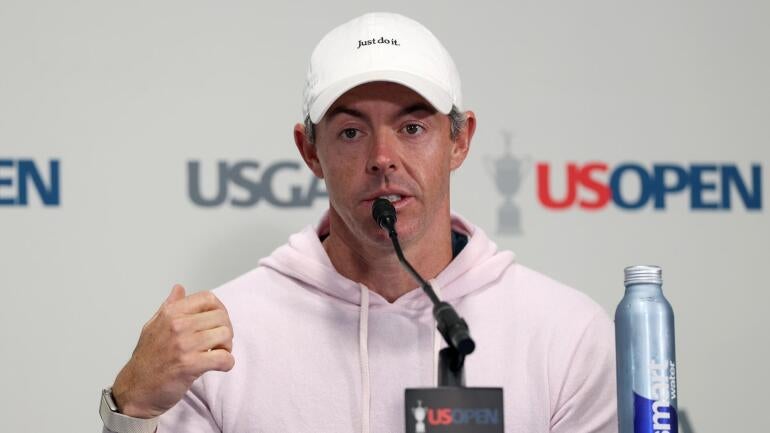
Rory McIlroy met with the assembled media at Shinnecock Hills Golf Club on Tuesday ahead of the 2026 U.S. Open, where he'll look to capture his second U.S. Open title and move into the top 10 all-time with seven major championships. As McIlroy has gotten older and become the game's most prominent voice, his press conferences have expanded to no longer be just about the tournament ahead, but to get McIlroy's thoughts on the state of the game overall.
The U.S. Open is the first major since the PGA Tour announced its planned schedule for the 2027 season, with even bigger changes in the works for 2028, as they set their sights on a two-track system. Tuesday provided a chance for McIlroy to provide his thoughts on the Tour's upcoming plans. He voiced some of his concern about how the events in each track will be chosen and also noted that with LIV Golf seemingly crumbling, the Tour might want to reconsider the "false economy" of huge purses their rivals created.
"An event like last week, the Canadian Open potentially going to one of these Track 2s -- and Track 2 is a glorified Korn Ferry event, that's just what Track 2 is going to be. So I don't think the Canadian Open should be one of those, and I just think there's going to be certain events that lose their stature if their sponsor doesn't pony up $30 million," McIlroy said. "So that's the tough thing. But, I'm not in those rooms. I don't know. I play my schedule and I'll continue to play my schedule -- which is getting less and less as the years go on.

"But yeah, it's funny, I think as they've done all this work you start to realize the way the Tour was before LIV came along was actually pretty good. It was a pretty good structure and everything worked pretty well. LIV created this false economy where we had to up prize funds and had to cut fields and try to support top players and all of that -- which I think needed to happen because that was the only way to retain talent at the time -- but now that LIV looks like it's less of a threat, I think as I said that the old ways of the PGA Tour weren't actually that bad."
Signature events with $20 million purses were a direct response to what LIV Golf was paying out for its events. Now that LIV no longer presents the same threat, it's fair to wonder if a market correction is coming for tournament purses to a more sustainable level. The PGA Tour has insisted the appetite for sponsorship is strong enough to keep purses where they are going forward -- and potentially grow them in the future -- but McIlroy suggests that might not be wise for the long-term success of the Tour.
His concern about the two-track system seems to be that events rich in tradition and history could be dropped to the second track in favor of those with bigger corporate backing. While sponsorship support has always been important for PGA Tour events to remain on the schedule and be successful, there is something lost in a sport where history is so important if you start knocking traditional events down to replace them with something that pays out more.
McIlroy has been vocal in recent years about how important he views national opens -- and not just the two that have become major championships. While he didn't play this year with the shift in the schedule, he's a past winner at the Canadian Open and recently made his first trip in more than a decade to play at the Australian Open -- and is committed to do so again next year, with the PGA Tour set to be a partner with Golf Australia and the DP World Tour starting in 2027 to help grow that event.
Part of the PGA Tour's push to retain players during the height of the battle between the tours was that LIV Golf could pay players all they wanted, but there you can't manufacture importance or the weight of tradition. That proved to be true, but McIlroy seems concerned the PGA Tour might not have fully learned that lesson and make their own pursuit of a short-term windfall to keep the money flowing.