What to make of TGL as Tiger Woods and Rory McIlroy's simulator golf league enters its second season
TGL faces a prove-it second season with questions lingering and some stars missing

•
3 min read
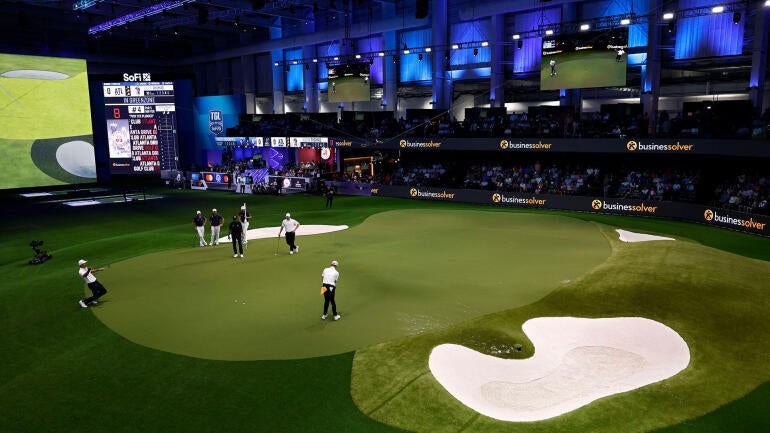
Will the bubble pop on TGL in Season 2, or is this just the beginning for a new phase of professional golf? Many are wondering whether the indoor simulator league helmed by Tiger Woods and Rory McIlroy has legitimate staying power amid massive investments from sports team owners and investors and an inaugural campaign that started slow but finished with a flash.
As we have seen in recent years, when it comes to these fresh golf ventures, answers are not truly revealed until the shine and initial excitement wears off and the core product reveals itself.
There were bumps in the road throughout the first campaign, but to TGL's credit, it not only made modifications in the middle of the season but in the offseason before its second opportunity to capture an audience. Keeping short attention spans focused on the faster-paced simulator golf matches was key, the goal being to keep the product as shiny as possible.
Golf course architects were brought in to design new holes. Now, each of the six teams possesses a hole specifically tailored to their roster with a nod to each city: New York, Los Angeles, Boston, San Francisco, Atlanta and Jupiter, Florida. Some of them are fun - seriously fun -- but more than cool hole designs are needed for TGL to succeed.
🚨 NEW HOLE DESIGN JUST DROPPED 🚨
— TGL (@TGL) December 17, 2025
Cenote | Par 3 | 259 yards
Taking its name from the natural limestone sinkholes of the Yucatán Peninsula, prepare for one of TGL’s most dramatic challenges in Cenote.
Designed by @pizagolf, Cenote (suh-know-tay) is the ultimate match-play… pic.twitter.com/4l1hOBGi0r
The gameplay must improve, and again, to TGL's credit, changes have been implemented to that end as well.
In the middle of the first season, TGL altered the hammer rule so that each team has three available to use throughout the match. (The original rule gave the hammer to one team, allowing them to use it and lose it.)
The simulator technology had its issues in Season 1, and those problems are unlikely to be resolved soon, given the partnership between the company and a certain league founder.
The green complex has been reimagined: It is bigger, boasts more potential hole locations, and the turf around the green is all down grain so that players face conditions more conducive for cool, nippy, spinny shots that will make fans vocalize their excitement when pulled off correctly.
Changes to the broadcast and general social media strategy have been apparent, too. A new TGL analyst -- former PGA Tour player and league consultant Roberto Castro -- will be added to the broadcast. Content partners include influencers. Podcasts and independent projects have churned out content promoting Season 2.
In-house viewing will be different, too. Fans in the SoFi Center will now be able to hear the dialogue between players, which was not mad epossible in Season 1.
None of this will matter much without the players making the golf more entertaining. It is those striking the shots and running around like chickens with their heads cut off who ultimately bear the weight of this venture.
Even then, there are some question marks.
Tiger Woods and Justin Thomas, two of the biggest names competing in TGL, will be sidelined for at least part of the season due to injuries. Woods' team, Jupiter Links, is rostered with zero players inside the top 100 of the Official World Golf Rankings: Tom Kim, Max Homa and Kevin Kisner.
Meanwhile, Billy Horschel, a spark plug for Atlanta Drive in the inaugural campaign, returns from an injury of his own. Sahith Theegala revealed that he hurt himself from playing in TGL last season.
If the players continue to take the unserious nature of the league seriously, then it should remain additive ... but that's probably all it can be.
After all, TGL is not aiming to replace legitimate competitive professional golf. It is not here to win over your fathers and grandfathers. It is here to be a sideshow, a slice of entertainment during a slow period in the sports calendar, targeted to a younger demographic.
That is a place where TGL can thrive. If it attempts to overextend itself and try to reimagine more than golf holes and the essence of the league, it may ultimately have the opposite effect.