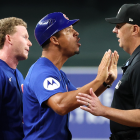


An egregious missed call cost the Cubs a run in a game they ended up losing, 2-0, to the Diamondbacks on Wednesday. At the time of the umpiring mistake, it was 0-0 in the sixth and the correct call would have given the Cubs a 1-0 lead.
To set the scene, Cubs leadoff man Pete Crow-Armstrong doubled to lead off the sixth and moved to third on a groundout. He remained on third with two outs and Michael Busch at the plate. As D-backs starter Eduardo Rodriguez went to throw a pitch, Crow-Armstrong took off like he was going to steal home. Crow-Armstrong's movement toward home appeared to fluster the All-Star pitcher, who was in the windup rather than the stretch.
Rodriguez, during the course of his windup, clearly stepped backward off the pitching rubber and then still proceeded to throw the pitch to the plate.
Here’s a video of the incident ⬇️ pic.twitter.com/K0GyAuBARn https://t.co/FzXwkyr61T
— Jacob Zanolla (@jacobzanolla) August 26, 2026
It was called a ball and treated like a pitchout. The umpiring crew got together to discuss the play and home plate umpire Alfonso Márquez even announced over the loudspeaker that the crew "determined it is not a balk."
Crow-Armstrong was livid at the turn of events and had to be held back by third base coach Quintin Berry.
Bit of confusion in the 6th w/ #PCA on 3rd and 2 outs. All #Cubs involved thought a balk was incurred as Pete started towards home. Looked like Eduardo Rodriguez stepped off the rubber, however briefly, before the pitch.@Cubs #GoCubsGo #Dbacks pic.twitter.com/EtdpVzf30m
— Billy Krumb (@ClubhouseCancer) August 26, 2026
After the game, Márquez acknowledged to a pool reporter that they got it wrong.
"We just didn't see it. After looking at the video (postgame), it looked like he stepped off," Márquez said (via the Chicago Tribune).
"I saw four umpires miss a pretty obvious play," Crow-Armstrong said after the game (via Marquee Network). "They're out there every day just like we are. Their one job is to get calls right and if they get it wrong, they're supposed to talk about it, figure it out and get it right. And they didn't."
Crow-Armstrong said he understands how Márquez, the home plate umpire, could miss the call based on his vantage point. But for the others, he was not as forgiving.
"I don't know how you miss somebody starting their motion and then stopping it and stepping off," Crow-Armstrong said. "I just don't know."
"They flat out missed it," said Cubs manager Craig Counsell (via Marquee Network). "It's obvious to everybody on TV, it's obvious to anybody, they missed it. I don't even know what to say. It's hard to argue when they just flat out miss it. The umpires said he did not disengage from the rubber. He disengaged from the rubber in his windup. Tough call for the home plate and second base umpire; easy call for the first and third base umpire."
Here's how it's described in the rulebook, via Rule 5.07(a)(1):
The pitcher shall stand facing the batter, his pivot foot in contact with the pitcher's plate and the other foot free. From this position any natural movement associated with his delivery of the ball to the batter commits him to the pitch without interruption or alteration. He shall not raise either foot from the ground, except that in his actual delivery of the ball to the batter, he may take one step backward, and one step forward with his free foot.
Further, the Rule 5.07(a) comment says:
The pitcher may not take a second step toward home plate with either foot or otherwise reset his pivot foot in his delivery of the pitch. If there is a runner, or runners, on base it is a balk under Rule 6.02(a); if the bases are unoccupied it should be treated as an illegal pitch under Rule 6.02(b).
Since the runner was on third base in a 0-0 game, said runner -- Crow-Armstrong -- should've been awarded home plate and the Cubs should have grabbed a 1-0 lead. The Diamondbacks did go on to win 2-0, but a 1-0 Cubs lead in the sixth changes everything that comes after.