
Bam Adebayo's 83-point game may have laid the blueprint for someone to challenge Wilt Chamberlain's 100
A player needs five things to make a real run at 100 points

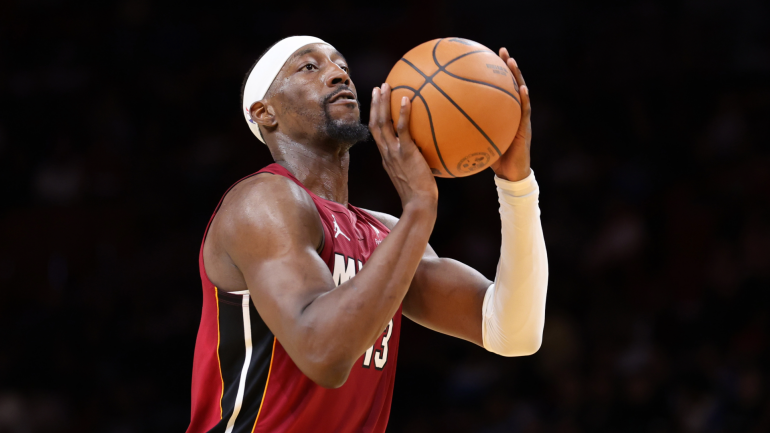
In theory, Bam Adebayo is about as surprising an 83-point scorer as the NBA could realistically produce. He has never been among the NBA's top 40 per-game scorers and his career high entering Tuesday's bout with the Washington Wizards was 41 points. Adebayo is a star. He's an Olympic gold medalist. He is not, at least on paper, Kobe Bryant or Wilt Chamberlain. Were you to rank players by how likely they were to score 83 points in a game prior to Tuesday, you may not have put Adebayo in the top 83.
But the truth about scouring outbursts of this magnitude is that they don't really come in normal basketball games. As Yahoo's Tom Haberstroh jokingly argued, you could apply asterisks to basically any 70-point game. No player has ever scored 70 points in a win over a team that finished the season with a winning record. Many of these games come under unusual circumstances. Say, a player chasing a scoring title on the last day of a season or, in Chamberlain and Adebayo's case, commitment from the teams in question to help the player push for as many points as possible. Even Bryant did some stat-padding in his 81-point game. He scored the last 22 Laker points. The last 17 of those points came with the Lakers leading by double-digits.
There's a reason we don't see 70-point playoff games. When the outcome genuinely matters between two good teams, none of the chicanery that leads to historic scoring comes into play. Basically, all 70-point games are a little fake. You could argue that Chamberlain's 100-point performance was the fakest of them all. In the fourth quarter, the Warriors removed all of their starters except for Chamberlain so their bench players could intentionally foul to help Chamberlain get more scoring possessions. According to Gary M. Pomerantz's book, "Wilt, 1962: The Night of 100 Points and the Dawn of a New Era," one of Chamberlain's teammates, Guy Rodgers, said at halftime, "Let's get the ball to Dip. Let's see how many he can get." Essentially, the Warriors played that game to see how many points Chamberlain could score.
From that perspective, Adebayo's 83 starts to make a bit more sense. Everyday scoring and single-game scoring are separate concepts. Predicting who might next challenge for a place in the history books isn't as simple as listing the NBA's best scorers. No, pushing for a night like Bryant's, Adebayo's or even Chamberlain's is largely circumstantial. You have to be a great player to do it, of course; that's just table stakes. It happened for Adebayo and not for Michael Jordan or LeBron James because the stars aligned for him in a way they didn't for those players.
And yet, the fact that Adebayo isn't Jordan or James or someone of that ilk but still managed to hit 83 points suggests that if the right player found himself in a situation similar to the one that Adebayo did, he could make a legitimate push for Chamberlain's 100 points. Adebayo, after all, became the first 70-point scorer to miss more shots than he made on Tuesday. He was just 2 of 14 from deep after the first quarter. If someone in Adebayo's shoes just made more shots, the all-time record could really be in play.
Essentially, this means that Adebayo laid the blueprint. If anyone is ever seriously going to challenge Chamberlain's records, they need five factors working in their favor.
1. You have to be perfectly conditioned
Conditioning isn't the first trait you tend to ascribe to star scorers, but it's the easiest connective tissue between Bryant, a guard, Adebayo, a forward-sized big, and Chamberlain, the biggest player in the NBA during his prime.
Remember, Chamberlain was a high school track star. He never played fewer than 42.3 minutes per game and in the year he scored 100 points; he actually averaged more minutes per game (48.5) than there are minutes in a regulation NBA game (48) because he spent more time playing in overtime than actually sitting on the bench. Bryant's maniacal work ethic and conditioning are well-documented, and Adebayo plays for a team that literally put "best conditioned" on its home court. Miami is famous for body fat tests and rigorous conditioning, and Adebayo is the face of modern Heat culture.
It takes a lot of shots to score 100, or even 80, points. By the fourth quarter, your legs are going to be gone. Even Chamberlain admitted that in Terry Pluto's book, "Tall Tales: The Glory Years of the NBA." "When I got into the 80s, I heard the fans yelling for 100. I thought, 'Man, these people are tough. Eighty isn't good enough. I'm tired.'" As if the exhaustion wasn't enough, think about how much harder defenses try to stop a player once he gets within sniffing distance of history. By the final minutes of Adebayo's 83-point game, the Wizards were double- and triple-teaming him off the ball just to try to prevent him from shooting. The outcome of the game didn't matter. Their whole goal was keeping him below 81 and avoiding becoming footnotes in his history.
It takes an exceptionally well-conditioned player to cross the 80-point threshold because it takes four quarters to get that many points, and the later points are substantially harder to come by than the earlier ones. But Bryant scored 55 second-half points in his 81-point game and Chamberlain scored 59 in his 100-point game. This was an essential component of Adebayo's outburst. He was in good enough shape not to fade down the stretch. He scored 43 points in the first half and 40 in the second.
2. You have to get hot from 3
Tuesday night's outburst wouldn't have been possible for most of Adebayo's career. After all, he made five 3-pointers in the first quarter. He made eight 3s in the first six years of his career, and fewer than half of his total 3-pointers have come this season. Now, Chamberlain didn't have the 3-point line when he went for 100, but he played in a different league. The average NBA team took around 108 shots per game in the season he scored 100 and averaged 50. Now, that figure is around 89. The league just isn't as fast as it used to be.
The benefit of shooting 3s isn't just inflating your point total, but doing so quickly. Remember, these enormous scoring outbursts are very often dependent on the player's team committing to inflating his total. A player is likelier to consciously push for 80 points if he has 30 after a quarter, as Adebayo did on Tuesday. He finished the first half with 43 points, making it the second-highest scoring first half ever behind the 44 points Karl-Anthony Towns scored in the first half of a 2024 game against the Hornets. In that first half, Towns made eight 3s. He just faded down the stretch, shooting just 7 of 18 from the floor. There were two other pertinent factors working against Towns that night, and we'll get into them in a bit.
Three 70-point scorers played before the 3-point line: Chamberlain, Elgin Baylor and David Thompson, who only reached 73 in pursuit of a scoring title. David Robinson played during the 3-point era, but rarely took 3s himself. Like Thompson, he was chasing a scoring title. Among the other 70-point scorers, everyone else made at least four 3s. Damian Lillard tops the list with 13. The formula here probably starts with someone like Lillard opening a game scorching hot from deep as Adebayo and Towns did. But that's only part of the equation.
3. You have to get to the line and make your free throws
Adebayo set the NBA record for both made free throws (36) and attempts (43) in his 83-point game. Chamberlain previously held the record for made free throws (28) in his 100-point game, and while Bryant wasn't quite as egregious in his free-throw total when he reached 81, he notably made 12 free throws in the fourth quarter against the Raptors. His last seven points all came at the line.
This ties back in with conditioning. Any player chasing a historical scoring mark is going to be exhausted by the time the fourth quarter arrives. Free throws are the least physically demanding points an NBA player can score. It just isn't reasonable to expect a player to score his 80th point breaking down a defender off of the dribble and then dunking over two help-defenders in traffic.
Those late points are far likelier to look like Adebayo's did: multiple defenders draped all over him, making it far harder to actually get the ball, but seemingly easier to draw a whistle once you've done so. For all of the bellyaching over Adebayo's free-throw total, no one is arguing that the fouls themselves were illegitimate. That's what happens when you defend so desperately. Players make mistakes. They make unnecessary contact that draws whistles. Referees are human. Someone with 76 points is going to get all of the 50-50 calls.
You need to make a lot of 3s to get to the point where your team commits to boosting your point total... but once you're there, your primary mode of offense is probably going to be free throws. This is one of the factors that doomed Towns' push for history. He got to the line 12 times in the first half, but only twice in the second. Without those easy shots, he ran out of gas and topped out at 62 points. The other thing working against Towns? His team was trying to win the game.
4. You need the perfect opponent
These games almost universally come against bad teams. The 1962 Knicks won 29 games. The 2006 Raptors won 27. The Wizards are 16-48 and actively tanking. Starting center Alex Sarr, the team's best player, defended Adebayo early but called it a game after 20 minutes. The Wizards have allowed 126 points per 100 possessions during their current nine-game losing streak. You may not have predicted Adebayo would be the one to score 83 points in a game this season, but if you were drafting teams it might happen against, Washington may have been your first choice.
It would be easy to just say that a game like this needs to happen against a terrible team that's in the middle of a tank, but it's a bit more complicated. For starters, the NBA has given every indication that it is going to make rule changes that curb tanking next season. Yes, there will always be bad teams in the NBA, but with less of an incentive to tank, there may not frequently be teams as bad as the Wizards are right now.
And then there's the fear of beating them too badly. The margin between the Heat and Wizards was perfect. Miami led by 11 after one quarter, 14 at the half and 17 after three. The Heat had firm control of the game, but weren't up by, say, 30 or 40. A lead that big is going to get you taken off the floor before you get within range of history. Klay Thompson scored 60 points in 29 minutes against the Pacers in 2019. Steve Kerr didn't play him in the fourth quarter because Golden State led by 33 after three.
It's an exceedingly delicate balance. You don't want to be winning by too much, but you don't want to risk losing the game either. This is what happened to Towns. The Timberwolves were so focused on feeding Towns in the second half that they lost all offensive flow. The Hornets outscored them 36-18 in the fourth quarter to steal the win by three points. Yes, Bryant's Lakers trailed for much of his 81-point game, but that was something of an anomaly. Raptors coach Sam Mitchell infamously refused to double-team him. In most competitive games, if a single player is scoring at a historic clip to singlehandedly keep his team in the game, the opposing coach is going to start doubling.
Chasing history is a decision made on the team level. Your coach has to be willing to leave you on the floor. Your teammates have to buy into the idea of feeding you the ball on every possession. That means playing a bad team, yes, but not beating them so badly that you risk leaving the floor. It also means playing on the right sort of team yourself.
5. You need the perfect set of teammates
Do you know who holds the record for most points by a starting backcourt in NBA history? It's not Luka Dončić and Kyrie Irving, or Chris Paul and James Harden, or even Stephen Curry and Klay Thompson. It's Kobe Bryant and Smush Parker with 94, 81 of which came from Bryant. It's a pretty fitting record to come from the 2006 Lakers, a team defined by its deference to a single scorer because nobody else on the team, save Lamar Odom, was really capable of supporting him.
Normally, this isn't the case for Adebayo. He's only Miami's third-leading scorer on the season. But Tyler Herro and Norman Powell sat out Tuesday. So did Andrew Wiggins, Kel'El Ware and Nikola Jović. Adebayo scoring 31 points in the first quarter was unexpected. Adebayo taking 16 shots, though perhaps excessive, was a bit more predictable. Who else was supposed to shoot for Miami?
We've talked about the importance of making 3s as a way of inflating your early point total, but an underwhelming supporting cast achieves the same thing. You probably need to make a lot of 3s, yes, but you definitely need to take a lot of shots. Great players are rarely on terrible teams organically, and they're typically not going to freeze out good teammates early in a game they're trying to win. So we're either looking for players who don't play with many other scorers or we're looking for those random nights that occur throughout a season in which many of a star's best teammates happen to be sitting out.
For Adebayo, that night conveniently came against a terrible Wizards team, and all of those absent teammates helped keep the score close enough to keep him on the floor. If Powell, Herro, Wiggins and Ware were available, they might've won the first half by 30 and none of this happens. He got hot enough from 3 early on to put the idea of a historical scoring night in the minds of his teammates and coaches, and he got enough whistles later on to sustain his scoring as he tired late. Of course, he was well-conditioned enough to keep finding the ball, generating contact and making his free throws later on. Put all of that together and we got an 83-point game.
It would be pointless to predict who all of those stars will next align for because, as established, it seemed so unlikely that it would happen for Adebayo. This is circumstantial. It has to play out organically throughout a game. Even the player himself won't know it's possible until, say, the second or third quarter. But Adebayo reminded us of what's possible with his 83-point explosion. If what happened for him happens for a slightly better or at least hotter scorer, any scoring total, even Chamberlain's, is theoretically in play.