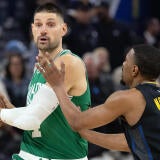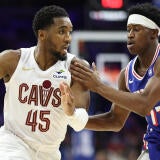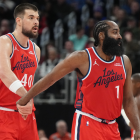

Why the Clippers won the trade deadline by dealing James Harden and Ivica Zubac for a brighter future
Los Angeles has a new point guard and a new direction

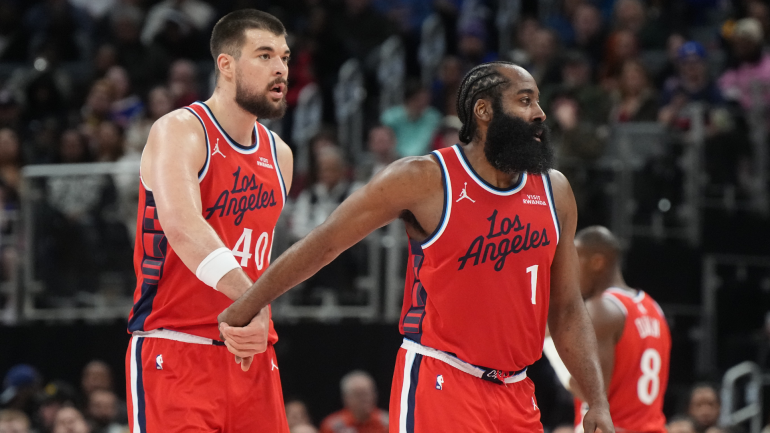
Just three days ago, it didn't seem like the Los Angeles Clippers were going to do much of anything at the trade deadline. They'd won 17 of their previous 21 games, the NBA's best record during that stretch, to totally turn around their season after a 6-21 start. If they were going to make any moves, they profiled as buyers as they climbed to ninth in the West with Kawhi Leonard playing at an MVP level. "In our situation, I don't see much movement," coach Tyronn Lue had recently told reporters.
That quote is now hilarious. Before Thursday's deadline, the Clippers traded their second- and third-best players. The front office completely reoriented the franchise, prioritizing the future over the remainder of this season. They were the kind of moves you'd expect from the most disappointing team in the league, not the hottest one. They were also two of the best trades that any team made at the deadline.
I find every part of this strange, as I liked seeing Los Angeles turn into the type of team I thought it would be coming into the season. From that vantage point, it's a bit of a bummer to watch the organization pivot away from what was working. There is no way, though, that I can argue with what the Clippers did from a team-building perspective. They didn't just turn James Harden into an All-Star-caliber guard 10 years his junior; they convinced the Cleveland Cavaliers to send them a second-round pick for their trouble. And they didn't just turn Ivica Zubac into multiple picks in a deal with the Indiana Pacers; they turned him into a pair of good firsts, one of which is particularly interesting.
Let's start with the Harden trade. Unless Garland has the most persistent case of turf toe in history, the Clippers will look brilliant for buying low on him. Just last season, Garland had the best year of his career, averaging 20.6 points on 60% true shooting as an integral part of the league's top offense. After two-plus years of Harden running the show, it will be jarring to see this team with a lead guard who is active and dangerous off the ball.
Given concerns about durability -- he's played in only 26 games this season and has been out since mid-January, but told reporters in LA that he's "ready to hoop" -- and the defensive viability of a Garland-Donovan Mitchell backcourt, it's understandable that the Cavaliers, firmly in win-now mode (and convince-Mitchell-to-sign-an-extension mode) wanted to swap him for Harden. For a Clippers team that was ancient and light on draft capital, though, this was a no-brainer. They sidestepped extension discussions with a star who turns 37 in August and replaced him with a 26-year-old who will be a core player going forward.
I am curious to see if the Clippers, who rank 30th in offensive pace, speed things up with Garland. The biggest question coming out of the deadline, though, is what will happen with the protected pick they received in the Zubac deal. The particulars are fascinating. In a throwback to the 2012 trade that sent Kyle Lowry from the Houston Rockets to the Toronto Raptors, the Pacers agreed to send Los Angeles their pick in this year's loaded draft with double protection, so it stays in Indiana if it falls between No. 1 and No. 4 or if it's No. 10 onward.
This is a hell of a risk for the Pacers. If the lottery lands them between No. 5 and No. 9, they'll have to send the draft pick that was supposed to be their reward for a "gap year" to Los Angeles. And if doesn't, then the outcome isn't necessarily bad for Los Angeles: It will immediately turn into to an unprotected 2031 first-round pick. (There are, obviously, a wide range of outcomes. If Indiana wins the lottery and pairs Kansas star Darryn Peterson with Tyrese Haliburton, I'd bet against them sending the Clippers an awesome pick in 2031.) At the moment, the Pacers have the NBA's third-worst record; if that holds, Los Angeles will have a 47.9% chance of getting the pick, per Tankathon.
Zubac, 28, is an excellent player and an incredible development story. The Clippers stole him from the Los Angeles Lakers at the 2019 deadline, and since then he's improved as a rim protector, a post-up threat, a passer and a finisher. He earned a spot on the All-Defensive Second Team last year, and he'll feast as a roll man next to Halliburton next season. That said, one could make the case that the aforementioned pick alone would be worth giving him up. In addition, the Clippers got Indiana's unprotected (!) 2029 pick, plus wing Bennedict Mathurin and big man Isaiah Jackson. (They also sent wing Kobe Brown to the Pacers.)
Mathurin was a popular Most Improved Player candidate coming into the season, but, in the last year of his rookie contract, he failed to convince the Pacers that they needed to keep him around. He has upped his 3-point rate, though, and is averaging 17.5 points on 58.6% true shooting, both career highs. The former No. 6 pick is still just 23 years old and a talented bucket-getter, and the Clippers will get to spend some time with him before deciding how they want to approach his restricted free agency. They did Indiana a favor by taking on Jackson's contract, which doesn't expire until 2028, but he at least gives them another big body with Zubac walking out the door.
Like all trades involving picks, young players and injury concerns, there are a lot of variables here, and the protected Pacers pick is an unusually wild one. We don't need the benefit of hindsight, though, to know that, value-wise, the Clippers crushed this deadline. Until now, they were at the end of an era that began with the arrival of Leonard and Paul George in 2019, trying to make the best of the situation without sacrificing flexibility. Now they've started to build something new.