

The NBA took a deceptively clever approach to punishing the Los Angeles Clippers for their efforts to circumvent the salary cap with Kawhi Leonard. Throughout the investigation, there was a widespread assumption that the Clippers would be able to fight any discipline through an arbitration process detailed in the league's collective bargaining agreement. However, that process can only be triggered by the NBPA, so when the NBA and the NBPA agreed on the punishments in the case, the Clippers had no league-sanctioned recourse.
That left them with two options. They could have attempted to fight the punishments through the court system, but that always would have been an uphill battle. Recent precedent, such as when the New York Knicks sued the Toronto Raptors, suggests that the courts prefer sports leagues to settle matters like this internally. Or they could simply accept the punishments: five stripped first-round picks, suspensions for Steve Ballmer, Gillian Zucker and Lawrence Frank, and a $30 million fine.
On Sunday night, the Clippers chose the latter.
In a statement, Ballmer apologized to Clippers fans and the league "for the distraction and distress this matter has caused, for which I accept responsibility as principal owner." He noted that the Clippers have paid the $30 million fine, and while they still disagree with elements of the findings in the league's report, they will move forward in compliance with the league's penalties. Ballmer and Zucker will be suspended for one year, and Frank will be suspended for six months.
A statement from Steve Ballmer. pic.twitter.com/YvhdXA8dQf
— LA Clippers (@LAClippers) September 14, 2026
Why accepting the penalties makes sense
This was the responsible choice for any number of reasons. Their odds in a protracted legal battle would have been poor. Even if they had succeeded in getting a judge to hear the case, the prospect of public discovery likely appealed to nobody. But most notably for Clipper fans, league precedent suggests this was likely the only path toward eventually reducing their sentence.
Let's turn the clocks back to 2000, when the Minnesota Timberwolves were hit with similar penalties for cap circumvention involving Joe Smith. They were stripped of five first-round picks for illegally agreeing to multiple contracts with Smith in advance, effectively using the Bird Rights system to gain access to a player they otherwise could not have afforded initially, only to eventually overpay him as a reward for joining them. However, that five-pick penalty didn't last all that long.
The initial five-pick penalty came in October of 2000. However, by December of that year, the NBA had given the Timberwolves their 2003 first-round pick back after owner Glen Taylor accepted a suspension and lead basketball executive Kevin McHale agreed to a leave of absence. "We are pleased to put this episode behind us, so that we and the Timberwolves may focus our full energies on basketball rather than protracted legal proceedings," then-commissioner David Stern said.
A year later, in December 2001, the NBA gave the Timberwolves their 2005 first-round pick back as well. "In light of the other penalties that have been imposed on the Timberwolves, and the team's conduct since the Smith matter concluded, we feel it is appropriate," Stern said at the time.
We're dealing with a one-case precedent here, so it is hardly ironclad. None of this is laid out in the CBA. But when Minnesota was hit with similar penalties, it got one pick back essentially for not fighting the NBA's ruling and another for a year of good behavior. By accepting the penalties here, the Clippers seem to at least be opening the door for similar relief.
Why the NBA might not follow the Wolves precedent
Whether or not they are actually successful in regaining any of their picks obviously remains to be seen. One of the notable differences between this case and Smith's is that the Clippers are now getting investigated by the Department of Justice. If they find something the NBA missed in its own investigation, that obviously changes the equation.
And then there is the matter of the team's conduct moving forward. The undertone to Stern's quote about Minnesota in 2001 suggested that they followed the rules following the Smith debacle. The Clippers were already a repeat offender when the Leonard investigation began because of their cap cirumvention violations involving DeAndre Jordan in 2015. And there has been speculation about other instances of possible recent cap circumvention from them that have not yet triggered an NBA investigation.
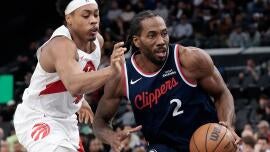
Last offseason, the Clippers signed Bradley Beal to a two-year, $11 million contract with a player option on the second year using the taxpayer mid-level exception. He played six largely ineffective games for them last season before suffering a season-ending hip fracture that would seemingly make him less valuable, not more valuable. Yet this offseason, he declined his player option and re-signed with the Clippers for a 20% raise, the highest allowable figure given his Non-Bird Rights. Meanwhile, the Clippers elected to sign-and-trade a younger and healthier player at the same position, Bennedict Mathurin, to the New Orleans Pelicans despite him making only slightly more on his new deal.
While the NBA is not known to be actively investigating the Beal contract, it does bear some notable resemblance to a situation the NBA is looking into: the Gary Trent Jr. contract with the Milwaukee Bucks. Trent signed a one-year, minimum salary contract with the Bucks in 2024 and then re-signed for a 120% raise in 2025 before getting a four-year, $64 million deal with the Bucks this offseason that seems on paper to be completely out of place within the current league marketplace.
The Clippers have a long history of signing accomplished veterans to minimum deals through buyouts before eventually rewarding them with long-term deals with Early Bird Rights after two years, though players like Nicolas Batum and Reggie Jackson who have been added and retained this way were paid in line with what the market has suggested they would be worth. The Beal contract is the first one that stands out as somewhat puzzling in a pure basketball context, especially for a team that is ostensibly moving into something of a rebuild. Again, this contract is not known to be getting investigated, but if there's any whiff of impropriety here or in any other Clipper dealings, that would likely work against them in possibly getting picks back.
There is no definable path for doing so. That would happen at the commissioner's discretion, and the Smith and Leonard cases are different enough that Silver may not view Stern's approach to the Timberwolves as the correct course for the Clippers. But losing five first-round picks is about as close to an organizational death sentence as an NBA team can get. If there is any route whatsoever to reclaiming some of that lost draft capital, taking it was the wisest course of action. The Clippers could have elected to fight a losing battle. Instead, they're accepting a punishment they can now at least hope to eventually see reduced.