
Darius Acuff Jr. is dominating March. His NBA fit is more complicated.
Darius Acuff Jr. has exploded into March Madness stardom, but his defense and one-way profile raise familiar questions for NBA teams.


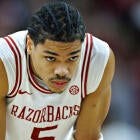
Darius Acuff Jr. is no stranger to making history. This season, the 19-year-old Arkansas point guard became the first player to lead the SEC in both points and assists since Pete Maravich in 1970, and third to win both freshman and player of the year.
Indeed, pretty much everything about Acuff screams superstar. He's more than an electric basketball player. There's an icy cool charisma to him -- the kind Reebok believes is ready to be the face of a franchise, as the company announced on Tuesday that it has signed Acuff to a signature shoe deal (meaning he will have his own shoe when he takes the court for his first NBA game), marking the first time that has ever happened for a male athlete that is still in college.
Allen Iverson showing love to Darius Acuff on IG:
— Legion Hoops (@LegionHoops) March 22, 2026
“The next HIM.” 🔥 pic.twitter.com/uXslmoFOoO
Anyone who gets the "HIM" endorsement from Allen Iverson is true-hooper stamped, but a necessary caveat is that it is Iverson's jojb to sell the world on Acuff's impending stardom. He's Reebok's vice president of basketball. For now, this is just marketing. There are no guarantees. What kind of actual NBA player Acuff turns out to be, both in the short and long term, remains to be seen.
And that's where this gets interesting. Or, if you're the team that ends up drafting Acuff with a top-five pick, potentially dangerous. Acuff represents what has become the league's most precarious positional archetype: The small, score-first point guard who can't defend.
Now, before we go any further, a couple disclaimers. First, Acuff isn't that small. He's listed anywhere from 6-foot-2 to 6-foot-3, and at 190 pounds he's built like an old-school SEC running back -- his sturdy frame and straight-line strength is actually one of his most devastating attributes, at least against college players. Yes, he'll be undersized in a lot of NBA point guard matchups, but so is Jalen Brunson, who one league scout told CBS Sports is one of Acuff's better NBA comps.
"If you're going with the more high-end outcomes [for Acuff's career], I suppose there's some Damian Lillard in there. Maybe a bigger, stronger Keyonte George on a little bit of the lower end," the Western Conference scout said, noting the "natural fade" to a lot of Acuff's midrange pull-ups that remind him of George.
"But yeah, I think Brunson is a probably a good example [of what Acuff can become], just with the way they use their leverage; they get you on their hip, get that shoulder into you, and from there you can't get them off their line. ... Remember, nobody projected Brunson to become what he has. We said the same things, right? Too small. How's he gonna guard? But there's no backdown in that guy. ... It's hard to go wrong betting on those kinds of guys."
Indeed, Brunson is an interesting comp for Acuff -- not just for the size and skill similarities (Acuff is a better athlete) but through the prism of defensive deficiency. Even as great as Brunson is offensively, there's still a question as to whether he can be the best player on a championship team as a weak-link defender, even as the Knicks have tried to insulate him with long wings and rim protection.
Which brings us to the second disclaimer: we don't know that Acuff can't defend. We only know that he hasn't chosen to yet.
It's partly, if not largely, an awareness issue on tape -- he can look like a chicken with his head cut off away from the ball. But in theory, he has the athleticism and physicality to pull his weight. Maybe he'll figure it out in the NBA. So far, the evidence is not terribly encouraging.
I heard that Darius Acuff Jr. might be the worst defender in the NBA next year. Watched his defense during the SEC Championship to see if people were exaggerating.
— Steph Noh (@StephNoh) March 19, 2026
It's pretty rough. pic.twitter.com/GbLRN9nH13
Last Saturday, Acuff had absolutely no chance of staying in front of High Point point guard Rob Martin, but neither did anyone else. Martin is a human bullet. You give that guy a head of steam and 90% of defenders, even NBA ones, are going to become a billboard on an F1 track.
Again, it was the effort and focus lapses that stood out. Acuff's screen navigation is a real problem. The want-to just isn't there. He's too content to fall out of the play, which wouldn't seem to be in keeping with all the "tough competitor" praise he gets. Watch here as he takes the scenic route around two picks on which he isn't even touched, just to lazily trail from behind as Martin cruises in for a layup.
Rob Martin with a sneaky bucket for the Panthers 👀 pic.twitter.com/kyO56XVmXj
— CBS Sports College Basketball 🏀 (@CBSSportsCBB) March 22, 2026
Even when Acuff did manage to stay attached to Martin, he still got powered through at the rim by a guy who is generously listed at 5-foot-10 and 170 pounds.
Rob Martin TOUGH and-one 💪#MarchMadness @HPUMBB pic.twitter.com/tmPq2jQg1o
— NCAA March Madness (@MarchMadnessMBB) March 22, 2026
The flip side to this, of course, is that like Brunson, Acuff gives it right back to you -- and then some -- on the offensive end. He put 36 on High Point. Scored 12 of Arkansas' final 15 points. Turned a tie game with three minutes to play into a 90-83 lead with a personal 7-0 run. The clutch gene is evident. You can't teach it. Acuff has it.
Through two NCAA tournament games, Acuff has racked up 60 points and 13 assists. Chris Paul is the only other freshman since 1973 to open his NCAA Tournament career with consecutive 20-point/5-assist games. There would appear to be almost no doubt that Acuff is going to be an offensive weapon at the next level, perhaps even a deadly one.
🏀 Darius Acuff Jr.'s sizzling NCAA Tournament
| Stat / Feat | Context |
|---|---|
| 36 points vs. High Point | Second-most by a frosh in NCAA tourney history (De'Aaron Fox, 39) |
| 60 points through first two NCAA Tournament games | Most ever by a freshman through two tournament games |
| 30+ PPG, 5+ APG through two games | First player to hit those marks since Jimmer Fredette in 2011 |
| Multiple 20+ point, 5+ assist games | Joins Chris Paul (2004) and Derrick Rose (08) as only frosh to do it |
The NBA, generally speaking, does not value this type of one-way player -- particularly as the face of a franchise -- the way it did even five years ago. Trae Young's outsized salary just got dumped. Nobody wants to touch Ja Morant. It's hard to imagine any team paying Tyler Herro $130 million today, but in 2022 the Heat did.
Even closer to the roster margins, teams are largely moving away from one-way scorers who bring little else to the table. Cam Thomas is a walking bucket and he just got waived by the Bucks. Jordan Poole has averaged 20 points per game over a season two times and is basically a castoff. Jonathan Kuminga dominated playoff games as a scorer, yet could hardly crack Steve Kerr's rotation before he was shipped to the Hawks. Collin Sexton was an elite scorer in college and has remained a very good one in the NBA, and nobody is handing him the keys to their team.
There are exceptions. If your name is Luka Dončić, Stephen Curry, Donovan Mitchell, prime James Harden or Lillard, or certainly the aforementioned Brunson, a lot of these size and/or defensive flaws will be tolerated. It begs the question: Is Acuff's offense that great?
"[It] has a chance to be, in my opinion," a separate scout told CBS Sports. "It's not just because of what he does with the ball, but he can [play] off it, too. That's become so important. I mean look around, how many teams do you see playing that Luka style anymore, where you're just giving it to one guy and letting him play pick and roll all game long? It's not many."
It's true. Context matters. You're a lot more exposed as a defensive liability when you're the face of a team, especially right out of the gate. Keyonte George has it easier than Trae Young did in Atlanta. George isn't the best player in Utah. At best, he'll be the third-best player next year. Plus, the Jazz have built their roster to insulate him with bigs everywhere, trading for Jaren Jackson Jr. to put alongside Walker Kessler and Lauri Markannen. And George, an electric scorer, still might be a problem when they start trying to win games. Maybe we'll find out next year. It's an interesting litmus test.
For Acuff, a situation like Dallas would be perfect. He wouldn't be the best player on the team (that would be Cooper Flagg), and Kyrie Irving would allow him to ease into his career in the same way that De'Aaron Fox is doing for Dylan Harper, the second overall pick in 2025, in San Antonio.
CBS Sports lead draft scout Adam Finkelstein has Acuff going in the six to eight range, which is Jazz/Mavericks/Grizzlies/Hawks territory. Would the Jazz put Acuff alongside George, or take him with the plan to move George? The Hawks have a good shot at a mid-lottery pick, too (via New Orleans' or Milwaukee's pick), but would they make another bet on a player like Acuff after just having punted on Young? Maybe. Maybe not. Every organization is looking out a different window.
"You try not to put a lot of stock in these generic prototypes, as far as where the league is going or what kinds of players are en vogue at whatever moment," one Western Conference exec told CBS Sports. "It wasn't that long ago that centers were supposed to be dying. Everyone was going small. Now everyone is looking for size again. ... You really have to just go case by case. What's good for one team might not be a fit for another. Do the strengths outweigh the weaknesses? And then, can the weaknesses be improved?"
Ah, the improvement card. It's always a popular one to play around draft time. If you took a shot of tequila every time some analyst said the words "he needs to improve his shooting" on draft night, you'd be in the back of an ambulance before the end of the first round.
For years this led teams to use lottery picks on the likes of Michael Carter-Williams, Elfrid Payton, Kris Dunn, Emmanuel Mudiay, Ricky Rubio, Dante Exum and Frank Ntilikina -- all on the assumption that their shooting would meaningfully improve. Not one of them ever made an All-Star team.
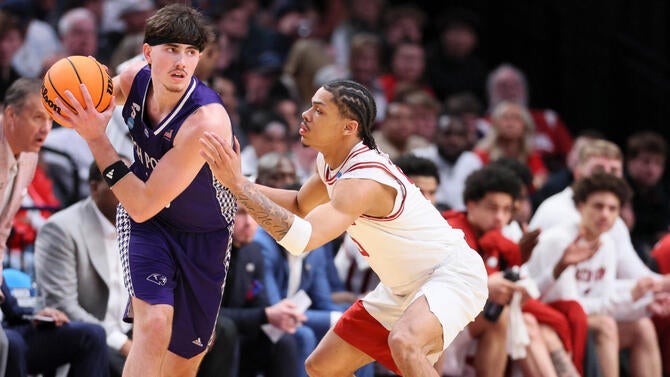
It's not to say improvement can't happen. Of course it can. In this regard, defense, to whatever degree your size allows, is no different than any other skill. Ben Simmons didn't give a damn about defense in college, but in the NBA he became the portrait of modern versatility before flaming out of the league for just about every reason other than defense.
Go talk to Darren Erman about Klay Thompson. Erman was an assistant with the Warriors when Thompson came up, and he'll tell you all the stories you want about Thompson going into the gym and working out for hours without a ball, working on his defense, his movement, his technique, anything and everything until he became one of the league's best perimeter defenders.
Acuff doesn't have the size of a Simmons or Thompson, but he can get better if he wants to. Curry did it. You better believe a lot of GMs are trying to make as educated a guess as possible as to whether Acuff will do the same. Like us, they'll be watching closely when Acuff squares up against top-seeded Arizona, which has NBA players all over, in the Sweet Sixteen on Thursday night.
If his defense is a wreck and the Razorbacks get spanked, will it hurt his draft stock? If he balls out and leads Arkansas into the Elite Eight, will it rise even more than it already has? It's easy to say teams evaluate the big picture over a small sample of big-stage showings, but evidence often speaks to the contrary. Showing out in the tourney can, and does, influence even the most unemotional of evaluators.

Sometimes knocking a your marquee audition out of the park proves to be a predictor of NBA success, as was the case with Curry and Brunson, even a Kemba Walker, to name a few tournament darlings. But for every one of those guys, there's a Trey Burke. A Shabazz Napier. Small guys who were big-time college point guards and showed out in the tourney but never panned out in the NBA.
Acuff is almost certainly going to pan out on some level. It's impossible to imagine him being a full-on bust. But we're talking degrees here. He's probably going to go in the top 10, with the expectation that he will someday soon be not just a statistical darling but an actual star who can influence winning. Those are two very different things and the league is now starkly differentiating between the two.
Which one will Acuff become? Who knows. He's only 19-years-old. Everything is on the table. His lack of interest in playing defense is a red flag. Ultimately he will have to either fix it or find a way to be so great on offense that the defense does not matter. One team this June is going to make a huge bet Acuff can swing one of the two outcomes. It would be a lot of fun if he could do both.