Inside the NBA's ambitious plans for creating a European league
The NBA Europe managing director provided CBS Sports with detailed insight into plans for a new European league

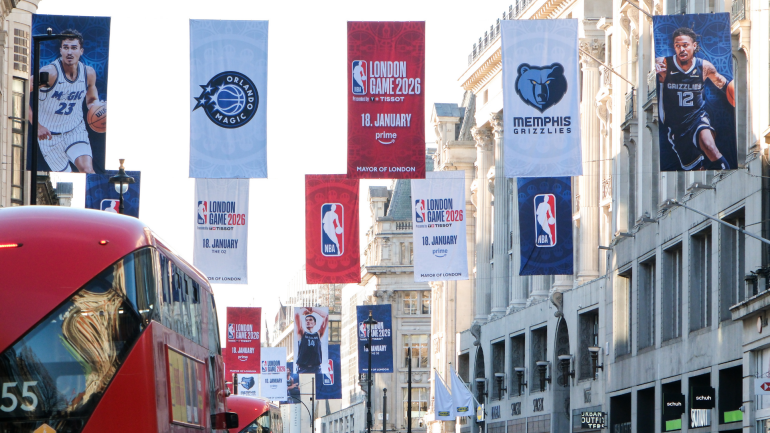
The Orlando Magic and Memphis Grizzlies will play the NBA's 98th and 99th games in Europe this week, with a pair of games in Berlin (2 p.m. ET on Thursday) and London (12 p.m. ET on Sunday).
These games come at a critical moment in the NBA's constant push to become a bigger global entity, as the NBA and FIBA recently announced they were moving forward with plans to engage prospective teams and ownership groups for a new European basketball league that will compete with the EuroLeague. The league's plan is to feature 14-16 teams at launch -- a combination of 10-12 permanent clubs and 4-6 qualifier spots for FIBA-affiliated domestic leagues -- with the competition scheduled around domestic league and national team games.
Ahead of Thursday's game in Berlin, CBS Sports spoke with the NBA Europe and Middle East managing director George Aivazoglou for a wide-ranging discussion on why they feel there's such a major opportunity in Europe despite the EuroLeague's presence, how the NBA's approach to adding or creating new teams will vary from city to city, the unique challenges of European basketball and much more.
Why is the NBA targeting Europe?
The reason why the NBA wants to create an entirely new league in Europe is fairly simple. League officials don't believe the current system in European basketball comes anywhere close to maximizing the potential of the European sports industry and doesn't serve many of the biggest markets across the continent.
The NBA will quickly tell you basketball is the second-most popular sport in Europe (270 million fans and growing), but that all of the domestic, regional and pan-European leagues account for just 0.5% of the $50 billion European sports industry. Aivazoglou laid out the three major reasons why he and the NBA believe European basketball has fallen short of its potential to this point, and what they believe they can accomplish with their venture.
"European basketball doesn't have what in the world of sports we call a strong ecosystem pyramid," Aivazoglou said. "So if you look at soccer, which is the sport that's the most successful in Europe, you have a pyramid structure where at the base you have a series of very strong domestic leagues, like the Premier League in the UK, La Liga in Spain, Bundesliga in Germany. And there's great teams, great sports brands, that compete there on a national level. And then the winners of the league, and many times, the second and the third contender, they qualify, they earn their sport to go and play big pan-European competitions, be it the Champions League, which is the biggest one, or the Europa League. And then there is a clear connectivity between leagues that are regional and leagues that are domestic, and a very transparent merit-based way on how teams move from the one to the other.
"That ecosystem doesn't exist in European basketball. So it's very fragmented, and the worst of them all is that it limits the ability of something like 90% of the teams in the ecosystem to qualify. [...] I would say the top, tier one European League today excludes something between like 80 and 90% of European basketball fans, who will never see their team to compete in that league. So that's problem number one," Aivazoglou continued. "Problem number two is that there is many big countries and cities that, by extension, have been excluded, and those cities have millions, in some cases, tens of millions, of basketball fans. So you see a city like London, there's no representation there. A city like Paris, no permanent representation there. Same for Rome, same for Berlin, same for Manchester. So some of the most prominent European cities and the people who live there have been excluded. And then third, I would say that European basketball today is able to attract an audience that is a very core basketball audience, but that doesn't have the scale or the global, I would say, element to it. Whereas, by comparison, the NBA is able to attract a far more diverse and far bigger audience, and that makes it for a very, very superior and interesting proposition for not just for fans, but also for media and marketing partners a lot."
How will this new league work?
The NBA Europe league will feature both established teams and new teams occupying 10-12 permanent spots, with the opportunity for teams in FIBA-affiliated domestic leagues to earn the other 4-6 spots. That qualification piece is the "merit-based" pathway Aivazoglou spoke of, and is something he views as a key differentiator that can make the NBA's league. However, while that produces opportunities for new teams and different fan bases to get invested in the league, the permanent spots -- similar to the EuroLeague's license structure -- are far more fascinating to explore right now.
The biggest question from fans about the NBA's venture in Europe is which established teams that have played in EuroLeague will sign on. EuroLeague has contracts with many of Europe's biggest clubs, but three of the 13 teams with "A" licenses have yet to sign new long-term deals. Those three are Real Madrid (Spain), Fenerbahçe (Turkey) and ASVEL (France) -- with Barcelona (Spain) recently removing itself from that list by agreeing to a new 10-year deal, per reports -- and the battle for their commitment has begun.
Aivazoglou and the NBA understand the importance of bringing in some of the largest established brands in European basketball to give their new league legitimacy and greater reach. When highlighting the desire for NBA Europe to have a global footprint, Aivazoglou mentioned two of those clubs as potential examples of how the league wants to partner with existing global brands for their new league.
"If you look at the NBA in Europe, it's still the NBA as a brand, and its platform continues to be very global. In addition to that, some of the brands that we aspire to partner with are also global brands, " Aivazoglou said. "I'll give you a couple of examples. There are teams in Europe today -- take a team like, I don't know, Real Madrid, they have tens of millions of fans all over the world. Take other clubs like the two big Turkish clubs, Galatasary and Fenerbahçe, they have, -- I mean, we're in Germany today for our game on Thursday, and they have as many fans in Germany because of the Turkish diaspora as they have in Istanbul. So we tap into those, I would say, existing relationships, and obviously bringing them all together, along with the NBA and really creating that global concept."
Beyond existing basketball teams in Europe, there are two other types of teams that Aivazoglou has laid out previously as options for NBA Europe. Those would be clubs started by existing sports brands -- namely soccer clubs -- that don't have a basketball team currently, and completely new franchises. There are obvious benefits to partnering with an existing sports brand that has a built in fan base and name recognition, but the NBA is also cognizant of the importance of recognizing the city by city dynamics at play.
"We go into this process with a very open mind. I would say there's tremendous interest from across each of those parts of the ecosystem, and there is definitive pros and cons depending on the city you're looking at," Aivazoglou said. "And in some cities, you have very established big brands who are the dominant, I would say, team or the dominant brand for that city. And in others you have split cities. There's pros and cons in the approach of working with an established brand or a new brand, but I would say, part of what we're trying to solve for here -- and what we have done very well at the NBA side -- is bringing people that have a lot of that operational know how, but also the strategic perspective from a long-term standpoint to build significant assets here that would be worth in the 10s or hundreds of billions over time."
The pros and cons that Aivazoglou noted about working with established brands or creating new brands show that the league recognizes potential pitfalls that are unique to European sports. There are some cities with a dominant club that would make for an easy partnership that gives them a brand fans are already invested in. However, other cities have a more even split between two (or more) teams, and giving one of those a team and not the other would set up a scenario in which a significant portion of that city's potential fans would immediately be unwilling to support the other simply because of the name and soccer affiliation.
Aivazoglou didn't name any specific examples of clubs where that could be the case, but one could infer what he means based on some of the cities he highlighted as prospective markets above that don't currently have a club which bucket they may fall in. For example, he pointed to Paris and Rome as two cities without a permanent club that plays in EuroLeague, where soccer clubs AS Roma and Paris Saint-Germain represent the dominant brand in that city. On the other hand, London and Manchester are other cities the NBA views as untapped basketball markets. It's possible they could try and partner with top Premier League brands like Tottenham, Arsenal, Manchester City or Manchester United in either of those cities, but they are aware that doing so likely precludes them from gaining support from the other fanbase.
For those markets where the NBA decides a completely new franchise is the best option, Aivazoglou laid out at a high level what the NBA will be looking for in prospective partners for launching a new club.
"Without getting too deep on the process that's ahead of us, we'd be looking for things like, 'OK, it's a new club in this city, but does this potential partner have experience in doing something similar somewhere else? And is that experience in a similar sport, or is it fundamentally different?' That's obviously a broad point, but that can speak to their ability to create a brand and competitive team from scratch," Aivazoglou explained. "And some of the partners or potential partners we're speaking with have that. Another one is, what are their plans on building and engaging a fan base? Have they done that elsewhere? Have they done that for a consumer brand? Have they done that for a brand in the entertainment or sporting world? All these will speak to their qualifications. And lastly, just because I just made the point, what's their vision around infrastructure, arenas and fan engagement within the construct of a physical building? So these are some of the attributes, or some of the conversation points that will, I would say, direct us to the right answer per city."
What about the players?
As ambitious as the NBA's vision is for their European league -- with visions of billion-dollar franchises -- there are some important questions that must be answered. The NBA certainly has grown its presence in Europe, but it's fair to wonder how much of that allegiance is to the the league and not the players in it that draw in those fans.
While the NBA hopes to attract some of Europe's top teams and create others that can be highly competitive and have strong talent, one thing I was most interested in hearing from Aivazoglou was how the NBA would navigate the fact that hyper-elite talent will still leave for the NBA.
European leagues already have plenty of talented players and have gotten better and better over the years, but the household names and megastars that can tap into the larger, casual fan market the NBA believes isn't being served by European basketball don't stay long. The NBA points to the popularity of stars like Luka Dončić, Nikola Jokić and Victor Wembanyama as key drivers of the continued, rapid growth in the league's popularity in Europe in recent years. However, those kinds of superstars will still have their sights set on making it stateside in the NBA.
So, how exactly can you square up the NBA's ambitions to create a European league that captures a broader audience with the fact that the very best players will continue to leave for the NBA? Aivazoglou offered his explanation.
"Part of the vision here is to create pathways, career pathways, for a much bigger number of elite players. So we can assume that today, there is a number of players that consider to be elite, and the vast majority of those players are being absorbed by the NBA," Aivazoglou said. "I can tell you that definitely, many of those players are not considering play in Europe for many years, because the economics of European basketball don't support their ambition. So they end up playing in China, in Japan. They end up playing, on the younger side, they go to colleges in the U.S. They definitely don't spend many years in Europe.
"By introducing a league which will have global ambitions, that creates pathways and options for a number of them. That still doesn't mean that the top, top players in the world won't have the ambition to go and play at the NBA for a number of years, but that creates more options for players," Aivazoglou continued. "And I would say, over time, with investment that's going to happen in the broader ecosystem of European basketball, both at a team as well as a league level, the production of players will also increase. There's going to be more elite, more great players, having more options, which I think is a great thing for everybody. I would say as a last point, and I know and appreciate it will take time to get to that part, but you look at something like soccer, where you you can fit basically, in your portfolio a number of very competitive leagues. You have the EPL, as I said, La Liga, you have Serie A, you have the UCL, and there's space for more of them. And that, as well, is another example of giving great players from all over the world a lot of options. So that's, I would say that the destination here recognizing that it obviously take a lot of time for European basketball to get to this advanced stage. But that's the ambition."
We've already seen the fruits of the explosion of basketball's popularity in Europe in the 90s in the increase in European players and stars coming into the NBA and the talent on national teams that have started to close the gap on USA Basketball. The league believes NBA Europe can spark even further growth in the development of talent that wouldn't just port over stateside, but also that would remain in Europe.
If you subscribe to the NBA's belief that the basketball market in Europe has barely been tapped, perhaps they can be correct.
Beyond investing in the development of more talent and providing more financial incentive to stay and play in Europe, the NBA believes the league can do a better job engaging the masses than what is currently available to European basketball fans. Aivazoglou mentioned on multiple occasions that European basketball viewership is largely diehards, but that they have a vision to attract a larger, more diverse audience -- while also trying to strike a balance of retaining the "great color" and traditions of European basketball.
He highlighted their goals for building better physical infrastructure in the form of state-of-the-art arenas that are more similar to what we have in the United States, compared to the more utilitarian arenas teams tend to play at in Europe. From a distribution standpoint, the NBA would work with global platforms for distribution, that have greater technological capacities to modernize the TV presentation, along with national and regional networks in Europe to reach a local audience.
Aivazoglou's enthusiasm for the project and conviction that the NBA has the resources, relationships, plan and ability to do what no one else has been able to in European basketball are remarkable. He called the NBA's European venture "the single biggest opportunity in the world of sports today," something he has obvious personal investment in saying but seems to genuinely believe.
With a potential launch in 2027, we'll learn quickly whether he and the NBA are correct in their assessment, or if they'll face a steeper climb than anticipated.