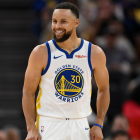


On Sunday, the Denver Nuggets spent $38 million for a $6 million player. That's because the Oklahoma City Thunder -- mostly to replace the wings they traded to duck the second, but partially to mess with a conference rival -- signed Spencer Jones to a two-year, $12 million offer sheet. The Nuggets matched the offer sheet to keep Jones. In basketball terms, they had to. Having lost much of last year's bench, they simply could not afford to let a promising young wing walk for nothing, let alone to perhaps their scariest Western Conference competitor.
But doing so came at a steep cost. The Nuggets are a repeat taxpayer, which means they pay a premium on top of whatever tax bill their actual payroll creates. Keeping Jones also took the Nuggets above the second apron, creating all manner of roster-building restrictions for a team that certainly didn't look championship-caliber last season. Jones will make only $6 million next season. However, that $6 million takes their tax bill from roughly $36 million to around $68 million. So, $32 million in taxes plus $6 million in salary equals, roughly, $38 million.
This is notable because Jones, while promising, was a 22-minute-per-game reserve. He was not the most important restricted free agent the Nuggets had to keep this summer. That honor belongs to Peyton Watson, who averaged 18 points and six rebounds on 52-44-75 shooting across 30 games between November and January while being arguably Denver's best perimeter defender. In theory, he should be worth a whole lot more than the $6 million Jones got.
In practice, that might be almost exactly what he winds up getting. Denver's initial offer to retain Watson was roughly $70 million over four years, according to Marc Stein. Watson, though, is reportedly weighing whether to accept his one-year, $6.5 million qualifying offer. Why would he do that? Because it would make him an unrestricted free agent next offseason, free to sign anywhere. Young wings as good as Watson looked last season are a scarce commodity. If he comes close to maintaining that performance next season, he might double that initial Denver offer on the open market.
In some cases, the qualifying offer terrifies teams attempting to retain restricted free agents. The risk of losing players for nothing is daunting. But under Denver's specific circumstances, the qualifying offer is actually enormously appealing. It's their best chance at keeping their roster intact without paying a historic tax bill.
Watson reportedly wanted $25 million per year entering the offseason. Were the Nuggets to re-sign him now to a contract worth that much, their combined payroll and luxury tax bills would exceed $400 million, potentially by quite a bit. They almost certainly would not find that tenable. However, should the Nuggets keep Watson on that $6.5 million qualifying offer, their projected tax bill would rise from $68 million to only $112 million. They'd still have a payroll above $223 million, but that's still far cheaper than the alternative.
The Nuggets could find ways to cut corners -- most notably if they stretched or could find a trade for Zeke Nnaji -- to get their tax bill down to a more manageable number without giving up a core player. They'd be at risk of losing Watson next summer, but with Cam Johnson's contract expiring, they'd have more money with which to sign him to a long-term deal. If they can't, it probably means Watson played well enough in the 2026-27 season to warrant an enormous contract, which bodes pretty well for Denver's immediate championship pursuit.
The Nuggets are juggling a number of complicated priorities this offseason. Winning the 2027 championship is obviously one of them. So is keeping that tax bill manageable. And looming over everything is the contractual status of Nikola Jokić, who is widely expected to re-sign next summer, but who can technically become a free agent. Until his signature is secured, cheaping out on the roster represents an enormous risk.
That doesn't mean it won't happen. After all, tax bills aren't finalized until the end of the season. Even if Denver re-signs Watson now, it would have until the deadline to trade away a different core piece to save money against the tax. But the Nuggets just lost in the first round of the playoffs. They were obviously dealing with injuries, but their opponents, the Minnesota Timberwolves, were far more banged up. It's hard to imagine Denver losing an important piece and still keeping up with the Thunder and the San Antonio Spurs. That makes the idea of keeping Watson on a small one-year deal very appealing.
Watson's options are limited at this point. There are no cap space teams left in free agency, so nobody is equipped to give Watson an offer sheet bigger than the $70 million offer the Nuggets originally made. There has reportedly been a fair amount of sign-and-trade interest, but the Thunder using Jones to push the Nuggets above the second apron complicates those negotiations.
Acquiring a player from another team by signing-and-trading one of your own creates a second-apron hard cap, which the Nuggets can't currently abide. They'd have to send Watson to a team with a trade exception big enough to take him without sending back any of its own money. Even if Denver could do that, what good would it really do them to get a couple of draft picks back for Watson? They're trying to win it all here and now.
Without Denver's cooperation, a sign-and-trade is out. That leaves Watson two options: a long-term deal on the team's terms or the qualifying offer. Restricted free agents at Watson's level rarely actually take the qualifying offer, and they have the rest of the offseason to negotiate. Maybe there's a middle ground here, but unless the deal is really team-friendly, Denver has every reason to try to nudge Watson towards the qualifying offer. Buckle up, folks, because this saga will likely drag on for a few more months.