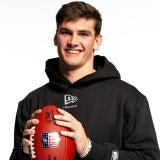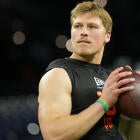
North Dakota State QB Cole Payton is not the next Taysom Hill -- and he's here to prove it
Payton's toughest test might be overcoming the dual-threat label that made him so successful at North Dakota State

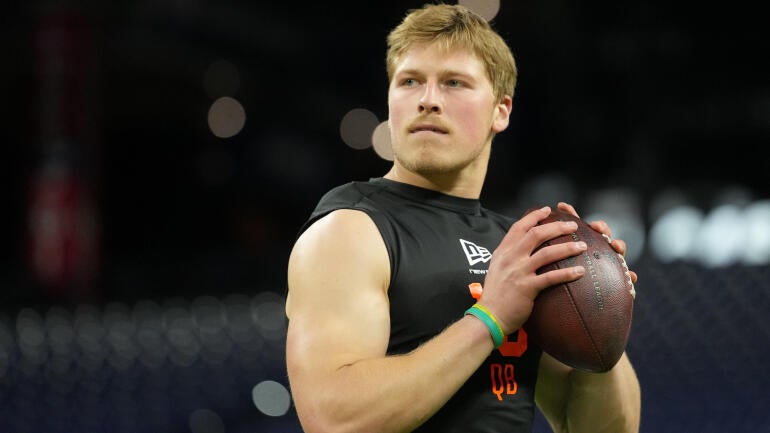
Fargo, North Dakota isn't the first place to come to mind when talking about quarterback factories. But for a storied FCS program that still might be considered off football's beaten path because of geography and competition, North Dakota State keeps churning out NFL-caliber signal-callers.
From Carson Wentz to Easton Stick, to Trey Lance to Cam Miller, NDSU has become an unlikely pipeline for the NFL's most important position.
But for Cole Payton, the latest dual-threat playmaker to emerge from the program, his biggest challenge isn't production, but perception – that he's an athlete who plays quarterback, instead of a quarterback who happens to be athletic.
He doesn't want to be a gimmick or gadget because of his God-given talents, he wants to remind the folks that have seen him – and prove to the ones just now learning his name – that he is, above all else, a quarterback who can sling it from the pocket, and who can win with his legs when the situation calls for it.
I made the mistake of comparing him to former BYU quarterback Taysom Hill, who has had a long and successful career in New Orleans as an offensive chess piece who can line up just about anywhere.
"There's always kind of been that label on me, that Taysom Hill label," Payton said, when we spoke with him on the "With the First Pick" podcast at the NFL combine. "I mean, yeah ... especially going into this last season, there was that narrative [about me]."
But Payton isn't interested in being a role player. And as he eyes the next step in his football journey, his message is clear: he is a passer who can run, not the other way around.
The 'gritty' persona
To understand Payton, one must understand the North Dakota State culture. It is a program built on playoff 'stashes – grown annually as the team makes its march toward another national championship. It's a look that screams throwback, and old-school, blue-collar toughness.
"The thing about [my] mustache is it's the playoff stash," Payton said, grinning. "Every year a lot of the guys would grow out their mustaches for the playoffs. ... I've stuck with it, you know. Got to stay gritty. Got to stay gritty."
That grittiness isn't just an aesthetic choice; it's the heartbeat of his playing style. When asked to describe his game to an audience that might only see him on social-media highlight reels, Payton doesn't lead with his 40-yard dash time (he ran 4.56, by the way), or his vertical (he got 40 inches on the vert, too), he leads with his mentality.
"I'm an animal when the ball's in my hand," he said. "I'm going to go over, through, or around you. It starts with being an ultimate competitor and I'm gritty. ... I think it comes down to being the ultimate competitor and freaking gritty, man."
This animal instinct is what led him to more than 900 rushing yards last season, according to PFF. It's what makes him a nightmare in the red zone. But Payton is quick to pivot the conversation back to the mechanics of the position. He knows that in the NFL, trying to run over a linebacker is a short-term strategy. Long-term success depends on what he does from the pocket.
Watching Payton operate isn't about raw arm talent or Madden-style highlight-reel chaos – it's about control. He wins with rhythm, efficiency and a calm, deliberate presence in the pocket. There's little wasted movement, little panic – even when the play stretches beyond its design. He works through progressions with patience, trusting timing and touch more than velocity, and he's comfortable delivering layered throws over the middle or dropping a deep ball into space 40 yards downfield.
And while the label of "dual-threat" follows him, his physicality is more tool than crutch. At 232 pounds, he's a punishing runner who can finish plays when necessary, but the tape also shows a QB whose mind leads the operation – composed pre-snap, steady post-snap, and intentional about winning from the pocket rather than escaping it.
He's not the 'next Taysom Hill'
The Taysom Hill comparison is often intended as a compliment. But for Payton, the label can feel limiting.
"Taysom Hill is a great athlete, a great competitor, [and he's] been in the league for a while ... but I'm trying to change that [perception]," Payton said. "I definitely changed that this year, especially along with being at the Senior Bowl. A lot of the conversations [with NFL teams] have been strictly playing quarterback. Some will ask me about special teams, but more often than not, it's about playing quarterback."
That belief manifested itself frequently during the 2025 season. But it also showed up at the Senior Bowl where quarterbacks who didn't play Power 4 ball have previously looked overwhelmed and out of sorts against bigger, stronger, faster players. Payton not only looked the part, he was consistently one of the best QBs on the field during the practice week.
That belief was also tested and refined during his time in Fargo. While he was used as a change-of-pace weapon early in his career, his development as a passer has been his primary focus. He credits his growth to the environment at NDSU and the talent around him, including, not surprisingly, wide receiver Bryce Lance – the younger brother Trey Lance.
"I think that [connection with the younger Lance] stems from my passing ability and being able to make every throw," Payton said. He speaks of Lance with the reverence a quarterback has for a reliable target: "Bryce is an unbelievable talent... freakishly fast, has got great hands and can move his body in this way, kind of like Justin Jefferson. But the thing about Bryce is he works his tail off... everything he's gotten, he's earned."
The center field mentality
Payton's athletic foundation wasn't just built on the football field. Before he was a Bison, he was a standout baseball player. Despite being a 6-foot-3 southpaw, he wasn't primarily on the mound.
"I pitched, but my thing was center field," he said. "Playing center field."
And it makes sense, given the job requirements: range, vision, arm strength, spatial awareness – traits that easily translate to playing quarterback. But even that gets folded into the "athlete" conversation. And while he doesn't reject that part of himself, he also refuses to let it define the ceiling of his role.
If anything, he sees it as part of what makes him who he is on the field.
The development of a passer
One of the most difficult transitions for a "mobile" quarterback is learning when not to run. When you are the best athlete on the field, it's easy to take off if the first read isn't there because, well, you're the best athlete on the field.
For Payton, the challenge of the last two years has been intentional restraint.
"It's just this idea of developing as a passer and that's just getting the ball to your playmakers, right?" Payton said. "Sitting in that pocket, not blowing over a read and just getting yards with your legs. It's finding the open guy, finding the completion. And I think that's [part of] me developing as a passer throughout my college career."
We've heard Donovan McNabb and Russell Wilson say that, despite their open-field athleticism, they wanted to be known as pocket passers. And when Wilson joined the Broncos in 2022, he talked about his "pocket-first" mentality. I posed the question to Payton – in an effort to prove his pocket-passing bona fides to NFL evaluators, does he make a concerted effort play from the pocket?
"I'm definitely not [thinking about it once the ball is snapped]," he said. "I'm just in my zone doing my thing."
But "his thing" has been undoubtedly impressive to watch. It's no longer just about being the "animal" who runs over people. It's about the subtle pocket movements, the ability to manipulate a safety with his eyes, and the footwork required to deliver a layered second-level throw to the sidelines on time and on his wide receiver's face.
The path forward
As Payton navigates his way through the draft process, he knows the questions will come. He knows there may be some coaches who see his 6-foot-3, 232-pound frame and his 900 rushing yards and think Swiss Army knife versatility. But Cole Payton isn't interested in anything other than being able to prove to any remaining doubters that he's a quarterback in the most traditional sense of the word.
"I believe I'm a starter in this league," he said.
Payton knows he will always be described as athletic. Always seen as gritty. Always defined, in part, by what he can do outside the pocket. But his dream, the one that has shaped his development from North Dakota State to the cusp of the NFL, is rooted in something more traditional and, on some level, more difficult to prove.
To be seen, first and foremost, as a quarterback who can win from the pocket. And as he continues chasing that dream, mustache and all, the message he repeats – quietly, consistently, and without apology – remains the clearest window into who he believes he is becoming: "I believe I'm a starter in this league."