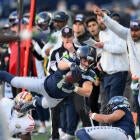


The mantra that football is "a game of inches" rang true in Week 5 when the Seattle Seahawks fell just short of an opportunity to tie or take a late lead against the San Francisco 49ers. A close call on the game's decisive play gave new life to the question of why the NFL cannot use technology to spot the ball, because human error might have been the difference between the Seahawks staying alive or falling to their NFC West rival in the 32-29 defeat.
Seattle, trailing by three points, faced a fourth-and-10 from midfield with 54 seconds to play in the game. Sam Darnold completed a pass to Cooper Kupp, who ran towards the 40-yard line and lunged toward the first-down marker as he flew out of bounds.
The officials marked Kupp short of the line to gain. The play went to a booth review and stood as called on the field. Seattle had only one timeout remaining, so the 49ers knelt with the ball to drain the clock for their fifth consecutive victory to open the season. The Seahawks were left frustrated with the result of their do-or-die play, as they would have had time to seek a go-ahead touchdown or game-tying field goal had the officials granted Kupp a first down.
What should the ruling on this play be?
— FOX Sports: NFL (@NFLonFOX) October 11, 2026
📺: FOX/FOX One pic.twitter.com/YzuDyGXn0S
If the ruling on the field was a first down, the call likely would have stood due to a lack of concrete evidence that Kupp was short. It went the other way, which emphasized both how crucial it is to get the call right in real time and how there is still a gray area in spotting the ball.
As the league embraces the use of technology to track player data, deliver countless camera angles, complete video reviews and implement virtual measurements, it is reasonable to wonder why it does not have the ability to spot the ball digitally.
The answer is that the technology is not yet reliable enough.
Why doesn't the NFL use ball-chip technology for spotting?
The NFL began placing RFID microchips in footballs at the start of the 2017 season. The chips capture data, including speed, distance and rotation, that are collected for Next Gen Stats. They weigh three grams and are embedded in the balls during production. While they act as accelerometers, these chips are not precise enough for use in the spotting process. The 6-inch margin of error makes any argument to use this technology for spotting a non-starter.
"In some cases, those 6 inches might be good enough [to spot the ball]," Zebra Technologies' Jill Stelfox said in 2017 when her company partnered with the NFL to create the chips. "But in all cases, it's probably not good enough at this point with the technology being where it is. It also depends on where your feet are, and your knees are, and we don't have those tagged with chips. They're only in the shoulder pads. So the NFL is still going to need referees to do that."
Making up for potential inaccuracies is not as simple as stitching together videos of the play, determining when the ball carrier went down or out of bounds, and syncing that timestamp with the location determined by the chip. There will always be the chance that the measured distance is up to 6 inches off from reality. It is no different from officials incorrectly interpreting where the ball is at a given time with their own eyes.
Assume, for instance, that the replay officials found the ball in Kupp's hand broke the plane of the sideline. While they could sync the chip with that video and determine the ball's position, if it is within a half-foot of the first-down line, they cannot say with certainty that it actually reached the marker.
And then there is the problem of camera angles. Even with all of the cameras in use during NFL games today, there is not always an angle that shows the exact moment a player hits the ground or the ball crosses a line. Over-the-top cameras positioned directly above the ball and down-the-line cameras positioned directly on each yard marker, sideline, goal line and end line are required for precision. That does not even cover situations in which the ball is not clearly visible, either.
What about Hawk-Eye?
The NFL's replay system received a major upgrade with the introduction of Sony's Hawk-Eye technology in 2021, which allows the league to process live video in real time and sync camera angles with timestamps. In 2025, use of the Hawk-Eye system expanded to the virtual measurement process, wherein the NFL uses six 8K optical-tracking cameras in each stadium to mark the exact position of the ball relative to the line to gain. This is more accurate than the in-ball RFID chips but comes with its own limitations.
Most prohibitive is the fact that the cameras require a clear line of sight to determine the ball's position. For measurements, officials manually spot the ball and move out of the way so the cameras can detect its position. In the flow of play, there are far too many instances in which the view of the ball is blocked.
This is why Hawk-Eye is far more useful for real-time decisions in tennis and soccer than it would be for spotting the ball after each play. In tennis, the cameras can see clearly whether the ball landed inside, outside or on the line. In soccer, the cameras can generally determine whether the ball crossed the plane of the goal or whether players are offside. There is too much congestion on the football field to consistently track the ball.
Will virtual spotting ever be feasible?
Considering the NFL's willingness to adopt technology and its commitment to making the correct call on every play, if the opportunity arises to relieve officials of spotting duties, one has to imagine the league would jump on it. The fact that RFID chips and Hawk-Eye can accurately capture so much additional data suggests that it is only a matter of time until a breakthrough makes digital spotting a reality. There is no telling when this capability will come to fruition, though.