

For most of the last decade, NFL teams have operated under a simple premise when it comes to running backs: You can find them anywhere. Don't use premium draft capital on the position, don't hand out massive second contracts, and when one back gets expensive, find the next one in the draft, often outside of the first round.
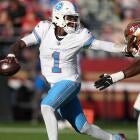
It's a philosophy now being tested by Bijan Robinson and Jahmyr Gibbs, the No. 8 and No. 12 picks in the 2023 NFL Draft, who are both looking for new deals from the Falcons and Lions.
There's plenty of evidence supporting that approach. Alvin Kamara was a third-round pick. Aaron Jones went two rounds after that. Kyren Williams, like Jones, was another fifth-rounder, while Jonathan Taylor, Nick Chubb and Derrick Henry all came off the board in Round 2. And the data confirmed part of the conventional wisdom: If a later-round back earns meaningful NFL opportunities, he can be efficient.
But that isn't quite the question facing the Falcons and Lions as Bijan Robinson and Jahmyr Gibbs seek new contracts. Neither team needs to find a running back; they need to decide how much they're willing to pay to keep two backs who, through three seasons, have done things almost nobody at the position has done.
And that's where the data starts to tell a very different story. We looked at every running back drafted from 2016-23, tracking what they did over their first three NFL seasons, then used more than 500 individual RB seasons from 2015-25 to see just how rare Robinson's and Gibbs' combination of rushing, receiving, and efficiency really is.
Robinson has 5,648 yards from scrimmage through three seasons. Gibbs has 5,029. Among the running backs in our 2016-23 draft sample, only Christian McCaffrey (5,443) and Ezekiel Elliott (5,247) eclipsed the 5K mark through three seasons.
That matters because the argument against paying running backs has never really been that they don't produce. It's that their output can be replaced much more cheaply. So instead of asking whether Robinson and Gibbs are great players -- we already know the answer -- we tried to answer a more useful question: How easy would it actually be to replace them?
The results weren't especially kind to the "you can just draft another one" posse.
If you take a randomly selected Day 2 running back from our sample, that player had a 42.5% chance of reaching at least half of Robinson's production over the same three-season window, and a 45% chance of reaching half of Gibbs'. Get to 70% of their production, though, and those probabilities fall to 10% for Robinson and 20% for Gibbs. At 80%, we're talking about 2.5% for Robinson -- essentially one in 40 -- and 10% for Gibbs. Not one Day 2 back matched either player's total production.
Replacement target | Bijan Robinson | Jahmyr Gibbs |
50% of production | 42.5% | 45.0% |
70% of production | 10.0% | 20.0% |
80% of production | 2.5% | 10.0% |
90% of production | 0.0% | 2.5% |
100% of production | 0.0% | 0.0% |
Day 3 is where the "just draft another one" argument really starts to fall apart. Of 119 backs taken on Day 3 in the sample, not one reached 70% of Robinson's production over that three-season window. Not one reached 80% of Gibbs', and only one reached 70% of Gibbs' total.
But there's a catch: Draft capital buys opportunity
There's an important caveat here, and ignoring it would overstate the case. First-round running backs are given more opportunities than later picks, and by a lot. Among drafted RBs, players selected in the top 20 averaged 873 touches during their first three seasons. Picks 51-100 averaged 396, and players selected after Pick 150 averaged just 153. The relationship was substantial: where a back was drafted, nearly half of the differences in workload were accounted for.
RB workload and production by draft range
Draft range (2016-23) | Avg. touches | Avg. scrim yds |
Picks 1-20 | 873 | 4,762 |
Picks 21-50 | 609 | 3,009 |
Picks 51-100 | 396 | 2,020 |
Picks 101-150 | 268 | 1,256 |
Picks 151+ | 153 | 730 |
In other words, some of what we're measuring is opportunity. Teams invest more in first-round backs, so those players get longer leashes, more chances to play, and more chances to rack up yards. We accounted for that by comparing backs based on workload, and the enormous advantage for early picks got much smaller -- but it didn't disappear. Earlier picks were also somewhat more efficient with those opportunities.
There's another layer to this, too. Touches aren't handed out randomly. Draft status can get a player on the field initially, but sustaining a 250-touch workload requires him to keep producing. And when we limited the comparison to later-round backs who actually earned meaningful NFL work, plenty were efficient -- in some measures, surprisingly close to the early-round backs. That's real evidence for the league's approach to the position.
If a Day 2 or Day 3 back is good enough to earn meaningful NFL work, the data say he can be productive. The mistake, though, is confusing that with the odds of actually finding one who earns the workload, maintains that efficiency and delivers what Robinson or Gibbs do. Those are two very different questions.
Replacing an RB isn't the same as replacing Bijan or Jahmyr
Because replacing Robinson or Gibbs isn't about finding somebody who can average 4.5 yards per carry. It's about replacing everything else that comes with it.
Robinson's 2025 season is the best example. He finished with 2,298 yards from scrimmage, but we wanted to know how difficult it would be to replicate his entire profile. So we looked at 508 NFL running back seasons from 2015-25 with at least 100 carries and compared rushing yards, receiving yards, yards after contact per attempt and yards per route run.
Only eight of those 508 seasons reached even 70% of Robinson's production in all four categories. At an 80% threshold, there were two: Saquon Barkley in 2018 and Robinson himself in 2025. At 90%, there was only Robinson.
That's the distinction that gets lost when we talk about replacing a running back; we're not asking whether Atlanta can find somebody capable of rushing for 1,000 yards. We're asking whether it can find someone who can approximate Robinson's rushing volume, receiving value, tackle-breaking ability, and receiving efficiency simultaneously. And across more than a decade of NFL running back seasons, almost nobody has.
Gibbs isn't quite the singular statistical phenomenon, but he's still operating in elite company. Just 3.1% of those 508 seasons reached 80% of his 2025 production across the same four categories, and 1.4% reached 90%. His value also extends well beyond rushing production; his 2025 route grade ranked in the 98th percentile of the qualifying RB seasons.
So finding an efficient running back later in the draft isn't especially unusual. Finding one who earns enough opportunities, remains efficient at that volume, creates as a runner and receiver, and does it year after year like Robinson or Gibbs is. That's a much different definition of fungibility.
Then there's the other argument against paying running backs: Why commit big money to a player just as the wear and tear starts to catch up with him?
Todd Gurley remains the cautionary tale, and it's a legitimate one. But when we looked at the 2016-20 draft cohorts with six complete NFL seasons, the broader results weren't nearly as ominous. Among backs with at least 3,500 scrimmage yards in Years 1-3, 10 of 11 produced another 3,000-plus yards in Years 4-6, with median production retention of 87.8%. All five backs who topped 4,000 yards in their first three seasons -- McCaffrey, Elliott, Taylor, Kamara and Chubb -- produced at least 3,000 more over the next three.
That doesn't eliminate injury risk, but it does challenge the idea that paying an elite 24- or 25-year-old running back means buying the decline. For Robinson and Gibbs, Years 4-6 are precisely the seasons Atlanta and Detroit would be trying to secure.
So what are they actually worth?
And that brings us to the money. CBS Sports salary-cap expert and former agent Joel Corry recently laid out the case for Robinson and Gibbs becoming the NFL's first $25 million-per-year running backs. Saquon Barkley currently sets the market at $20.6 million annually, which, on paper, means $25 million is a 21% jump. That seems astronomical and absurd, especially given how we've discussed the position in recent years.
But Corry points to a better historical comparison: Todd Gurley, Ezekiel Elliott and Christian McCaffrey all reset the RB market after their third NFL seasons, just as Robinson and Gibbs are positioned to do now.
Adjust those contracts for today's $301.2 million salary cap and they're worth roughly $24-$24.5 million annually. Corry also notes that applying the average increase from the last three RB market resets to Barkley's deal produces another reasonable benchmark of about $23 million. So $25 million isn't nearly as radical as it first sounds -- particularly when Robinson and Gibbs have produced at the same level, or better than, the backs who previously reset the market.
Player | Scrimmage YDs through first 3 seasons |
Bijan Robinson | 5,648 |
Christian McCaffrey | 5,443 |
Ezekiel Elliott | 5,247 |
Jahmyr Gibbs | 5,029 |
Todd Gurley | 4,599 |
Saquon Barkley | 3,563 |
And that's the bridge between the contract argument and the football one; Robinson has outproduced Gurley, Elliott and McCaffrey through the same point in their careers. Gibbs has outproduced Gurley and sits within 414 yards of McCaffrey. The market question isn't whether $25 million is unprecedented -- relative to the cap, it really isn't -- but whether these two are exceptional enough to justify returning to that valuation.
None of this means Atlanta or Detroit should just write a $25 million check. At that number, one running back would consume about 8.3% of the salary cap, and roster construction still matters. In fact, our analysis reinforces why teams became reluctant to pay the position in the first place: Day 2 backs who earn opportunities can be very efficient, competent rushing output is relatively inexpensive, and spending premium dollars on a player whose contribution can be closely approximated by a rookie-contract replacement remains questionable.
The question our data can answer is whether Robinson and Gibbs are productive and scarce enough to justify being valued differently from that replaceable-RB archetype. On that, the evidence is pretty convincing.
Robinson and Gibbs are the exceptions that test the rule. Robinson has the stronger $25 million argument because his combination of volume, receiving production, and efficiency is almost without precedent in recent history. Gibbs gets there differently, as a runner and receiving weapon, which makes him considerably harder to replace than your garden-variety, old-school between-the-tackles back.
So the NFL didn't get the running back market wrong when it decided ordinary production could be replaced cheaply -- the mistake would be assuming the same economics should apply to extraordinary players. The data say you can find backs throughout the draft, sometimes even as undrafted free agents, and you can find really good ones without spending a first-round pick.
What it doesn't say is that you can just go find another Bijan Robinson or Jahmyr Gibbs.