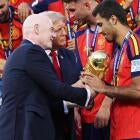
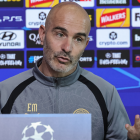
Two days before they would stand on opposite sides of the sidelines, Argentina head coach Lionel Scaloni took part in a long-awaited reunion with Spain counterpart Luis de la Fuente, who was one of his teachers as he pursued his coaching licenses in the suburbs of Madrid nearly a decade ago. It was no ordinary meeting, though – they had a moment to exchange kind words with each other, sure, but they did so with paying customers watching what comedian Kevin Hart would describe as "not a traditional press conference," tennis star Novak Djokovic and Super Bowl winner Tom Brady posing unperceptive questions someone likely fed them.
"I'm not going to tell you what I told him as this was a bit of a surreal situation on this stage," Scaloni recalled later, running a half-hour late to the actual press conference elsewhere at New York's Javits Center during Fanatics Fest. "We met after a long time in this peculiar event but you know I appreciate him very much."
It was a fitting moment in the final weekend of this summer's World Cup, soccer's much-anticipated return to North America 32 years after sports' biggest event came to these shores, this time for the tournament's biggest-ever edition. FIFA has found ways to jam new forms of pageantry into a weeks-long event that has always been defined by on-pitch spectacle while always serving as the world's greatest cultural exchange program. The on-field entertainment and off-field shows have coexisted almost seamlessly, or because there was really no way around it. It is technically a good thing that Katy Perry's rendition of "Wonder," as hyped as it was by FIFA, was overshadowed by the U.S. men's national team's blowout of Paraguay moments later at their World Cup opener at SoFi Stadium, and it is genuinely hilarious that one of the celebrity shots in that very building weeks later ensured we would all be treated to actor Owen Wilson's raw reaction to a miss from Brenden Aaronson.
The experience was uniquely American – or at least lived up to some of the perceptions people have of the World Cup's primary host nation. The tournament was a sight to be seen at just about every turn, both ironically and unironically. It was just as easy to boo the mandated hydration breaks every half as it was to take in the brilliance of players like Argentina's Lionel Messi and Cape Verde's Vozinha.
The World Cup was an unrivaled, unparalleled success in all that it attempted to accomplish, peculiar at almost every stop along the way. It captured a host nation that rarely ever embraces soccer in this capacity. It delivered memorable moments in record numbers, some much more unpleasant than others. This summer had a little bit of everything, getting close to just about every extreme one could envision. Its legacy also the risk of changing the complexion of a centuries-old game, for better and for worse.
First foray for expanded World Cup
The World Cup's expansion to 48 teams was not without its valid concerns or without a selection of blowouts, most notable among them Germany's 7-1 demolition of Curacao in the island nation's first-ever game at the tournament. The expanded format, though, was more entertaining than not, at least in its first go-around.
There was plenty of excitement for a batch of World Cup newcomers or teams that made a long-awaited return, African teams in particular making a case that the continent is full of teams willing and able to create competitive matches. DR Congo's progression to the round of 32, weeks after holding Cristiano Ronaldo's Portugal to a draw, offered its own excitement. Brian Cipenga, one of soccer's many journeymen, scored the game's first goal against England and had a lead over the eventual semifinalists for nearly 70 minutes.
This edition of the World Cup had moments for stars like Lionel Messi and Kylian Mbappe and for the game's newfound cult heroes in equal measure, chief among them Cape Verde's Vozinha. The West African island nation firmly put itself on the map this summer, playing finalists Spain and Argentina even in 90 minutes, earning not only the admiration of their continent but the world. Vozinha himself is an example of the underdog we rarely seen in sports anymore – the Erling Haaland craze, for example, was simply an exercise in discovering an athlete who was already amongst the elites. The Cape Verde goalkeeper had gotten to the World Cup the hard way and left as one of its great standouts.
"In our country, the chances we had to be professionals in sports, it's very small," he told CBS Mornings last week. "First of all, you have to fight for the visa. It's the first kind of things and we have a lot of quality in a small country but it's hard and also when you are in Cape Verde, no one can watch you. We don't have the facilities, the conditions and you have a lot of talent there, even from [the] past. They never had the opportunity, for example, to go Europe and when you can develop. For example, the coaches we have, they do a lot for us but in the end, they don't have the knowledge and even they were ex-football players but they never studied [coaching]."
The new format still had its unfortunate but predictable flaws, naturally. The math of figuring out which third place teams would advance was not only headache-inducing but also counterproductive at times. South Korea and Scotland spent days at their respective base camps, stuck in purgatory as they waited for other results that would eventually knock them out of the tournament. A few of those group stage finales got awfully close to being dead-rubber without being so – Australia's tepid 0-0 draw with Paraguay definitely flirted with the idea of being known as the Disgrace of Santa Clara, while the round of 32 sometimes felt like the extension of the group stage rather than the true start of the knockouts. Several soccer executives with questionable taste (and selfish motivations) will argue the solution is to expand the World Cup to 64 teams to solve that particular conundrum and are already trying to make that a reality for 2030. There is no reverting back to the 32-team World Cup, next summer's women's edition in Brazil essentially a farewell to a perfect format.
Whether or not the 64-team plan comes to fruition, there's a certain amount of judgment to be reserved for the 48-team edition since the sample size is small. The magic of a World Cup, though, is that it can be undeniably entertaining in any format, which has been the main takeaway of the summer.
The U.S. remains the soccer world's ATM
Ticket prices were a talking point in the build-up to the World Cup and reasonably so – FIFA had more than doubled the price of group stage games from the last tournament to this one, seats going for hundreds of dollars for the preliminary stages. The organization's adoption of a dynamic pricing scheme ensured Sunday's final would be one of the most expensive sporting events to buy a ticket to, the worst seats going for thousands.
In the end, it somehow did not matter. Empty stadiums were not a feature of this World Cup, exorbitant prices be damned.
FIFA successfully gauged that the U.S. would be a perfect spot for a tournament where they could rake in heaps of cash, though it was as educated a guess as any. The U.S. is an economically complex country – the national average for annual salary falls just under $70,000 as of 2024 per the Social Security Administration, likely pricing millions of Americans out of a wide array of games. In a nation of nearly 350 million people, though, there will be plenty who actually can spend that kind of money, or can be convinced to for what has been billed as a once-in-a-lifetime experience.
There are several clashing lessons to be learned from the whole experience. Americans, unsurprisingly, love major sporting events and were ready for the cultural exchange that is always the best part of a World Cup. The halftime show at the final did not actually capture the attention of the 80,000-plus at MetLife Stadium on Sunday in any meaningful way but Scotland's fans taking over Boston – and running their beer supply dry – was World Cup fever on full display, as was the fervor for ranch dressing and the obsession with cowboy hats. The U.S. is not just a country that has always captured the world's attention but has always been well-positioned to receive it, even for its many glaring flaws.
That said, there is a reasonable concern that the prices still shut out a number of people that would add a desired fervor to the domestic product and helped build a natural culture that comes along with it. There may have been an opportunity missed along the way, especially since American soccer has historically had a habit of shutting out people of lower income levels, even if they are trying to quit it.
The big question now is whether the party can transition into a meaningful mission to grow the sport in the U.S., something U.S. Soccer is already working on. What is actually unquestionable, though, is that there are enough people in this vast nation that are willing to come along for the ride. The groundswell that followed the USMNT's run to the round of 16 was not a figment of the imagination – more than 50 million people tuned in for their 4-1 defeat to Belgium on July 6, an unprecedented figure for a country that is slowly embracing the world's game. How exactly the popularity funnels into the game post-World Cup is almost hard to gauge, especially as it pertains to the domestic leagues since they may not have made the dent they wanted to this summer. There were already a healthy number of soccer-watching people in the U.S., many of whom have morning routines watching Europe's top leagues, and that number is unlikely to decrease anytime soon.
Undesirable precedents set
By design, World Cups are supposed to offer a little bit of everything and this one was no exception. It was a perfect snapshot of the world we live in today, and in more ways than one.
FIFA will likely take a victory lap on the revenue generated from this summer's tournament sooner rather than later, taking full advantage of the U.S.' over-commercialized business habits – even if American audiences were not the ones asking for it. Fans swallowed the ticket prices with little issue but were consistent in their contempt for hydration breaks, which went from serving a purpose on hot days to becoming obligatory for the sake of advertising dollars FIFA earned with no struggle. It added a gimmick to the whole procedure because it felt contrived, changing the flow of games in a sport that is well-known for its continuous run of play. Considering FIFA measures its success in profit and not fan opinion, the question now becomes whether or not these will become a permanent fixture in the sport at large.
"Before starting this journey, back in May, we had a meeting with the players and I told them how this unique competition, this unique World Cup could pan out – the specifications, peculiarities," de la Fuente said on Friday, resigned to things like a 30-minute halftime and mandatory hydration breaks. "We talked about humidity, time zones, long travels, heat, recovery and we ended up saying it is what it is. From now on and since then, no one's complained. Nothing. No one's pulled a face. Nothing. Everyone's proud of being here. However, I think that everything that we consider to be strange or odd nowadays – hydration breaks, this 30-minute halftime, maybe in 30 years will become a normality. Maybe football is developing that way. We don't know. It is what it is. It's the situation we have. We have to adapt and we need to accept those things we cannot change. We can't change that so we'll have to enjoy it."
There are, though, several unpleasant memories that this World Cup will be known for long after it is over. No matter how you slice it, U.S. president Donald Trump had undue influence over the tournament at several different stages, FIFA slipping into a new mode of hypocrisy as his actions were condoned. FIFA president Gianni Infantino had once promised that all teams would be treated fairly and welcomed to this World Cup but Iran's tournament played out differently. The ongoing war in the country, which began with joint military strikes from the U.S. and Israel in late February, had wreaked havoc on their spell in North America – they were forced to change base camps in the weeks leading up to the tournament, swapping Tucson, Ariz. for Tijuana, Mexico. Their travel in and out of the U.S. was heavily restricted, forcing them to cut training sessions short and limiting their ability to properly recover after games. One of Asia's most talented teams were bounced in the group stage as a result, Infantino's series of promises falling short time and time again.
"FIFA is trying their best, I thank them for that," Iran head coach Amir Ghalenoei said during the group stage, "but it doesn't mean it succeeded."
It was unfortunately predictable that Infantino would march to the beat of Trump's drum on that front, the FIFA president having inserted himself into the head of state's orbit in the years leading up to the World Cup. Trump claims to have exerted his influence on another occasion and in an unprecedented manner – he continues to insist he made the call to Infantino to reverse Folarin Balogun's suspension for the USMNT's game against Belgium, which disrupted the team's focus but also marks quite the overstep. Things have only devolved from there – France asked to have Michael Olise's yellow card rescinded, a decision disciplinary bodies do not make and one that ultimately was left alone and did not impact the group's semifinal run. Golfer Bryson DeChambeau, meanwhile, is now being accused of threatening to call Trump after he received a two-shot penalty at the Open on Friday.
The fact that these incidents will come and go with little accountability for Infantino comes with little shock, even if it inspires plenty of disappointment. The joys of the World Cup always find a way of overshadowing the thorny moments but calling sporting merit into question multiple times over is a stain on this tournament, one that will likely go underaddressed. It led UEFA president Aleksander Ceferin to skip Sunday's final in protest, in particular over the Balogun decision, but who knows if it will spawn any other notable response.
It is the starkest reminder that, no matter how often we try to opt for optimism, it is an intentional choice because of the blatant, unapologetic but intentional disorder when these decisions go unchecked. The best case scenario here is that these incidents are the only flash-in-the-pan moments from a World Cup that has always run the risk of being a singular summer, especially since it was billed in part as the start of a new trajectory for American soccer. It is hard to know if that will certainly be the case as Infantino begins another re-election campaign, forcing us all to balance the fantastic moments from an unforgettable summer with those we desperately wish we had not experienced.