Burning questions for Premier League's Champions League race: Can Liverpool take Arsenal's set piece crown?
Plus, who are Aston Villa, can Chelse behave, and have Manchester United finally, finally, finally turned the corner?

Ten games to go and we've got a proper top four race on our hands in the Premier League. Or should that be top five? English teams haven't mathematically guaranteed their division another spot in the Champions League but such an implausible set of results are needed not only from them but their Spanish, German and Italian counterparts that it is not unreasonable to work off the assumption that there'll be at least five representatives from the Premier League in next season's competition.
That is good news for the sort of teams like Chelsea and Aston Villa whose books would look a lot cleaner with the sort of nine figure sum they could expect from participating in the Champions League. Whether or not both will get it is another matter. The Blues have picked up only eight points in their last five games, Villa five. Both trail Liverpool and Manchester United in the form table and indeed the latter now holds an advantage in the actual table too. Before we get to them, however, we'll head on over to their great rivals.
1. Liverpool, set piece powerhouses?
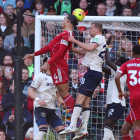
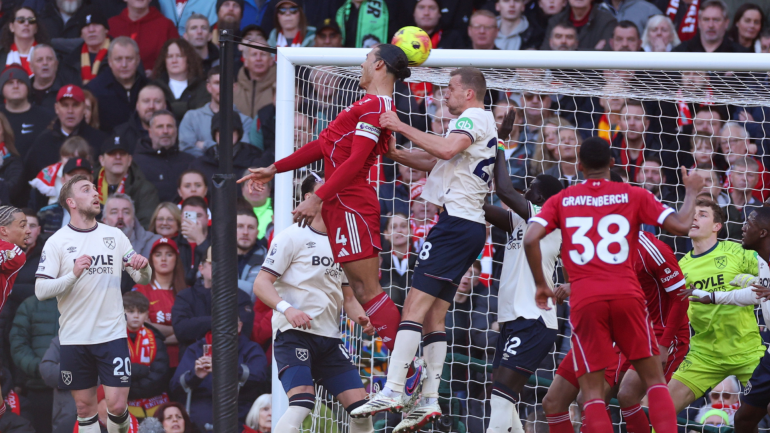
If you're either a Liverpool fan or one of those Arsenal supporters who feel compelled to argue about the framing of every article about set pieces everywhere on the planet, you will doubtless have seen Arne Slot's side garlanded with praise of late. The Premier League's new king of set pieces, the club that decided to sack their set piece coach. Since Aaron Briggs departed Anfield on December 30, the Reds have scored nine goals from set pieces, a tally matched only by the Gunners. Having conceded 12 in 18 league games before their changes in the dugout, they are now at three allowed from 10.
The great stylistic shift, at least in an attacking sense? You'll never guess. Get corner, swing corner into meat wall (credit: Michael Caley), chaos ensues. Welcome to the 2025-26 Premier League, where there's as much variety in set piece delivery as there is the shot maps of your average NBA game. Before parting ways with Briggs, Liverpool had taken 92 corners in Premier League games, almost exactly half of which (47 to be precise) were inswingers, the sort aimed at landing around a six-yard box filled with bodies. Since then, 51 of their 71 corners have been aimed at the meat wall. In the last month, they've taken 28 corners. Guess how many were inswingers.
...
No, you're wrong. It's actually 27. This was the one occasion where Liverpool felt their best option from a set piece was not to hit the meat wall. A goal up, on the road, two and a half minutes left. Otherwise, boys, keep inswinging.
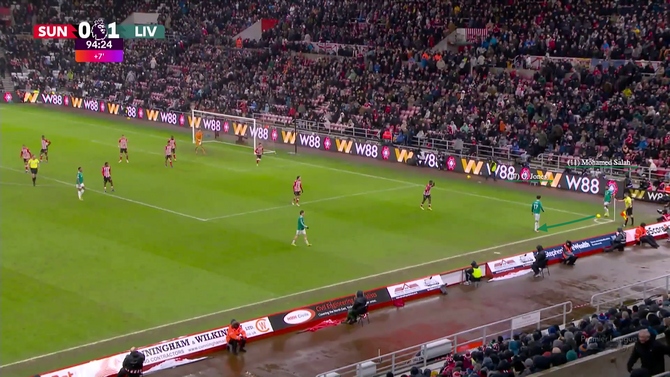
There's a real question for the sport's governing bodies here, or at least the Premier League's, given that in the space of a few months the sport has homogenised quite rapidly. In 2020-21 less than half of the 3856 corners delivered in the competition were inswingers. Even last season, when the threat posed by Arsenal and Brentford was well-established, only 60% of corners swung inwards. In the last month, the league as a whole is a percentage point short of 80%.
Anyway, as for Liverpool, are they now the undisputed masters of this new trend? Not really, although they have the ingredients to be very effective. Mohamed Salah on the left and Dominik Szoboszlai on the right, both hitting the ball at Virgil van Dijk. That has already delivered three goals, and there are a few more from corners that have come to the likes of Hugo Ekitike as well. The set piece that has really separated Liverpool from so many others this season though, is actually something altogether more elegant. What they have that no other team does is Szoboszlai, scorer of 20% of the direct Premier League goals in the Premier League this season. Substitute them from the post-Briggs sample, and you have a very good but not extraordinary set-piece goal output. You also have two quite spectacular free kicks.
2. Are Manchester United a legitimate defensive force?
You've come unmoored from the linear passage of space and time. You find yourself drifting back to Old Trafford, the Friday before the 2023 FA Cup Final. You come across a disconsolate Manchester United fan sporting a fresh new trim and immediately feel compelled to share some blessed relief from the future. Michael Carrick's Red Devils are back in the Champions League places. Their most blindly optimistic fans are talking about the title charge that might be if they win every remaining game. And all of this is coming off the back of what might appear to be a competent defense. It is at that point that the supporter collapses in incredulity. And that's why time travel is dangerous. All the damage you can do, just with a revelation of adequacy.
The attack might get all the expenditure and attention where United are concerned, and rightly so on occasion, but the worst days of the post-Sir Alex Ferguson era have been those where this team hasn't been able to defend what little lead it might eke out. Since 2018-19 there has only been one Premier League season in which United have conceded fewer than one goal a game, and they have averaged 49 against over the last seven campaigns. Letting in more than 38 tends to disqualify you from title talk, letting in the best part of a half-century makes it very hard to reach the top four or five.
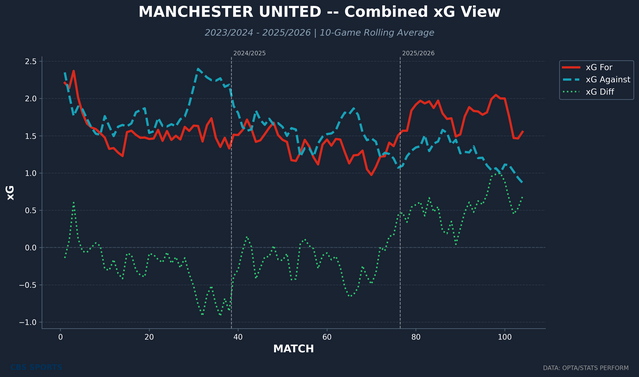
This season, they will almost certainly concede over a goal a game across the course of the Premier League season -- they have already let in their full complement of 38 -- but laser in on Carrick's interim tenure and there is cause for optimism. Six goals against in seven games is all the more impressive when you bear in mind that he started against Manchester City and Arsenal. Such a small sample size is inevitably open to warping by one or two matches, but there really isn't any greater evidence of that. The most expected goals (xG) United have given up under Carrick were the 1.19 they allowed to Arsenal, the least the 0.47 to City. There is a remarkably small delta so far for a team who have allowed just 5.56 non-penalty xG in their last seven games.
A great deal of their recent success speaks to the simplifying work Carrick has done. Stick Casemiro on one side of a double pivot, and you can get high-grade defensive midfielder-ing at 34 years of age. Have your flanks defended by fullbacks rather than repurposed wingers, and you won't be so vulnerable on the counter. Senne Lammens has proven himself to be an extremely competent goalkeeper. That he leads the division in goals prevented -- the post-shot xG value of efforts on his goal minus the number of goals conceded -- might not mean he is the best shot-stopper in the division. We don't have enough of a data sample for him to get anywhere near that, but we can say with increasing confidence that he is very decent. That in itself is an upgrade.
It is also an upgrade not made by Carrick, and it is worth noting that, despite conceding 30 goals in their first 20 games, United were trending sharply in the right direction under Ruben Amorim. After a few clunky games early in the season, this team found a defensive rhythm that they have continued ever since. The return of Lisandro Martinez helped, as did an upswing in Casemiro's form even before the change in coaching. Beyond personnel, you could see a team that was starting to grasp their coach's vision in and out of possession, whose shape was a bit more disciplined when the ball was turned over.
Since then, Carrick has honed United's defense even further with a compact shape, aided by the commitment of players like Bruno Fernandes and Matheus Cunha to getting back and plugging gaps. The vulnerabilities that this team faced when opponents overloaded their wing backs seem to have been squashed out; no team has created a shot from a pull-back against United since Arsenal back in January. To hear Harry Maguire explain it, this has been the most profound improvement United have made defensively.
"We defended our box nowhere near well enough," Maguire said before last month's draw with West Ham. "Every time the ball went in the box, they had a chance, but in the last three games, there has been more urgency, not just from the defenders, but from the midfielders, from the wide men getting back in and the striker protecting the edge of the box."
It's working. Go back to the November international break, and you have a 17-game sample size, nearly half a season, where the only team allowing more shots and xG than United are Arsenal. If United players are seeing signs of improvement under Carrick, then it is building on increasingly stable foundations. The days of this team being unable to repel a stiff breeze look to be a thing of the past.
3. Who are the real Aston Villa?
If this season continues in the fashion it has been going so far, then there could be a few supporters entitled to file a class action lawsuit at Villa Park come late May. There seems to be no better way to get whiplash than following Aston Villa around. They began 2025-26 looking like they were in the relegation scrap. By Christmas, there was talk of a title challenge. Now, well, Wednesday's visit from Chelsea feels almost as risky for Unai Emery as it does the Blues. Come kickoff, they might already be out of the top five.
It is hard to believe that the team that could deservedly beat the top two at home are now the sort who are clinging on against Leeds and were overwhelmed at Wolves. Surely one of these is the real thing, the other a bad cover version? Well, the big picture view of Villa struggles to greatly differentiate between the two.
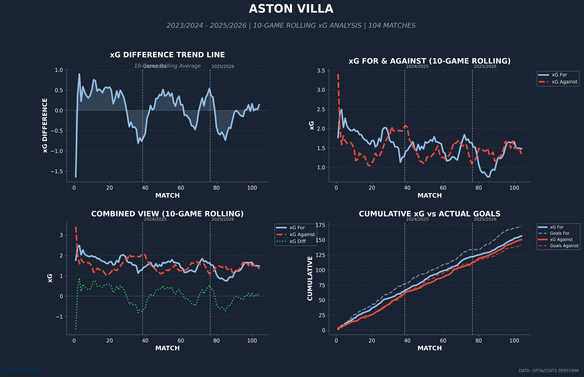
Aston Villa are who they are, and who they are is broadly who they've been for the past two seasons. In their good moments, they have a sustained run of excellence, and there was legitimate cause for concern at how they started 2025-26, but really what we see is a team with the underlying metrics of a slightly above-average Premier League side. Undoubtedly, they have got quite a lot of points for their performance -- more than anyone bar Liverpool, Manchester City, and Arsenal since the start of 2023-24 -- but there were rarely, if ever, sustained signs that the xG difference was catching up with the points return.
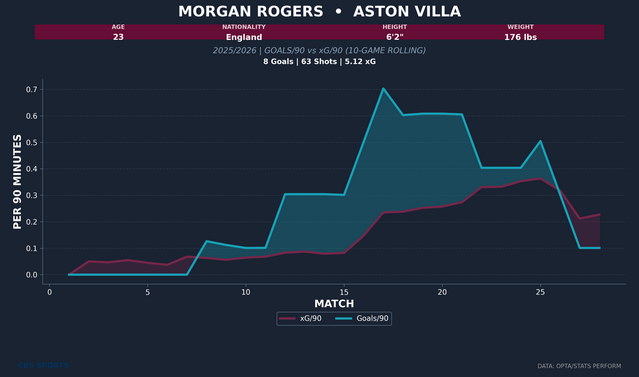
If anything, they are a walking, talking embodiment of regression to the mean. Six weeks ago, Morgan Rogers was dismissing xG as "a load of nonsense" at a time when it seemed like every shot that left his boot from outside the box was bound for the net. Since then, he has taken 11 shots from range and scored none of them. In the same time period, Villa have created shooting chances worth 8.82 xG and scored four goals. Rarely are the numbers quite so on the nose, but the fact that xG is more predictive of future results than goals does not necessarily disprove the notion of football gods who take pleasure in punishing mortals for their presumptiveness.
Beyond being an above-average Premier League team who have achieved a great deal, perhaps what we might say with some confidence about Villa in their third full season under Emery is that they look like a streaky team. You have the 12 wins in 13 games late this year, a run of nine wins and three defeats to close out last season, and 10 wins in 13 late in 2023. Now that might just be a low-scoring sport, throwing out numbers and us spotting patterns. It might also speak to a club that can field a very strong XI at full strength, but that, aside from when they made some smart loan signings in January 2025, don't really have the depth to weather injury storms like the one their midfield is in the midst of right now.
Even there, though, we are talking about the edge cases, the sort of high form moments that every team has, and that when captured on long trends don't exactly support an argument of Villa briefly clicking into super team status. So who are Villa now? And who were they when they were in the title race? The same as they ever were (under Emery, let's not get pedantic here). Same as they ever were.
4. Can Chelsea keep 11 players on the pitch?
After Chelsea's 2-1 loss to Arsenal at the weekend, the consensus was clear. Chelsea this season have been far too ill-disciplined. It can't go on like this. It can. This is a well we were drawing from back in December 2024, when we warned of the overwhelming volume of yellow cards Chelsea were receiving for acts of ill discipline, just like the act of dissent that put Pedro Neto on a disciplinary tightrope when Gabriel Martinelli was breaking away at the Emirates Stadium.
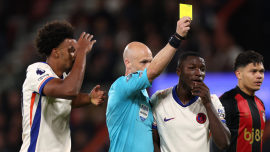
At that stage of last season, Enzo Maresca's side had the most in the Premier League since the start of 2023-24 by a ludicrous 30%. The bad news is that they now have 55% more yellow cards than the second worst offenders (Bournemouth, bet you'd never have guessed them) for what we might term deliberate, not defensive acts, which Opta classifies as follows: dissent, time wasting, excessive celebration, arguments, fighting, off the ball actions, encroachment, abusive language, entering or leaving the field of play, entering the referee's area, excessive use of the review signal, not retreating and diving.
In their last 104 Premier League games, Chelsea have received 125 yellow cards (two of them second yellows) and one red for what we might term ill-discipline. That is to say nothing for the moments like that on Sunday when Neto made what is a very silly tackle by a player who has already been booked and a quite sensible act of sportsmanship from someone who hasn't. This is a tally completely out of whack with the sides they might compare themselves to. Liverpool, Manchester City and Arsenal have between 47 and 56. Even Newcastle United, who so infuriate big teams with their occasional indulging of cynical ploys, only have 63.
There really are no signs that the careless attitude of this very young team has improved since we last visited the topic. In 28 games, they have 28 such yellows. Enzo Maresca got one too for his wild celebrations against Liverpool, and while no one here would want membership of the celebration police, maybe the old Chelsea boss could have curbed his enthusiasm when his players find that so difficult to do.
Certainly, his successor, who has presided over 13 instances of ill discipline yellows in eight games, is determined to stamp this culture out. "I can't afford to go for a season every two or three games with a red card," said Liam Rosenior. "It's just not possible. I need to see improvement in that. I need to adjust my team selection based on who is showing those capabilities."
If that is indeed the case, expect Cole Palmer, 15 yellows for the aforementioned actions, and Enzo Fernandez, 14, to either improve their behaviour or find themselves out of the XI. That might seem extreme in the case of two of Chelsea's most talented players, but this is a team that has probably been the third best in England this season at full capacity, but who keep taking it on themselves to decrease their numbers. If that doesn't change soon, then they will not be playing Champions League football next season.