Jurgen Klopp's influence looms large at RB Leipzig one year after taking Red Bull job
Klopp joined Red Bull as the head of global soccer at the start of 2025, a job he describes as 'an advisory role but with power'

•
11 min read
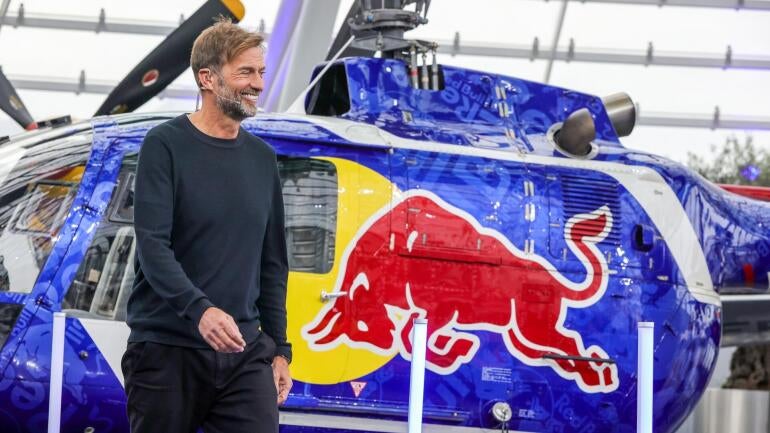
LEIPZIG, Germany – There is an unflinching honesty that seems to be shared by many at RB Leipzig about where exactly they rank in soccer's food chain of clubs, one that sneakily escapes coming off as harsh through casual, matter-of-fact delivery. Two days before a game against Bayern Munich slipped completely out of reach, captain David Raum did not hesitate to say his side would be able to give the Bundesliga leaders a real challenge while admitting that winning the DFB Pokal was a much more realistic goal for them this season than fighting for the league title. Jurgen Klopp, now the head of global soccer for Red Bull, was perhaps even more blunt.
"If Leipzig wins the league anytime, we'll probably sell the five best players," he admitted, "Next year, you have to find five players who have a similar quality."
As cognizant as they are of the reality in front of them, though, they are equally unfazed by it. Last season's failure to qualify for the UEFA Champions League, only the second time missing out on Europe's premier club competition since their first trip to the competition in the 2017-18 season, Leipzig have leaned on the tried and true strategies that has made them one of Europe's most consistent clubs. A batch of fresh faces in the last year and change, headlined by Klopp, have only reinforced an idea to take the club back to basics while putting their own spin on things. The people that make up the club do not shy away from admitting some ambitious goals – managing director for sport Marcel Schafer, for example, rattled off a list of teams that have pipped Bayern to the title in the last two decades and hopes Leipzig join their ranks one of these days. In a sport where superclubs with incredible financial might tend to reign supreme, though, Leipzig are not actually aiming to break into the elites.
"You might see pictures where people give me the trophy," Klopp said. "I didn't take my pride out of that. For me, it was the journey that I loved. That gave me much more than the moment."
Leipzig's reinvention this season outlines Klopp's ambitions with Red Bull a year into his very expansive role, which includes oversight across a global network of clubs in which the ex-Liverpool manager is fully invested in. The plans laid out by Klopp have positioned Leipzig – and the other clubs in the network – to settle into the unique comfort of prioritizing style over anything else, a departure to clubs around them who discard style as often as they do the coaches who define themselves by their tactical ideas.
"I think we need to be honest to ourselves," Schafer said. "We need to be realistic. There are 10, 15 – depends a little bit on the situation – clubs who are above us and in my opinion, they will be, in three and in five years, still above us regarding the history … They have an economic situation which is far away from our situation and it's not Red Bull's style."
Klopp's spin on Red Bull's style
Leipzig, as always, hold true to the principles that were laid down long before Klopp entered the picture – a high-intensity approach built around an attack-minded focus with and without the ball. Under new coach Ole Werner, who joined the club in the summer after several years with Werder Bremen, though, some of the specifics have changed.
"With the ball, we play a little bit different," Raum said. "A different formation but we play with clear wingers now and this helps us as fullbacks because we have very, very good wingers, good one-v-one players and if we can bring them into the game, it's very hard for every opponent and last season we played more with a [No.] 8 and wingers, they played more from the middle so I had the full line as a fullback and this season, it's more different because I have one in front of me and we can play with double wings. A little bit different but I like it."
Emphasis on wide players is an immediate throwback to Klopp's Liverpool team headlined by Mohamed Salah and Sadio Mane on the flanks, though he also cites Luis Enrique's Champions League-winning Paris Saint-Germain team as a more modern example of the successes of that strategy. It arguably paved the way for Leipzig's signing of Yan Diomande from Leganes over the summer, who is amongst the Bundesliga's most impressive rising stars in his first season in Germany's top flight. Leipzig paid around $23 million for the 19-year-old's services despite very little experience as a professional footballer but he was a perfect match for their new approach, his seven goals and three assists so far this season indicating as much.
"We played for many years a 4-2-2-2, not really wingers, it was inverted wingers and now, latest after the arrival of Jurgen Klopp, everybody knows him, everybody knows his style of play and his teams and the system but we have the same idea with the same thoughts for the future. We want to play with clear wingers, wingers who have an athletic profile and high intensity with and against the ball. players who try to handle one-v-one and of course, scoring ability and speed."
Player retention, as Klopp noted, is not much of a focus for Leipzig, a decision that feels inherently practical. For starters, the club has an impressive track record of acting as a launching pad for players like a real estate agent eager to land an HGTV show about flipping homes – the likes of Barcelona's Dani Olmo, Manchester City's Josko Gvardiol and Bayern Munich's Dayot Upamecano had their breakthroughs in Leipzig, their former clubs pocketing a nice chunk of change each time.
"We want to help and to support players for a certain time in their career so we want to sign players – young hungry, high potential – we want to work with them, we want to develop them until a certain stage," Schafer said. "Hopefully to an [absolute] maximum on their position in the Bundesliga … We always need transfer revenues but this is good because it fits to our philosophy, [gives] it a little bit pressure and again, at a certain time, if a player like [Christopher] Nkunku, Gvardiol has such a big offer on the table, we know exactly that. How can we block this?"
Amidst the sport's increased fixation with spending power, financial might and titles essentially go hand-in-hand, leaving many to assign existential crises to the clubs who have fallen short in either category. Klopp has another blunt – and humorous – response to that prompt, too.
"Money's a real subject in England," Klopp noted. "In Germany, we just accept that Bayern [Munich] has more money so we don't think about it. … Everybody knows it. Who cares?"
For someone who has found more reward in the journey than in the destination during his storied coaching career, though, it should come as no surprise that Klopp is happy to define Leipzig's success as something more complex than just lifting trophies.
"That's worked out really well here because seven years in a row, they qualified for the Champions League. How did they? By selling some of the best players, best prospects in European football," Klopp said. "I kept [the strategy] because they were independent … That works in all leagues but takes different time."
Klopp's emphasis on coaching
One area of improvement in terms of player development Leipzig have identified, though, is through their academy. The club has seen very few players break through their youth ranks and become regular professionals in the Bundesliga, entrusting ex-Huddersfield Town manager – and Klopp's former colleague at Borussia Dortmund and longtime friend – David Wagner with the task of reversing course. Like Klopp when he left Liverpool, Wagner was in search for a change of pace and found it in Leipzig and comes to work every day with clear goals passed down to him from his higher-ups.
"They said, 'Listen, you get hired because of two reasons and you create here a football club was successful if first, we will do what we've never done so far, that we will establish an academy player in our first team permanently, not only for two or three games, permanently, that we find an academy player that we can educate, an academy player who can be in our first team for three or four seasons, playing 150 games. The second one is we have to make sure that we have coaches in our academy that for the moment, where we search a coach in our multi-club owner system for whatever club, wherever in the world, you can raise your hand and say, okay, I have one here so take him.'"
Wagner believes a handful of things need to go right at the exact same time to get an academy to churn out top talent, above all a set of coaches at all levels who are willing to take bets on young talent and foster their growth. The multi-club model, he believes, can help facilitate that – he has built relationships with his counterparts in New York and Brazil in his first six months in the job, arguing that Red Bull could do a better job of utilizing the entirety of its resources to further player development.
"I think in terms of get the right club for the right talent at the right moment," Wagner said. "Let's say a top talent age of 16 or 17 does not start in the team which he deserved to start. Maybe then we have made the wrong decision. Maybe he should go on loan to this club to start there on the right level rather than to be on the bench on this club and only start 10 games in a year. It's all about playing, starting games and there we have to look in the mirror and be honest to ourselves. Have we done everything right that we found, for player X, the right level? If he only started 10 games in this season and we rated him as a top talent, then it was not the right team, then it maybe is a team below and maybe this team below is not in my club because the team below is three levels below. This means the team below has to be in Japan or wherever and I think we haven't used this as much as we could have done."
Finding the right coaches for Red Bull's various teams means, naturally, that they have to be a stylistic fit. The company's tactical preferences are ultimately why Wagner took his new job, but it also applies further up the chain of command. In Klopp's first year with Red Bull, a handful of teams under his purview have gone through managerial changes, including at Leipzig and New York. The company's global head of soccer has heard himself described as a "gravedigger" for coaches, which is "pretty much the last title I ever wanted to win," instead seeing himself as an advocate.
"I'm 100% involved without making the decision," he said. "I'm the one who fights the longest for the coaches, definitely. It's not that I'm coming in the morning like other people in European football recently and tell them, 'We lost the game – sack him!' No, that's not me, obviously. I understand and I really fight for the coaches but, that's how I said, I expect real impact [from] the coaches as well."
Those expectations are, of course, results-driven but Red Bull's longstanding stylistic preferences lead the way.
"Right now, there's a development in football I really find strange," he said. "When I was in England and I came back, all of a sudden, there's a revival of man-marking. Man-marking died mid-90s, early 2000s because always, the better team wins. Now, the best teams, they man-mark, that makes sense for them because they have the best players. It doesn't make sense for anybody else. If you don't have the best players, why are you man-v-man? It means we lose a lot of these one-on-one situations so why would you play it? … This is a word I didn't know I learned recently – mirroring the opponent. Why would you do that? It means you spend a whole week mirroring somebody you play only once. Why would you do that? We were completely dependent [on] what they do. We suffer from it – sometimes, because they were really good, but because we could work on our own football and now we are always prepared to destroy somebody else. We try to make sure that nobody can do what they want when they play us."
For the coaches who do end up on Red Bull's books, though, Klopp has nothing but time for them. This is perhaps the reason he keeps turning down Real Madrid whenever anyone asks if he's interested – or other roles, for that matter.
"My idea with the coaches, which is obviously my expertise, because I did it in the job, is to be the guy I never had, nobody ever had in football, in this business. I sat in my office very, very, very, very often very, very, very alone," he recalled. "I never had to be in those difficult times alone but making decisions means you're alone … Now, I want to be in the moments when I feel, when I know they are alone and feel alone, I want to be there. Talk to me about it. I will not judge it because I know. That's what I said. I never considered myself as a world-class coach because I had so many questions. Still, when I finished, I was like, 'How can I be world-class with all these questions?' And I know they have questions as well."