The game does not care who you are, what greatness you've achieved, how you'll be remembered or how many millions of people have pictures of you hanging in their homes.
Sometimes, the game is the game and it can be so unconcerned and cruel in its sendoff.
Such was the case Sunday afternoon in New Jersey at the World Cup final for one of the greatest soccer players the world has ever known, Lionel Messi. Had Argentina won, it would have instantly ranked among the most historic victories in world sports, the rare occasion of a repeat World Cup champion (and the first since Brazil in the 1960s). But that did not happen. Even Messi's brilliance has its boundaries, and like so many other global sports icons, he does not get to conduct a championship apex in the final act of his fabled career.
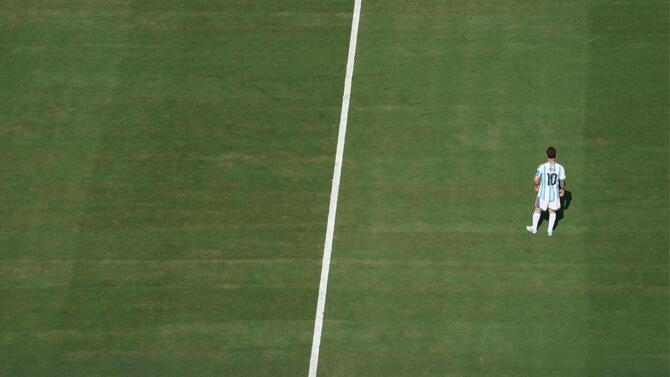
So, congratulations to Spain for one of the more methodically suffocating championship-match performances ever. La Roja won 1-0, the winning margin coming from the foot of a reserve, Ferran Torres, in extra time.
In what's not yet officially (but all the same believed to be) Messi's final World Cup, No. 10 failed to make a mark against an all-time Spanish resistance. Spain just pulled off the best defensive run by a World Cup champion in the event's 96-year history. Eight games played, one goal allowed. ONE. Uno. A record, and an astounding one. That level of stubbornness will probably never be matched in our lifetimes.
Spain have gone 38 consecutive games without being defeated, a record in international soccer, and that is as clear a reason as any why Argentina could not summon one more miraculous coup. (As was this stupefying statistic: Argentina did not register a single shot on target across 120 minutes.) That group of swashbuckling escape artists didn't muster the creativity, ability, vigor or desperation to get one more win for a man who sure seems like he's got the best case of them all as the best soccer player in history.

Messi even making it to the final with this Argentine supporting case was incredible in its own right, akin to LeBron James taking the Cleveland Cavaliers to the 2007 NBA Finals. You can make the case it was just as impressive as winning the whole thing four years ago in Qatar, which is the critical bullet point on the résumé that gives Messi credence to being the best footballer in history. Had Argentina been felled in the quarterfinals or semis it would have been even less a shock than a shame, but Messi's will to get them to the final day of the competition is all the more reason why he's an eternal talent.
It's easy to take greatness for granted, but we weren't guaranteed to see him on the Cup's last day of competition. Yet there he was again, becoming the first person to ever start in three World Cup finals.
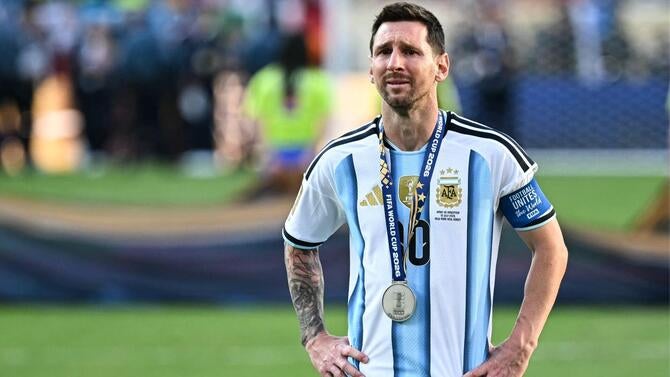
What a twist to see the legend not only silenced on Sunday, he was largely reduced to something that feels wholly inappropriate: an afterthought. Messi was mostly MIA, but that has as much to do with Spain's strategy as it does his 39-year-old body. (Messi, after all, was mere days removed from an instantly iconic reaction/GIF that will outlive us all and seemed to set into motion Argentina's comeback over England.)
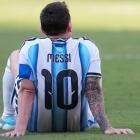
Only just before the final whistle, in the dying last minutes of extra time, did Messi find a chance to try and send an outrageous bender from beyond the box … but it was just a bit too far and a bit too wide. So, barring the truly unthinkable, that 2022 title will be his one and only. That realization seemed to hit him to the core right there on the field as Spain celebrated its second World Cup conquest.
Thank you Messi, no matter what's next 🩵 pic.twitter.com/QCQQUdRPgB
— FOX Sports (@FOXSports) July 19, 2026
Messi probably hasn't played his last competitive game, but this surely seems to be it for his availability on a World Cup pitch. Sunday's no-show aside, what a farewell tour we got. There was the hat trick against Algeria on June 18, a performance that reminded the world of his brilliance — and is also his one and only World Cup trifecta. More recently, in the knockout stage, Argentina pulled off its Egyptian escape in the quarterfinals, followed by the bloody L delivered to England in the semis, with Messi providing the assists on both strikes that shot La Albiceleste into the final — his cross to Lautaro Martínez as thrilling a highlight as any across 104 Cup battles in the past six weeks.
Here in the U.S., it's easy to sometimes underestimate the global fame of the global game's biggest stars. Some of America's biggest athletes can pale in comparison to the modern supernovas of Ronaldo, Mbappé, Haaland, Kane and, biggest (yet smallest) of them all: Lionel Messi.
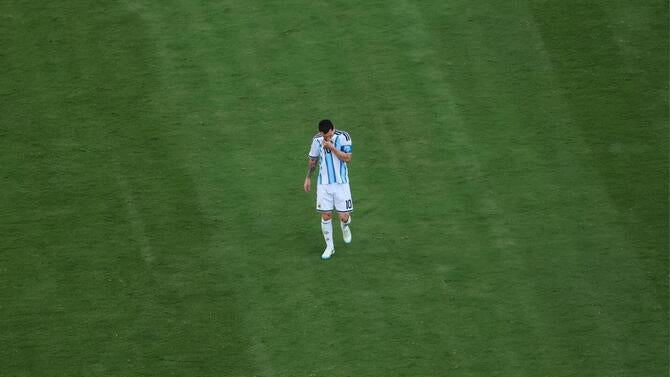
Ranking his prestige would be pointless — just know he's just in the group of the greatest ever. The sports public (and its media) can be all too prone to overstate the importance of its athletes, but there are those who are for the ages. Competitors whose achievements and images and lore will still be referenced and talked about hundreds of years from now. Messi's company includes the likes of the ones who only need one word for identification, all of their names shorthand for unequivocal greatness: Jordan, Ali, Tiger, Serena, Bolt, Brady, Shohei, Phelps, Pelé, LeBron, Biles.
And there's another at that table who feels particularly apt, comparison-wise: Gretzky.
Unquestionably the greatest his sport ever saw, Wayne Gretzky has a few common attributes with Messi. They're undersized relative to their peers, which makes their achievements all the more incredible. They are better than what feels physically possible, or allowable, yet there they go time and time again. They can pass just as well as they can score. You always have to account for where they are, and to the average viewer, your eye just drifts to them like magnetism.
There's a little Steph Curry in that analogy, too. Messi and Steph are sport-shifting talents who were so gifted, they changed the way the game was played. As they did it, they sparked dreams and motivations in untold millions of kids to play just like they do. They see Steph, or Messi, in themselves.
Messi's power is so weighted in soccer, and in global sports, that the World Cup's ending seems just as much about him, and what he's done, and what he might do next, as it is about the team that won the tournament.
And what a tournament this was. Maybe the best World Cup ever, even if the final was a dud. It brought the beautiful game's biggest event back to North American soil for the first time in 32 years — and delivered incessantly. Most of soccer's biggest stars came through, so much so that it feels like soccer will grow all the more for the American sports fan in the years ahead.
That, too, is thanks to Messi more than any other player. His decision to play for Inter Miami since 2023 whet the appetite for the World Cup in 2026. I have covered sports for the past two decades — which is essentially as long as Messi has been a massive star. At no point did soccer in the United States feel as big of a deal as it did in this past month. This was a watershed moment and Messi was as big a motivating factor as anything else.
It's hard for us to send off our sporting greats; sometimes it seems harder for the public than the athletes themselves. But whatever comes next for Messi, no matter how many games are left for him to play, his legacy is etched in eternity. One of the world's most important athletes ever, of course, but also the man who made soccer feel like something the United States is finally ready to fully embrace on a mainstream scale moving forward.
Knowing this country's complicated and erratic history with the sport, that's as incredible of a feat as just about anything he's ever done.