How Mikel Merino has become more than just Arsenal's emergency center forward
The Spanish talent has been a crucial piece for Mikel Arteta as the Gunners state their case for major silverware

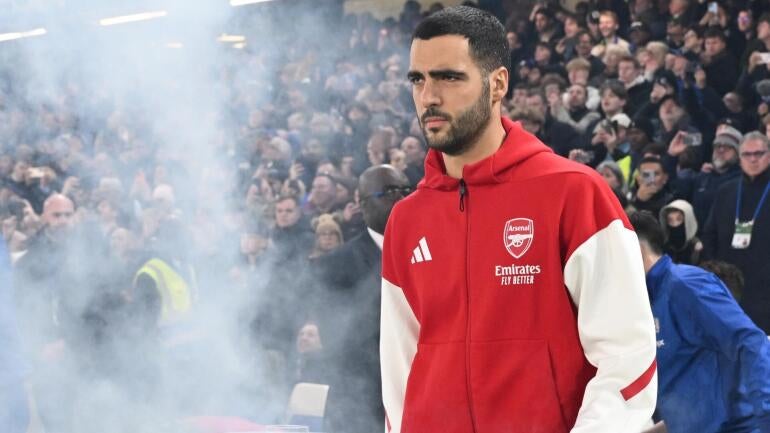
LONDON -- At a pivotal point in the 2024-25 season, Arsenal needed someone, anyone who could take on the mantle of center forward, maybe weigh in with the odd goal and just give their injury-addled team something of an outlet at the top of the pitch. Injuries to Kai Havertz and Gabriel Jesus meant every senior center forward was sidelined and so Mikel Merino was thrust into a role he had not been signed for. He adapted quite reasonably, delivering the goals in some of the biggest games that allowed him to float around the peripheries of the others.
At a pivotal point in the 2025-26 season, Arsenal needed much the same. It turns out that no matter how much squad depth Mikel Arteta has, he's going to be obfuscating over the fitness of three or four key players, many of whom will be attackers. He spent his summer worrying how he was going to manage a strike force of Viktor Gyokeres, Havertz and Jesus. It's December and he's still weeks away from that particular headache. Instead, he has a different one to go with the many, many injury questions. Do any of his other striking options merit stealing the starting spot from Merino?
After all, this is a position he has made his own. If last term was about the Spaniard filling in in a pinch, this has seen Merino make the center forward role his own. No longer do Arsenal play with a box-to-box midfielder masquerading as a nine. They now play with a low-touch midfield eight, a last gasp box crasher and an old-fashioned target man all in one eminently cromulent package. In other words, they're getting all the qualities that drew them to the former Real Sociedad midfielder in the summer of 2024, just in a different spot on the team sheet (and perhaps not on the pitch). In Merino's second run at center forward, he has made the position work for him. Arsenal are all the better for that.
This, then, is not a player you would necessarily take out of your attack just because the guys you actually registered as forwards are now back in the picture.
As Arteta said, this is a player whose presence in a position he had never played before the start of this year makes Arsenal better. That is no small part down to Merino's own commitment to improvement.
"It's curiosity and his will to learn and probably his will to help the team. He knew that we had a major problem from the beginning of the season. We lost Viktor, Kai was out and Gabriel Jesus was out. We needed a solution," Arteta said.
"He did it last year really, really well. I think this season he's probably taking it to another step because he's able to do even more things."
What are those things? For starters, Merino, the center forward is finding himself in the midfield spots he knows so well altogether more frequently. The sample sizes of minutes in which he has led the line are still small enough to be open to a bit more variance but the most notable facet of the action bins below is how the proportion of touches in the penalty area have dropped from 9.5% to 5.4%.
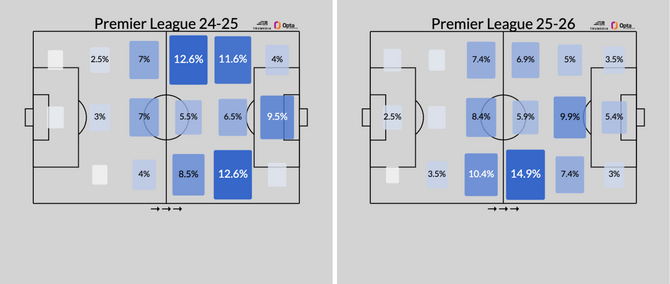
In that first dalliance with center forward-ing, Merino tried to be a real striker. That meant waiting for the ball to come to him and perhaps not offering the strength and technical qualities in build up that Havertz often delivered and that are within the skill set of any Spanish international midfielder.
Arsenal's link man
Now Merino is moving towards the ball, creating the box midfield with Arsenal's number 10, that has been a recurring theme of recent games. It has consistently been successful. The center forward dropping into midfield makes it easier for Martin Zubimendi or Declan Rice to split the center backs and aid the build up without compromising their team mates numerical situation in the midfield. Of course, it also leaves the opposition defense with no fixed reference point to defend against. The stretching runs in behind from Gyokeres keep a backline on their toes, Merino's movement lulls them into mistakes.
Nowhere was that more apparent than in the win against Tottenham. A brilliant assist for Leandro Trossard's opener was the peak but how often did Merino's movement open up space for others to exploit? Take the still below.
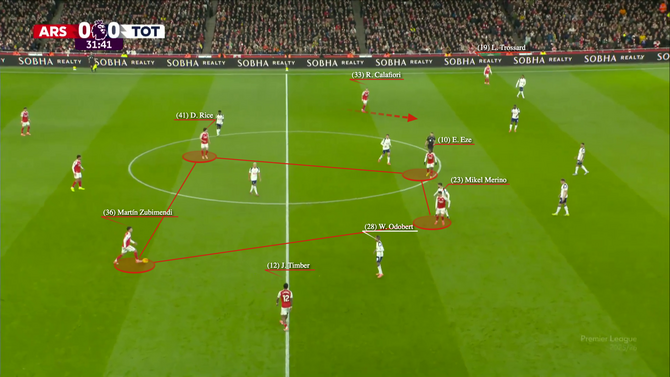
Arsenal have four in central areas against at most three Spurs midfielder, Wilson Odobert having to pay attention to Jurrien Timber and Richarlison hardly the picture of industry. Meanwhile the visiting back five doesn't have a single center forward to deal with. Instead, it must be live to the threats posed from so many angles, from Bukayo Saka and Trossard lurking menacingly on the flanks to the inevitable mad charge up the gut from Riccardo Calafiori. In instances like this, Arsenal have control, threat and unpredictability. No wonder the goals are flowing for Merino and others.
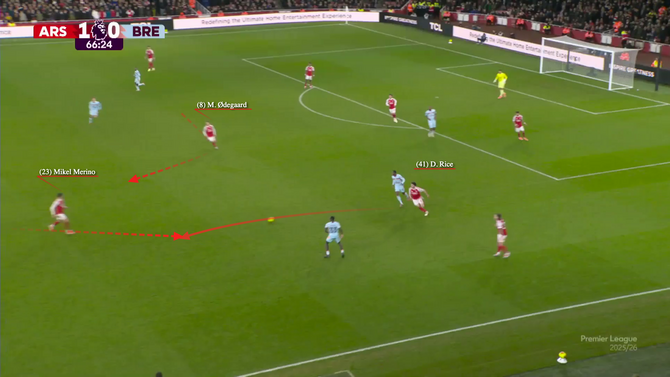
Dropping deep, it's also no wonder the Spaniard's involvement in play is skyrocketing. Last season, when playing as a center forward, he averaged 32.6 touches per 90 Premier League minutes and attempted 19.1 passes. Now those numbers are up at 45.3 and 29 (by way of comparison, Gyokeres averages 26.1 and 12.1). Merino functions as something of an aggressive midfielder in possession, a little looser with possession than a Martin Odegaard would be but always looking to push Arsenal upfield. The below is prime false nine play, Merino dropping deep into midfield and bringing a center back with him, opening space for a quick offload to Odegaard, who finds himself in space with runners ahead of him.
This wouldn't be the only time Merino excelled in build up. Similar movement in the 91st minute and he was able to roll a pass into Saka's stride, the Arsenal forward eventually delivering the goal that made certain of a five-point lead at the top of the table. The five assists he already has this season are a tally the 29 year old has bettered only twice in a long career.

That was not the pass Arteta chose to focus on, however. He was instead more impressed by a lofted through ball in the direction of an imagined Odegaard and the run Merino made to recover the possession he had given away. "He makes 40 meters to chase it to the corner flag and goes back, wins the ball back," said the Arsenal boss. "He is everywhere ... He makes the team much better."
All those little things add up to a compelling center forward, even more so when the changes laid out above haven't compromised Merino's goalscoring. He is taking 1.8 shots per 90 Premier League minutes as opposed to 2.3 last season but (small sample size caveat and all) the quality makes up for the drop off in quantity with him averaging 0.34 xG per 90 as opposed to 0.3. Around the box he might just have the best instincts for a chance of anyone in an Arsenal shirt. "He has that smell for goals," said his captain Odegaard. "He's always in the right areas and he's so good in there, so all credit to him."
Does Merino start over Gyokeres?
Given all that, the answer for Saturday's early trip to Aston Villa is obvious, right? Don't worry too much about the lack of rest and the availability of Gyokeres and Jesus, just let this Merino thing roll? Well, maybe not. For one, there is the immediate fact that Unai Emery's aggressive defensive line could be inviting for Gyokeres. More than that, though, even with all the other facets that Merino brings to the game, Arsenal's line probably shouldn't be led by someone who is a fair way short of two shots per 90. The same is true of a player who averages just over three touches in the box.
Certainly, the idealized version of Gyokeres, a shot monster who can bully center backs and stretch defenses deeper, is the best option of those currently available to Arteta. The best you could say about the summer's marquee signing is that Arsenal have seen that idealized version in flashes: a powerful display against Burnley just before his injury, the bullying of Olympiacos center backs in the Champions League. Even this limited version of Gyokeres, though, is just about doing more than Merino without getting the goal return to reflect that.
| Gyokeres | Merino | |
|---|---|---|
Goals | 0.33 | 0.45 |
Shots | 2.07 | 1.79 |
Non-penalty expected goals | 0.41 | 0.34 |
Penalty box touches | 6.53 | 3.13 |
Total touches | 26.01 | 45.33 |
Passes attempted | 12.08 | 29.03 |
Progressive carries | 2.61 | 2.01 |
Take ons | 1.85 | 1.34 |
Per 90 Premier League minutes, Merino stats when playing as striker
For most other teams, the extra bits and pieces they get from a center forward might just be worth compromising for a couple of shots and a shade less xG. Arsenal aren't most other teams. They are one who can afford to sacrifice a bit more control deep for the guy who will get them the most possible chances in the penalty area. That probably isn't Merino.
What he is, however, is more than just someone who can do a job. Merino is no longer a forward of the smash glass in case of emergency variety. It's a viable option in a team that, on the basis that the best predictor of future injuries is past injuries, might just need someone to pick up the striking burden again.