Day three of the 2026 World Cup and with it the first true smorgasbord of international football. I'm sorry, but a tournament isn't really a tournament until I'm having to negotiate with myself about my bedtime. Here in the U.K., that 6 p.m. ET Brazil game is making all sorts of eyes at me. That and then watching the Knicks win a championship straight after? Turns out you don't need to be in the States to set your body clock to World Cup time.
Beforehand, it's Qatar and Switzerland, a game you simply cannot deny will be played in Santa Clara. Then we head into Haiti's first game at a World Cup since 1974, Scotland's first since 1998, before rounding off the evening/kickstarting Sunday morning with a potentially significant clash for USMNT fans as Australia face off against Turkiye in Vancouver.
Brazil: Set-piece kings?
The enduring image of the Brazilian national team was set in glorious technicolor in the summer of 1970. This joga was all the more bonito in that glorious flash of yellow, blue and white against the parched seagrass of Mexico's arenas. Pele's gliding, Jairzinho's quick feet, Rivellino's technique: you might not have even been alive when this Brazil ruled the footballing world, but it probably defines your image of them.
What won't is that this was a side that was at the cutting edge off the field too. By 1970 Brazil were using data from NASA's human stress laboratory and inflicting the Cooper Test on their players to ready themselves for altitude. In 1994, led by former fitness coach Carlos Alberto Parreira, the eventual winners were pioneers both in tactical periodization and data, buying in the services of Zvi Friedman and Jon Kotas to deliver one of the sports earliest data models. The tale of the tape for a championship-winning Seleçao is often about how they have pioneered or at least embraced new trends in the game. Apropos of which, might I share with you how Brazil were lining up for their corners in their final pre-tournament friendly?
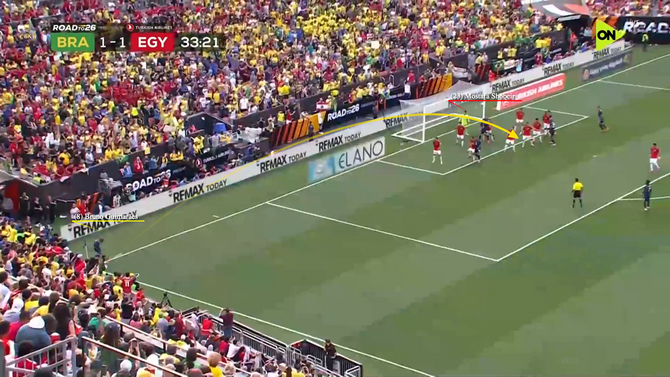
A bit light on attacking numbers, but as an early swing at a meat wall corner goes, well that's pretty decent. Look at how many bodies -- admittedly many of them your opponents' -- you've packed into such a small area around the six-yard box. Mostafa Shobein claims this corner well, but really these deliveries are an invitation to chaos. I've written in what some might term parodic detail about what could be the World Cup of the set piece this summer, whether FIFA want to stop it or not. To precis those 4000 words, the past few seasons of club football have seen a rush to embrace corners aimed into a packed six-yard box where bodies (purposefully or inadvertently) block the goalkeeper's route to the ball, and it only takes one touch to score.
Brazil are not going to be the only exponents of this approach, which they seem to have embraced enthusiastically for their warm-up games after not really using it much earlier in Carlo Ancelotti's tenure. England are going to be leaning on these. Czechia tried something not too dissimilar against South Korea. So did Canada against Bosnia and Herzegovina.
What those teams don't have in quite the same abundance as Brazil is the best targets in the six-yard box. Bremer scored a handy three set-piece goals for Juventus in Serie A this season, but he might only be a tertiary target. Gabriel Magalhaes might not score that many, but that is largely because two and a bit years ago, opponents started preparing for his arrival in the penalty area like a besieged army. Batten down the hatches, don't let that battering ram near the gates. That'll be easier said than done when the other target Bruno Guimaraes and Raphinha get to aim for is Casemiro, scorer of eight goals from dead balls last season.
That's a lot to aim at, a lot of big heads that could smash Brazil through some glass ceilings. If this is to be the World Cup of set pieces, then that might be very good news for the five-time champions.
Johan Manzambi could be one to watch
One of the stars of Freiburg's run to the Europa League final, Johan Manzambi might not have got a winner's medal in Istanbul last month, but he ended the tournament with two things that were arguably only slightly less significant: being named the competition's Revelation of the Season and with oodles of transfer talk, including links to Bayer Leverkusen and Napoli. A quick look at his data and you can see why there is such interest.
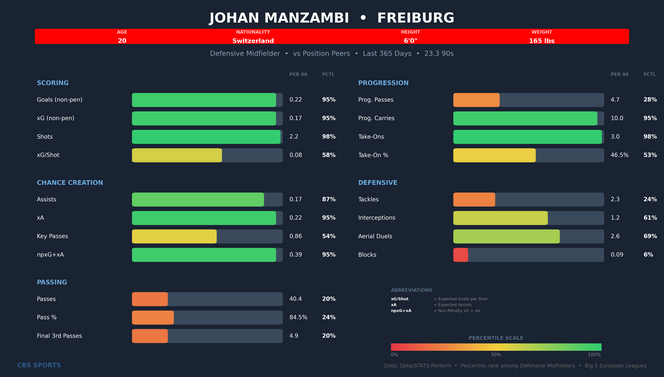
The first instinct when looking at bars that are so green and so orange might be to focus on the latter, and see a player who does not pass the ball much at all. However, a great deal of that will be down to the needs of Freiburg, who, even by Bundesliga standards, are not exactly big on high numbers of passes in their possessions and average barely three passes per attacking sequence, nearly 15% less than the average in a transitional league.
On the international stage, it is equally possible to get the best out of Manzambi if he is paired with the right talent. Imagine him driving from box to box with a Granit Xhaka-type volume passer in midfield. Well, good news for Switzerland, they have a Granit Xhaka-type. (Because my editors insist on me making this column approachable for you, whatever your level of soccer engagement, I should now note that Switzerland's Granit Xhaka-type is Granit Xhaka).
Manzambi has generally been used out wide by Murat Yakin, partly to cover for Swiss deficiencies in those areas, but Xhaka is already readying the 20-year-old to take his spot in the engine room. "He is an extraordinary captain," Manzambi said of his skipper. "Many teams would like to have a captain like him. He welcomed me very warmly, and we talked a little before I joined the team. He gave me some valuable advice."
With the Swiss in a favorable group that begins with Qatar, there may be plenty of time to see this bright young thing. Keep an eye on Manzambi as a potential star of the tournament.
Scotland's return is a pressured one
As Scottish fans touched down in Boston, declaring to local news that they were on the hunt for "the Cheers bar", this World Cup already seemed a more vibrant place. The Tartan Army have established themselves as one of European football's most endearing travelling fanbases in recent years and it is hard to imagine just how much fun they will bring to North America if they have much to celebrate.
Whether they will could be decided on Saturday evening. The draw was not kind to Scotland, who will have reruns from 1998 in the form of Morocco and Brazil after their opener. The structure of the tournament, however, might do them plenty of favors. With the eight best-performing third-placed teams qualifying for the knockouts, one win might be all it takes. When both Chuck Booth and I have had a go at picking every game of the tournament, we have had teams on three points qualify, with goal difference a decisive factor.
In other words, Scotland don't only need to win against Haiti. They might also need to win quite well if the Tartan Army party is to extend beyond 10 days. Oh, and if that weren't enough pressure, there's the small matter of the extra bank holiday scheduled back home, 20 hours after Andrew Robertson and company kick off in Foxborough. No pressure, boys but there's a lot of folks out there ready to party.