Another day, another six games at the World Cup that slows for no man. This tournament is proving to be a relentless ride of fixtures and today it is the turn for Groups D, E and F to wrap things up. There is something to play for in every group, whether it's the battle for second spot behind the USMNT in Group D or Ecuador scrabbling for the points they need to reach the last 32.
Meanwhile, Sweden need a point to be confident of their spot in the knockouts, but three wouldn't go amiss either in what is an intriguing battle. Every team in Group F looks like getting a big opponent, and there could be a scrabble between Netherlands, Japan and potentially even Sweden to get top spot and a game against Morocco. Better that than Brazil or France, as things stand. We start, however, where the games are much lower stakes.
Has FIFA muddled up its tiebreakers?
There should be a great deal to motivate Ivory Coast for their final game against Curacao. Under the old format of World Cup group stages, there would be a seven-goal gap to make up on Germany, who are going to be made to work to pick up further points against Ecuador. If Yan Diomande and company could make a bright start, why shouldn't they be able to eat into that head start of the team in the top spot?
Well because there is no way of catching Germany now that the head-to-head record decides what separates teams who are level on points. There really is no point in Ivory Coast doing anything other than resting their squad and settling for a draw. That guarantees they can't be leapfrogged by Ecuador, who they beat in the opener, and gives them some fresher legs for the knockout game against the runners-up in Group I, likely Norway but potentially France.
Group E is not even the most pronounced example of this. If goal difference were still the primary tiebreaker, then there would be plenty to play for between the United States and Turkiye. The latter sit bottom of the group on zero points and a minus three goal difference. In 2022 they would need results to break their way in the game between Australia and Paraguay, a draw locking them out whatever their scoreline, but there would absolutely be a chance of Kenan Yildiz and Arda Guler smashing their team back in the game. The U.S., too, might have to keep a close eye on events in Santa Clara lest their goal-difference lead get eaten away.
| Pos. | Team | Pld. | W | D | L | GF | GA | GD | Pts. |
|---|---|---|---|---|---|---|---|---|---|
1 | United States | 2 | 2 | 0 | 0 | 6 | 1 | 5 | 6 |
2 | Australia | 2 | 1 | 0 | 1 | 2 | 2 | 0 | 3 |
3 | Paraguay | 2 | 1 | 0 | 1 | 2 | 4 | -2 | 3 |
4 | Turkiye | 2 | 0 | 0 | 2 | 0 | 3 | -3 | 0 |
It would all be exceedingly unlikely that the final round of Group D games would end with Turkey through as a lucky third-place team, but this is the World Cup, half the joy of this stage is puzzling out the scenarios whereby the implausible happens and deluding yourself as to their probability.
It should be noted that FIFA is not alone in gravitating to head to head record. UEFA has been using it at the European Championships since 1996, but that too has been producing dead rubbers such as the Netherlands game against North Macedonia in 2020. It works too in leagues like the Spanish top flight. Instinctively, there seems to be a fairness that a team doesn't miss out on a higher ranking because a rival smashed up the worst team in the league by a greater order of magnitude than they did.
Over 38 games, maybe there is. But, with a brief three-game prelude to an elimination bracket, the scheduling of fixtures becomes altogether more valuable. The USMNT, for instance, had the good fortune to build up a head-to-head advantage over the only two teams that can match their points tally. Now, Pochettino can rest his squad for a dead rubber. France are not in such an advantageous position.
More significantly, this is a World Cup. It's not supposed to be the fairest tournament it ever was. It is supposed to be a feast of football, where across the planet there is always something that matters deeply to someone. How perverse it is that, when an expanded knockout stage means there are more paths to elimination games than ever before, the dead rubbers are prevailing.
Undav's big chance
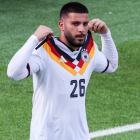
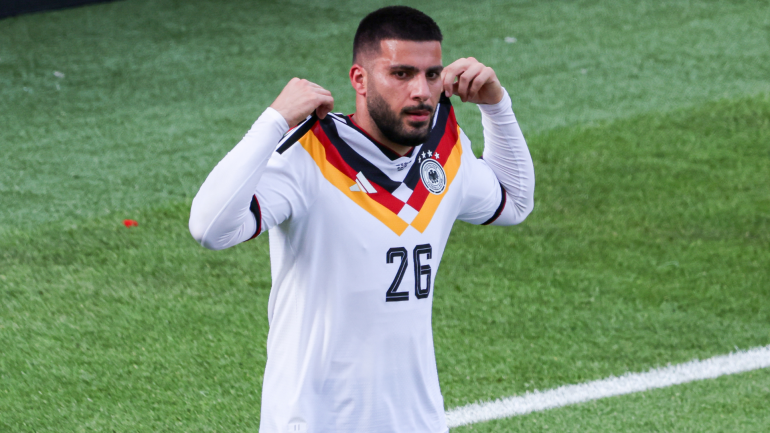
Germany are one of those teams with nothing to play for, but there are certainly those in Julian Nagelsmann's squad looking to make a mark. Among those will be Deniz Undav, the super sub of the win over Ivory Coast who will now be looking to muscle his way into the front four in the knockout games ahead. If that seems unlikely, given the talent in the ranks of Die Mannschaft, well it shouldn't have to anyone who has been tracking Undav's analytics.
The numbers for Stuttgart were ludicrous. The 0.76 non-penalty goals he averaged per 90 last season place him second behind Harry Kane across Europe's top five leagues. He is in the same spot for shots, an incredible 4.85 putting him behind only Nikola Krstovic of Atalanta. For non-penalty expected goals (xG) it goes Krstovic, Erling Haaland, Kane, Robert Lewandowski, Donyell Malen and Undav. This is elite company to keep and it's not off the back of hit-and-hopers, his xG per shot is about 10% above average across all positions, a shade below for just strikers. He is creating chances for others, is useful off the ball and gets involved in possession. Why has he not been hyped to all heavens?
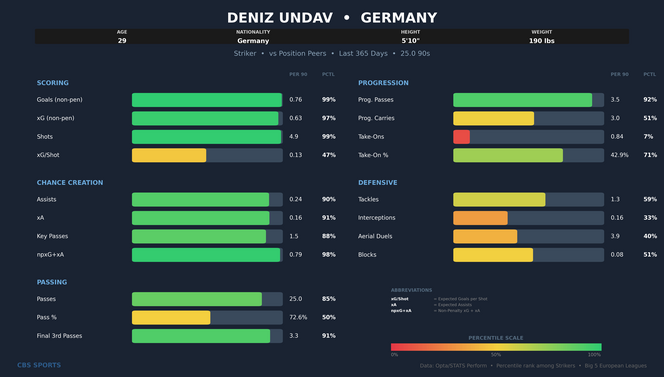
Certainly there's a Bundesliga tax to be paid there. The German top flight has long been something of a striker's paradise, over the last five years it leads Europe's top five leagues in goals, expected goals and shots per game. It is also the case that much of football analytics is viewed through the prism of player recruitment and even with that output you can see above, smart clubs should not be paying big money for a striker who is already 27 (meaning a five-year contract will end with him past his prime) and struggled in the Premier League once already.
Those are not matters that Nagelsmann needs to concern himself with. All they need to do is maximise his value to them, however fleeting it may be. Maybe that is just as the guy who comes on after the possession-heavy front four spearheaded by Kai Havertz that has worn down the defense. Perhaps there are games when Havertz can drop deeper and take the spot of a struggling Jamal Musiala. Or it might just be that Undav can be to this team what Miroslav Klose became in 2014, a reference point that brings the best out of the technicians behind him. Nagelsmann should enjoy finding out.