UFC Fan Guide: Understanding the important rules of the Octagon and how a fight is scored
From what constitutes a knockout vs. a TKO to illegal strikes, we take you through everything that can happen in the Octagon

Fight sports are a funny thing. The goal is simple: hurt your opponent. It's something that everyone understands. But the sportification of mixed martial arts introduces rules and concepts that sometimes confuse UFC viewers.
There is no need to explain why Conor McGregor became the featherweight champion after knocking out Jose Aldo at UFC 194, or who the victor was when McGregor tapped to Khabib Nurmagomedov at UFC 229. But, whether Alexander Volkanovski truly beat Max Holloway in their second meeting? That one will be endlessly debated.
UFC is more accessible than ever before under the new Paramount+ partnership. Before the new era takes off, beginning with UFC 324 on Jan. 24, let's take a deep dive or refresher course on how UFC fights are won, what moves are illegal, how rounds are scored, and what it takes to become a UFC champion.
More UFC Fan Guide: Brief history of the sport | Active fighters to know | Most exciting fights to watch ahead of UFC 324
How fights are won
Methods of victory fall under one of four categories: knockouts, submissions, decisions and disqualifications. Let's break down each of them.
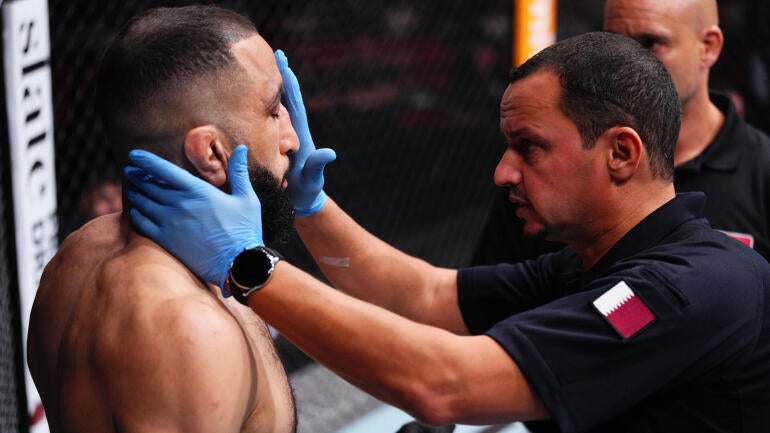
Knockout: The most common striking finishes are a KO or technical knockout (TKO). A KO ruling is made when a fighter cannot intelligently defend themselves. A TKO is different because a fighter is not intelligently defending themselves. A referee will often intervene with a TKO stoppage when a conscious fighter is visibly hurt and doing little more than covering up under a barrage of strikes. TKOs are also awarded if there's a doctor stoppage, a corner stoppage (e.g., throwing in the towel), or a fighter fails to answer the bell to begin a round. Doctor stoppages are usually rendered because of severe lacerations or injuries that compromise a fighter's ability to compete safely.
Submission: There are three subcategories for submission rulings. The most common is a physical tap out, where an opponent uses their body, most often in the form of short, rapid taps with their hand, to indicate surrender. Verbal tapouts are more nuanced. A fighter can verbally announce their surrender, but a voluntary or involuntary screen of pain or distress also counts. Lastly, there are technical submissions, where a submission move renders the opponent unconscious or breaks/dislocates their bones or joints.
Decision: Each fight is scored by three judges at Octagon side. Four different decision outcomes can result in a winner. A unanimous decision is read when all three judges score the fight in favor of one fighter. A split decision occurs when two judges score the fight for one combatant, and the other judge scores it for the opponent. A majority decision is similar, with two judges scoring the fight for one contestant, but the dissenting judge scoring a draw.
Technical decisions are very rare. If a fight is stopped prematurely because of an injury from an accidental foul, and the majority of the rounds have been completed (two rounds in a three-round fight, or three rounds in a five-round fight), a winner will be determined based on the scorecards at that point. This happened last February when Henry Cejudo, the recipient of unintentional eye pokes, was unable to continue after Round 3 of his main event fight.
There are also two conditions for fights that result in no winner: a no-contest or a draw. A no-contest occurs when a fight is stopped prematurely due to an accidental foul, and the conditions for a technical decision have not been reached. There are various types of draws, but they all amount to the same core principle: no fighter has an edge on more than one judge's scorecard.
Disqualifications: The intentionality of fouls is a hot-button topic in MMA. Referees are hesitant to penalize fighters, often resulting in situations where even repeat fouls are deemed unintentional. DQs are rarely exercised for this reason. A fighter can be disqualified if they injure their opponent with a severe intentional foul -- this is the most common utilization of the rule. DQs can also occur if a fighter commits multiple fouls or flagrantly disregards the rules or referee's commands, but good luck seeing that happen.
What's illegal in MMA?
MMA is a legitimate and widely accepted sport. Use this guide as trivia the next time your grandmother asks you why you're watching that barbaric, "no-holds-barred" cagefighting at Christmas dinner.
There are many different types of fouls in MMA, far too many to list here. Some of the most significant ones are head-butting, eye-gouging, groin attacks, and biting. Determining whether fouls are intentional or not, and how referees reprimand fighters, is a sticking point for the previously mentioned debate. It doesn't have to be a DQ or nothing situation. Referees can penalize fighters by deducting points for severe or repeated fouls. It's rarely done, but there seems to be an uptick in referee intervention after recent, high-profile eye poke situations, like Tom Aspinall at UFC 320, where he was unable to continue from an apparent accidental foul. Even extending fingers forward to an opponent's face or eyes is already considered a foul.
Numerous location-specific strikes are also illegal. Strikes to the spine, throat, and the back of the head are off limits. Kicking or kneeing a grounded fighter is also illegal. A fighter is considered grounded if any part of their body, other than their hands or feet, is on the mat. The rule was updated in 2024 to stop fighters from intentionally placing one hand on the mat -- at the time, a qualifier for being "grounded" -- thus gaming the system. The Association of Boxing Commissions also legalized 12-6 elbows, a move that famously resulted in the only loss, a DQ ruling, of Jon Jones' career.
While most state athletic commissions followed suit with the ABC's updates, they are not explicitly required to. A small handful of commissions have held onto older versions of the rule, creating a perplexing situation for fighters and viewers.
How rounds are scored (and why it's confusing)
Scoring criteria is probably the most confusing and divisive subject among fans, fighters and analysts. In 2022, CBS Sports published a long-form feature with multiple experts breaking down the issues with it.
UFC fights are contested across three five-minute rounds. The exceptions come in championship fights, main events and some special attractions that are held for a maximum of five five-minute rounds. Each round is scored independently. Whatever success you have in Round 1 bears no numeric influence on how judges score subsequent rounds. Three judges sit Octagonside, working separately from one another. Should the fight reach the final buzzer, their scorecards are tabulated, round-by-round, to determine a winner. Most often, whoever wins the majority of the rounds wins the fight, but that's where things get confusing.
Each judge awards 10 points to the fighter they believe won the round, with their opponent earning nine or fewer. In close rounds, this means judges might submit contradictory scores. A round too close to call, and one with a clear winner, can both be scored 10-9. This is because judges are disincentivized from scoring 10-10 rounds, and the margin between a nine and an eight is wide. A fighter can win a round 10-8 if they are dominant and create a large gap between winning and losing the round. This is where MMA and boxing differ as a boxer can win a round 10-8 by scoring a knockdown.
So, how are rounds actually scored? This is where things get messy. The Unified MMA Rules, the system UFC adopts for most of its fights, has a hierarchical criteria system: effective striking/grappling, effective aggressiveness and control of the fighting area, in that order. Think of it as having a Plan A, B, and C. If the judges can determine which fighter fulfilled the condition for Plan A more effectively, Plan B or C isn't considered.
"Effective" is another important word in the language. Holding onto your opponent for dear life, or clamping down on a position, shouldn't net you much favor with the judges. "Effective" fighting involves progressing to a finish. Think hard strikes, legitimate submission attempts, or advancing to more advantageous positions on the ground. The judges are told to reward these actions.
You can begin to see the nuance and elements of subjectivity that creep into objective scoring. Take a closer look at effective striking, for example. Effective striking is defined as "impact/effect of legal strikes" with the immediate outweighing the cumulative. A knockdown punch or strike that wobbles an opponent is more valuable than a handful of jabs. But what if someone lands one lucky punch in a round where they were severely outstruck? This is where nuance creeps in. Naturally, the damage accrued by striking will often be seen as more valuable than submission attempts, unless the opponent escaped by the narrowest window.
If your head hurts, that's OK, but try to keep these principles in mind. Rounds are scored independently; most rounds will be scored 10-9, and the round winner is the person who most effectively progressed the fight towards a finish through impact, dominance, and duration.