2026 WNBA Draft: Who should the Wings take at No. 1? Pros and cons of Awa Fam, Azzi Fudd and Lauren Betts
In the latest edition of WNBA Draft Prospect Stock Watch, let's take a closer look at the players who are in the conversation to go No. 1 overall

Recent WNBA drafts have lacked drama at the top of the board. In each of the last three years, the No. 1 overall pick was a certainty even before the draft lottery took place: Aliyah Boston in 2023, Caitlin Clark in 2024 and Paige Bueckers in 2025. That is not the case this time around.
The Dallas Wings, who recently won the lottery for the second year in a row, will have the top pick in the 2026 WNBA Draft in April. Over the next five months, they'll have to evaluate a number of top prospects and figure out which one will be the best fit alongside Bueckers.
Will they prefer the youth and potential of Spanish center Awa Fam? Or the outside shooting and instant connection UConn star Azzi Fudd would bring? Or perhaps the interior presence that 6-foot-7 UCLA center Lauren Betts could provide?
In the latest edition of WNBA Draft Prospect Stock Watch, let's take a look at the pros and cons of selecting each of these three talented players.
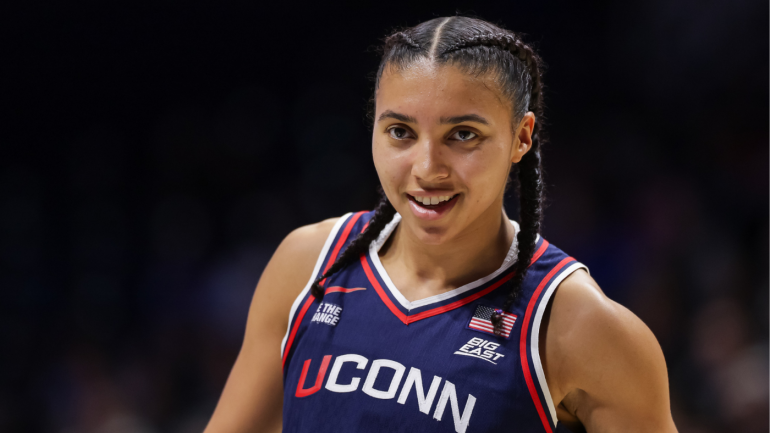
Azzi Fudd -- G, UConn: Up
Pros
- Elite shooting ability
Fudd is a truly special outside shooter. After going 4 of 5 from 3-point range in UConn's win over DePaul on Sunday, she is 31 of 57 (54.4%) for the season, including an astounding 19 of 30 (63.3%) on unguarded catch-and-shoot attempts, per Synergy Sports. For her career at UConn, Fudd is at 42.3% on 5.8 attempts per game.
Last season, only one player in the WNBA (Iliana Rupert) shot over 40% from 3-point range on at least five attempts per game. If you zoom out to look at the top 50 players in terms of 3-point attempts per game, only seven shot 40% or better.
WNBA teams are shooting more 3-pointers than ever, but there aren't that many elite shooters. Fudd would immediately be one of the biggest outside threats in the league and provide a skill that would be difficult to find elsewhere.
- Cohesion with Bueckers
Most of the time, any team picking first overall would prioritize talent over fit considering a lack of talent earned them the lottery berth. The Wings are in a unique position, however, as they have the No. 1 pick for the second year in a row and already have a franchise player in place in Bueckers. Whomever they select with their top pick this time around must fit next to her.
There would be no guesswork necessary on that front if the Wings select Fudd. Much has been made of Bueckers and Fudd's romantic relationship, and that will continue to be a storyline throughout their careers, whether they wind up playing together in the WNBA or not. However, that should not overshadow the fact that their time at UConn together showed they have a strong chemistry on the floor.
Bueckers knows where Fudd likes the ball and vice versa. Fudd's shooting would help open up the floor for Bueckers, who loves to operate in the mid-range. Though injuries limited them to 49 games together, they went 44-5 in Storrs and led the Huskies to the 2025 national championship. While most rookies would need time to learn how to play with their new teammates, Bueckers and Fudd could hit the ground running. That would not be an insignificant advantage.
Cons
- Injury history
During high school, Fudd tore the ACL and MCL in her right knee at a USA Basketball 3x3 event, and the devastating injury eventually required multiple surgeries. Early in her freshman season at UConn, she was sidelined for two months due to a right foot injury. More right knee issues limited her to just 15 appearances during her sophomore season, and two games into her junior season she tore the ACL in her right knee again (as well as her meniscus). Another right knee sprain cost her two weeks last season.
Fudd has only played 85 games since arriving in Storrs in the fall of 2021, and last season was the first time she played more than 25 games in a single season.
It's possible that Fudd has turned a corner with her health and will go on to have a long WNBA career, but her injury history is a real concern. If the Wings take Fudd at No. 1 and she can't stay healthy, that could derail their short- and long-term future.
- More than a shooter?
Outside shooting is far and away Fudd's best skill. Over half (51.6%) of Fudd's field goal attempts in college have come from behind the 3-point line, and for her career she's averaging 2.3 rebounds, 1.7 assists and 1.3 steals per game. The beginning of this season is the first time she's averaged more than three rebounds or three assists.
One of the main reasons Fudd returned to UConn for a fifth season was to show that she has more to her game than being a catch-and-shoot specialist. But while she's shooting the ball better than ever, there are still questions about her ability to create offense -- both for herself and others.
Notably, Fudd has only taken three off-the-dribble 3s this season, and is 14 of 36 (38.9%) on pull-up jumpers overall, per Synergy Sports. She's also only taken 24 attempts at the rim, and has made just 50% of them. If WNBA opponents force her off the line, is she going to be able to make them pay?
Awa Fam -- C, Spain: Steady
Pros
- Age
Domestic draft prospects have to turn 22 in the year in which the draft is taking place to be eligible, but international prospects only have to turn 20 in the year in which the draft is taking place.
Fam is 19 years old and won't turn 20 until June of 2026, more than a month into her rookie campaign. Fudd, by comparison, is already 23 years old, while Betts is 22. When Fam's rookie contract ends, she'll barely be older than Fudd is right now (assuming rookie contracts remain four years in the new CBA). Looking further down the line, Fam could play an entire decade before turning 30, while Fudd and Betts would be entering their mid-30s after a decade in the league. That's a significant difference.
While development doesn't end at 22 or 23, Fam has far more room for growth than Fudd or Betts, who are closer to being a finished product. Front offices must consider potential when they draft players, and no one in this class has more of that than Fam.
- Versatility
For years, the best players in the WNBA have been versatile forwards: A'ja Wilson, Breanna Stewart, Napheesa Collier, Alyssa Thomas, Nneka Ogwumike, etc. No two of those players are exactly the same, but they all share the ability to make plays inside and outside on both ends of the floor.
The athletic, 6-foot-4 Fam looks like she could be the next in line. As the league moves more toward position-less basketball, bigs like Fam are going to be even more important.
Fam is adept at scoring in the post, makes plays out of the pick-and-roll -- both as a scorer and passer -- can put the ball on the deck and runs the floor well. Her playmaking is particularly impressive for a big that hasn't even turned 20. She does still need to improve as a shooter, however. Defensively, her mobility allows her to switch and guard all over the floor. Though not currently much of a rim protector, it's easy to see her being a valuable defender in the WNBA.
All told, Fam has a chance to be a perfect modern big and a strong pick-and-roll partner for Bueckers.
Cons
- Will she be a consistent shooter?
Fam does a lot well on the offensive end, but her jump shot remains a work in progress. Though she has made 4 of 5 attempts from 3-point range in EuroLeague action this season, she's still much more of a threat to score in the paint.
Her playmaking and ability to put the ball on the deck adds multiple dimensions to her game that will prevent teams from simply ignoring her when she's away from the basket, but in order to reach her full potential she will have to develop a reliable jumper -- at least from the mid-range.
She's well aware, and is working hard to improve in that area.
"Right now I am confident when I am shooting a 3-point shot. The last year, or maybe two last years, no," Fam said in a recent interview with Hunter Cruse, adding that her coaches at Valencia continually encourage her to shoot the ball when she's open.
- Needs to be more aggressive defensively
Fam is 6-foot-4 with a 6-foot-8 wingspan, and is a terrific lateral athlete. She has all the physical tools to be an elite defender, and does make some extremely impressive plays. However, there are times when she is too laid back on that end of the floor.
It was notable that Fam acknowledged as much in her interview with Cruse.
"I think defense, the energy," Fam said, when asked what her coaches are working on with her. "You don't need to be the best defender, you need to put your energy. You put your energy, you are a physical player, you can defend this player, you can defend a center. They are talking with me and they say to me, 'put your energy in defense.'"
If you float on defense at the WNBA level, teams will take advantage.
Lauren Betts -- C, UCLA: Down
Pros
- Size
You can't teach size, as the old cliché goes, and there aren't many players bigger than the 6-foot-7 Betts. Last season, Brittney Griner (6-foot-9) was the only player in the league taller than Betts, and only four other players (Kalani Brown, Kamilla Cardoso, Teaira McCowan and Li Yueru) were as tall as her.
Even if you set the height filters a bit lower, there were only 14 players standing 6-foot-5 or taller in the league last season. While the league is moving away from the traditional center position, there's still something to be said for having size, particularly around the basket, which is where Betts is at her best.
Yueru and Luisa Geiselsöder both had some promising moments last season, but the Wings do not have a player they can definitively point to as their center of the future to pair with Bueckers. They will have to at least consider if Betts can be that foundational piece.
- Rim protection
Since she transferred to UCLA for her sophomore season and became a regular starter, Betts has never averaged fewer than two blocks per game. Nor has she had a block rate (the percentage of opponent 2-point attempts she blocks while on the floor) lower than 7.4%. The percentage of shots she deters is even higher.
Betts was named the Big Ten Defensive Player of the Year and Naismith Defensive Player of the Year last season largely because she was the best rim protector in the country. Her size and length allows her to swallow up opponents in the post, and she has excellent timing when arriving from the weak side. Despite challenging so many shots, she rarely fouls -- in her four seasons in college she has never averaged more than 1.9 fouls per game -- which allows her to stay on the floor.
Defenders have more to deal with in the WNBA -- defensive three-second rule, better and more athletic opponents, etc. -- but Betts' rim protection will immediately translate to the professional level. She has the size and defensive instincts to control the paint for a team for years to come.
Cons
- Offense is limited
Betts' numbers are down this season, in part due to a minor arm injury that kept her out of UCLA's win over Duke, and in part because she isn't taking as many shots now that the Bruins have a deeper roster. After setting career-highs of 20.2 points per game on 64.8% shooting as a junior, Betts is at 14.4 points on 56.8% shooting so far this season.
Even when Betts was at her best last season, however, her offensive game was limited. She is an efficient finisher around the basket when she has space or a clear size advantage, but struggles against more physical and athletic opponents, especially when she doesn't get great position. Betts also rarely shoots outside of the paint. She's never taken a 3-pointer in her career, and has only taken 14 shots outside of the paint in nine games this season (she has made 50% of them, which is encouraging).
Betts has more turnovers (192) than assists (166) in her college career. She has improved as a playmaker and has the size to see and pass over the top of the defense, but still does not deal well with aggressive, late doubles. Furthermore, she isn't a great screener and is almost never utilized as a roller, which may make her an awkward fit with Bueckers.
All told, Betts' more traditional, back-to-the-basket game is at odds with where the league is heading.
- Defending in space
Betts is an incredible rim protector, but she becomes less and less effective on defense the further she moves away from the basket. Ironically, one of the reasons Bueckers and UConn embarrassed Betts and UCLA in the Final Four last season is because the Huskies repeatedly put the Bruins' center in pick-and-rolls and hand-off situations.
While Betts is not a complete stiff, she doesn't have the mobility to switch on the perimeter, especially against WNBA-caliber athletes, which forces her to play a more conservative drop coverage. That can be effective against certain matchups, but a disaster against others. Most importantly, it locks teams into a specific coverage against screens when she's on the floor.
As floor spacing and 3-point shooting become an ever more important part of the WNBA game -- in 2025, only one team took fewer than 20 3s per games; in 2015, no team took 20 3s per game -- Betts' inability to defend in space is a real concern.