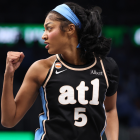


We don't yet know whether Team USA's trip to Berlin for the Women's World Cup will end in glory. One of the most dominant teams in the history of international sports currently sits two wins away from winning a fifth straight gold medal and its 12th overall with a semifinal against Spain and a likely final against a dogged France team on the horizon this weekend. Any way you spin it, anything less than a gold would be a failure for the Americans.
But no matter how the podium plays out, this trip has already been a success in one crucial way. It has shown the on-court potential of the Caitlin Clark and Angel Reese connection and proved that off-court harmony between the two is, in fact, possible.
As we gear up for the Sept. 17 return of the WNBA season -- and a potential playoff clash between Clark's Indiana Fever and Reese's Atlanta Dream -- that is a lesson worth savoring.
Reese and Clark have been in each other's orbit since they were teens, playing against each other in AAU and later in the Big Ten during their freshman and sophomore years when Reese was still at Maryland before she transferred to LSU. Individually, they are both magnetic forces of nature on and off the court, and together they've ignited a firestorm of excitement, devotion, investment and controversy that has both taken women's basketball to new heights and made it central to the culture wars in exhausting, reductive and damaging ways.

The mania around the pair took over the mainstream news cycle for the first time after the 2023 NCAA National Championship Game when Reese and LSU defeated the Clark-led Iowa team 102-85 in front of a then-record 9.9 million viewers. Reese was seen taunting Clark at the end of the game with the "you can't see me" gesture, and the moment blew up into a national conversation about sportsmanship and class that was, to put it mildly, tinged with racism. They met in the Elite Eight the next year, and Clark's Hawkeyes got revenge in front of 12.3 million viewers.
Weeks later at the 2024 WNBA Draft, more than three million people tuned in to see Clark get drafted No. 1 overall by the Fever and Reese go No. 7 to the Chicago Sky. Over the past three years, games between the two have continued to set ratings records and stir up controversy.
Rivalries are great for the sport, and the tapestry of women's sports is rich enough to support heroes, villains, petty hatred, blind loyalty and everything in between. But the conversation about the rivalry between Reese and Clark has become so detached from reality that it feels like it's happening in an alternate universe to actual WNBA games.
It has become less about the two athletes as individuals and more about race, gender, class, privilege, identity, gatekeeping and politics. It has clouded the phenomenal things both players have accomplished on the court in their first three years and taken nuance away from their remarkable journeys to their 2026 forms. It has fueled an ugliness that has cast a dark shadow over the league's explosion in popularity, an ugliness that is present even when the two stars aren't playing.
Clark entered the WNBA with higher expectations than perhaps any player in league history, and despite losing almost all of her sophomore campaign to injury, has managed the scrutiny with deftness and turned herself into a legitimate MVP candidate in just her third season. Reese dealt with front-office and roster instability in Chicago before finally being traded to the Dream in the offseason, and is now having the best rebounding season in WNBA history while preparing to make her playoff debut. So often, young stars can't make the transition from college to the pros and don't live up to the hype. These two are meeting the hype, even exceeding it.
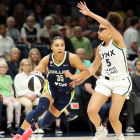
Now, in the middle of their career seasons and ahead of a possible playoff collision, Team USA has brought the two to the same side of the court in Berlin. Both of them have excelled individually in their first major international competition -- Reese is averaging 8.8 points and 6 rebounds per game, while Clark is averaging 8.5 points and 7 assists per game. Reese has the best field-goal percentage in the entire tournament, while Clark leads Team USA in assists and plus-minus and is third in the tournament in assists per game. But they're especially thriving as teammates, pushing the pace, finding each other in transition and leaving their opponents in the dust.
Caitlin Clark to Angel Reese is becoming a thing this World Cup 😈#FIBAWWC pic.twitter.com/eAVKzLo6IP
— FIBA Women's Basketball World Cup (@FIBAWWC) September 10, 2026
Just as their off-court popularity has shown, together their powers are magnified. The best part? They both truly seem to be enjoying playing together and being around one another. There is a mutual admiration.
"We're both fiery, fiery competitors and we want to win and it's one of the things I really admire about her game," Clark told the Associated Press about Reese. "She's competitive and she has a tremendous motor, like she has one of the best motors in the league. She works just as hard as anybody on the court. So, it's been fun to be able to play with her."
"We know each other's game like the back of each other's hand, she knows my spots," Reese said of Clark. "We just continue to build chemistry because we know we're going to be USA teammates for a while."
Clark and Reese don't need to be best friends and their fans don't need to start cheering for the other one overnight. Rivalries, tension, differences -- these are all good things that any sports league needs. But hopefully this World Cup experience can help lower the temperature of the discourse around the two into something more tangible. Like, perhaps, the sport of basketball itself.