WNBA CBA deadline passes with no deal after marathon bargaining session: What does it mean for 2026 season?
The league and the union met for 12 hours, but could not agree to a deal

Representatives from the WNBA and the Women's National Basketball Players Association walked into The Langham, a luxury hotel in New York City, around 5 p.m. on Tuesday and didn't reappear until the sun had nearly come up on Wednesday morning.
The marathon bargaining session over a new collective bargaining agreement had "a lot of conversation going in the right direction," WNBPA executive director Terri Carmichael Jackson told reporters gathered outside, but the two sides did not agree to a new deal. WNBA commissioner Cathy Engelbert said "we're working hard ... and still have work to do."
Late last month, the league notified the union and teams that if a deal was not in place by March 10, the 2026 season would impacted. Now that that deadline has come and gone, here's what we know about Tuesday's meeting, the state of negotiations and what happens next.
Will the 2026 season start on time?
The league previously indicated that the two sides needed to agree to a term sheet for a new CBA by March 10 in order to ensure the 2026 would start on time. It's unclear if there's any wiggle room there. Engelbert was non-committal when pressed about the timeline after the meeting.
"We've got to get it done soon," she said.
Once a new CBA is in place, it will take about three weeks for it to be ratified. Only then can the league commence with critical offseason agenda items, including the double expansion draft for the Portland Fire and Toronto Tempo, and free agency, which features over 100 players this year.
The 2026 WNBA Draft is set for April 13, training camps are scheduled to open on April 19 and opening night is supposed to be May 8.
At this point, it's going to be early April before a new CBA is ratified. Can the league squeeze the expansion draft and free agency into a ~10-day timeline before the college draft? That seems nearly impossible, which means the college draft may take place during or before free agency, which would be an interesting wrinkle. If free agency is pushed until mid-April, and even into the beginning of training camps, it's still possible the season could start on time, but it's going to be extremely tight.
The two sides might have a small grace period, but not much more than that.
What happened in Tuesday's meeting?
Details are sparse.
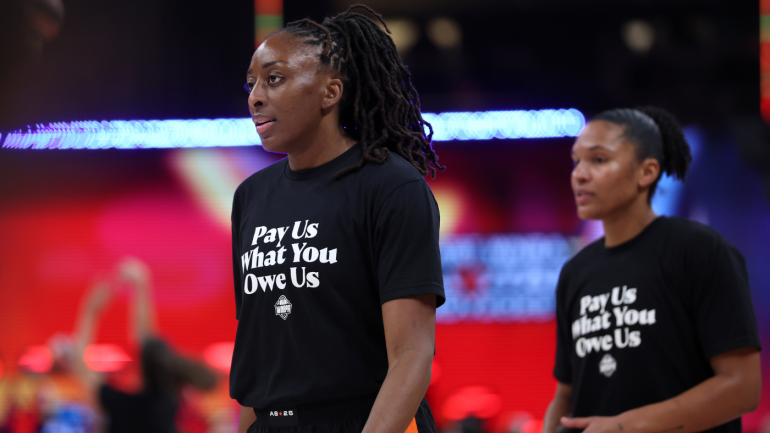
Per ESPN and Front Office Sports, the WNBPA contingent consisted of Jackson, other union staff and multiple players, including executive committee members Breanna Stewart, Nneka Ogwumike, Bri Turner, and Alysha Clark. On the league side, Engelbert was in attendance along with head of league operations Bethany Donaphin and New York Liberty owner Clara Wu Tsai, among others.
The meeting began at 5 p.m. on Tuesday, and the players left around 3 a.m. Wednesday morning. The players did not comment. Union and league staff continued negotiating until after 5 a.m.
Jackson and Engelbert offered brief comments to reporters on the scene.
"Every meeting is a positive meeting," Jackson said. "Seriously, every meeting is a positive meeting. The fact that we scheduled meetings, that we offer dates to schedule meetings that we actually get together, get in the room. I think that's positive. It's taking as long as it's taking. But you know, that's what it needs to be."
"I would describe the last 10 or 11 hours as a lot of conversation going in the right direction," Jackson continued. "The only thing I'm going to say on that is the conversations are continuing."
"It's complex," Engelbert said. "We're working towards a win-win deal like we've been saying, a transformational deal for these players that balances all the things we've been trying to balance with continued investment by our owners, et cetera. So we're working hard towards that, and we still have work to do."
What is the hold-up?
Entering Tuesday's meeting, the league and players were still at odds over some key items, including housing, core player designations and retirement benefits. However, the main hold up, as is always the case in labor negotiations, is money.
Crucially, the players have been fighting for a share of gross revenue, while the league has been offering a share of net revenue -- that is, the revenue remaining when league-specified operating expenses are removed from the pot.
The two sides exchanged new offers in recent days, though details remain unclear.
The last known offer from the league would see the players receive 70% of net revenue over the course of the deal, with a 2026 salary cap of $5.75 million. The union's most recent known offer called for players to make an average of 26% of gross revenue over the course of the deal, with a 2026 salary cap of $9.5 million.