The WNBA announced Wednesday that it will expand the regular season again, moving from 44 games to a record 50 games in 2027. Further details regarding the 2027 schedule, including the footprint and key dates, were not announced.
Per the new collective bargaining agreement, beginning in 2027, training camps can start no earlier than April 1 and the season can end no later than Nov. 21.
"Demand for the WNBA has never been greater, and expanding to a 50-game regular season reflects the extraordinary momentum we are seeing across the league," WNBA commissioner Cathy Engelbert said in a statement. "This move reflects our commitment to growing the game and creating more opportunities for fans to watch the best players in the world and experience the extraordinary talent and competition that define the WNBA."
Here's everything you need to know about the schedule and how it will affect the league and the players.
Another increase on the horizon
The historic new collective bargaining agreement, ratified in March ahead of the 2026 season, gave the league the "discretion" to increase the number of games in the regular season over the course of the seven-year deal. To no surprise, the league has immediately put that provision to use.
Here's the official language in the CBA regarding the number of games:
"The WNBA shall have the discretion to (i) increase or decrease the number of games to be played by Teams during the pre-season, Regular Season, and/or the playoffs and (ii) after consultation with the Players Association, change the playoff format (including the number of teams that qualify for the playoffs) provided, however, that: (x) the number of pre-season games in any Season covered by this Agreement (which, for clarity, shall not include any games that are part of a special competition or tournament even if such games count toward the Team's Regular Season record) shall not exceed four (4) per Team; (y) the number of Regular Season games in any Season covered by this Agreement (which, for clarity, shall not include any games that are part of a special competition or tournament even if such games count toward the Team's Regular Season record) shall not exceed forty-four (44) games per Team in the 2026 Season, shall not exceed fifty (50) games per Team in each of the 2027 and 2028 Seasons, and shall not exceed fifty-two (52) games per Team beginning with the 2029 Season."
The league will be allowed to increase the number of games to 52 in 2029, and will almost certainly do so. Here's a look at how the WNBA's regular season has changed over the years.
Note: The 2020 and 2021 seasons were shortened due to the COVID-19 pandemic.
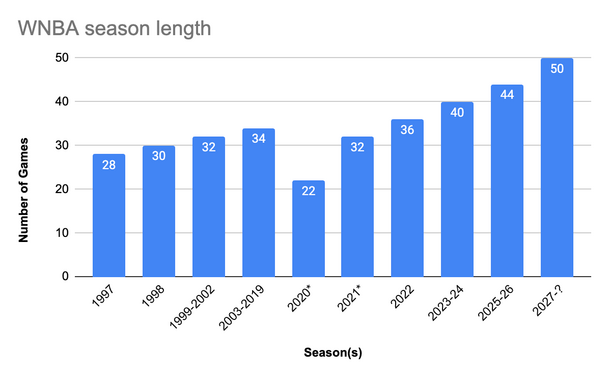
Over three decades, the WNBA has nearly doubled the length of the season from its inaugural 28-game campaign in 1997 to 50 games in 2027.
There are obvious benefits to more games, with significant pay raises for the players being the most important. The players would not have gotten the first comprehensive revenue-sharing model in women's professional sports history, six-figure minimum salaries or $1.4 million max deals without accepting a longer schedule.
However, it will be interesting to see how playing more and more games changes the nature of the league. For the majority of the league's history, teams played 30-36 games, akin to a college basketball schedule. Fewer games meant each one really mattered and, with more time off in between them, stars rarely sat and the level of competition was extremely high.
In a 50-game season, the value of each contest will decrease for everyone -- players, teams and fans. Will we start to see load management in the WNBA? Will teams change their play styles or rotations? How will fan behavior change, especially if a longer season means more overlap with other leagues and sports?
Another big question is how the league will adjust the playoff format in conjunction with a longer schedule and expansion. Over the next four seasons, three new franchises -- Cleveland (2028), Detroit (2029) and Philadelphia (2030) -- will bring the league to 18 teams. It would not make any sense to continue with the current playoff format -- top eight teams qualify regardless of conference, followed by a best-of-three first round, best-of-five semifinals, best-of-seven Finals -- in an 18-team league with a 50- or 52-game season. At the very least, the league would need to expand the earlier playoff rounds. Doing so would also affect how players and teams -- and fans -- approach the regular season.
How would more games impact player salaries?
As previously noted, expanding the schedule was baked into the revenue-sharing deal, and the major pay raises the players got in this new CBA. Here's a look at how the salaries have and will continue to change as revenue increases. The salary cap for the 2026 season is $7 million, and is expected to rise to over $11 million by 2032.
| Year | Minimum salary | Average salary | Supermax salary |
|---|---|---|---|
2025 | $66,079 | $120,000 | $249,244 |
2026 | $270K -- $300K (based on years of service) | $583,000 | $1.4 million |
2032 | $340K -- $380K (based on years of service) | $1 million+ | $2.4 million |
Salaries are now tied to revenue sharing, so players will not see a direct proportional raise from playing six more games. However, more games should equal more revenue, which is, in part, why the salary cap and salaries are expected to rise over the course of the CBA.
If the league decides to lengthen the playoffs, however, merit bonuses would see a proportional increase. Here's the CBA on that front:
"In any Season of this Agreement, if the maximum number of possible playoff games increases beyond twenty-nine (29), the merit bonuses related to playoff achievement of a Team set forth in Article IX hereof shall be increased proportionally. (For example, if the maximum number of games played per second round series in that Season's playoffs increased to seven (7) games (such that the maximum number of playoff games that could be played that Season would be thirty-three (33) games), then each of the per-player merit bonuses set forth in Article IX will be multiplied by a fraction, the numerator of which is 33 and the denominator of which is 29.)"
Say goodbye to the old record books
The WNBA's single-season records for points, rebounds, assists and triple-doubles have all been set since 2024, when the league expanded to 40 games:
- Points: 1,021 -- A'ja Wilson (2024)
- Rebounds: 451 -- A'ja Wilson (2024)
- Assists: 357 -- Alyssa Thomas (2025)
- Triple-doubles: 8 -- Alyssa Thomas (2025)
Those records will likely fall again in the coming years. When Wilson scored 1,021 points in 2024, she averaged a single-season record 26.9 points per game. For someone to reach 1,021 points in a 50-game season, they would only have to put up 20.5 points per game (assuming they played every game). Including this season, there have been 55 instances of a player scoring that much in a season.
The single-season blocks and steals records, which have both stood for over a decade -- Brittney Griner blocked 129 shots in 2014 and Teresea Weatherspoon swiped 100 steals in 1998 -- are likely to be broken in the coming years as well, though Griner's mark has more staying power than Weatherspoon's.
Additionally, the all-time record books will look significantly different years and decades from now. Just take Diana Taurasi's all-time scoring record of 10,646 points, for example. She spent 20 seasons in the league and kept playing into her early 40s to amass that many points. Along the way, Taurasi "only" played 565 career games. While that ranks second all-time right now, younger players are going to fly past that mark. With 50-game seasons, a player could get to 565 games in just more than 11 seasons, and with 52-game seasons, a player could get there in just less than 11 seasons. Even accounting for injuries and the fact that longer seasons may affect longevity, we're going to see players hit 750 or 800 games played. Even a 1,000-game career is not out of the question.
For her career, Taurasi averaged 18.8 points per game, currently the ninth-best career scoring average in league history. Someone who enters the league in 2027 -- say, projected No. 1 overall pick JuJu Watkins -- could easily wind up playing 750 games. At that rate, they would only need to average 14.2 points for their career to surpass Taurasi.
Pure math says every current all-time record is going to fall, and that's before you factor in player development and play style changes. Players are significantly more skilled than they were 10 and 20 years ago, schemes are more advanced, 3-pointers are a much bigger part of the game and the pace of play is up.
League averages through the decades
| Season | Off. Rtg. | 3P Rate | Pace |
|---|---|---|---|
1997 | 92.3 | .196 | 74.2 |
2007 | 98.1 | .241 | 77.2 |
2017 | 103.1 | .257 | 78.3 |
2026 | 107.4 | .367 | 79 |
Let's take a look at when some notable players could break the current all-time records in their respective fields.
Scoring
- Current record: Diana Taurasi, 10,646 points
- Biggest threat: A'ja Wilson, 6,078 points
Wilson, who has yet to turn 30, has 6,078 points, which puts her 16th on the all-time scoring list and 4,569 points away from passing Taurasi. She's once again leading the league in scoring at 25.6 points per game and has shown no signs of slowing down. At a rate of 20 points per game -- well below what she's averaged in the last four seasons -- Wilson would need 229 games to pass Taurasi.
With 34-game seasons, under which Taurasi played the majority of her career, it would take Wilson over six and a half seasons to get there. With 44-game seasons, assuming she didn't miss any time, that would take her over five seasons and well into her mid-30s. With 50-game seasons, Wilson would need just over four and a half seasons to pass Taurasi, or likely sometime in 2030.
Rebounding
- Current record: Tina Charles, 4,262 rebounds
- Biggest threat: Angel Reese, 983 rebounds
We've never seen a rebounder like Reese, whose league-leading 12.3 rebounds per game this season is the worst mark of her career. She has more games with 15-plus rebounds (25) than single-digit rebounds (14) and is already tied for the fourth-most 20-rebound games (four). In fewer than three full seasons, Reese is 138th on the all-time rebounding list and nearly a quarter of the way to Charles' all-time record.
Reese is 3,280 rebounds away from the all-time record, and at a rate of 10 per game -- below what she's averaged for her career -- it would take her 328 games to get there. With 34-game seasons, under which Charles played the majority of her career, it would take Reese a bit over nine and a half seasons to get there. 44-game seasons, assuming she didn't miss any time, that would take her nearly seven and a half seasons. With 50-game seasons, that would take her just over six and a half seasons, or likely sometime in 2032.
Assists
- Current record: Sue Bird, 3,234 assists
- Biggest threat: Caitlin Clark, 560 assists
Clark was limited to 13 games last season, or she would be even closer to Bird's all-time mark. As it is, she's nearly a fifth of the way there in less than two full seasons. Her 337 assists as a rookie are the second-most ever in a season, and she's averaging 8.4 assists for her career, which would be the highest career mark in league history. She is going to smash Bird's all-time record; it's just a matter of when.
Clark is 2,675 assists away from passing Bird, and at a rate of eight per game -- below what she's averaged for her career -- it would take her 335 games to get there. With a 34-game season, under which Bird played the majority of her career, it would take Clark just under 10 seasons to get there. With 44-game seasons, assuming she didn't miss any time, that would take her more than seven and a half seasons. With 50-game seasons, that would take her just over six and a half seasons, or likely sometime in 2033.