Geno Auriemma attacks the rims in March Madness rant -- and the NCAA should listen to him
The complaints from the legendary UConn coach aren't really about the rims, though


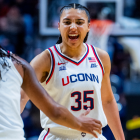
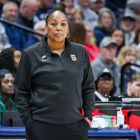
FORT WORTH, Texas -- On Friday, Geno Auriemma's UConn Huskies beat the North Carolina Tar Heels by 21 points to advance to their 29th Elite Eight in the past 32 seasons. But in his postgame press conference, he wasn't in an extremely celebratory mood.
While discussing the poor shooting percentages in the game -- the Huskies shot just 40% from the field and 20% from outside, well below their season averages -- he focused not on his players, but on a staple of the sport that typically relegated to supporting-character status: the rims.
"Do you ever notice when you come to the regionals, they use brand new baskets? These rims have never touched a basketball until now, so it's hard. You can't get a ball to go boop, boop, in. Once that ball hits the rim, it's going out of bounds. It's the weirdest thing," he said.
On Saturday morning, Auriemma continued to attack the rims during his off-day press conference -- which began at 9:30 a.m. local time, a full hour later than Notre Dame head coach Niele Ivey had to face reporters -- and this time, he came with receipts.
"I'm going read you some numbers, OK? Write them down: 4 for 20, 4 for 22, 1 for 17, 5 for 18, 4 for 16, 7 for 26," he said, unprompted. "That's the 3-point shooting [Friday] across the country. How many arenas are we going to sell out with that bullshit?
" ... They bring in new baskets, new basketballs right out of the box. Got people dribbling the ball off their feet. You got people missing layups all over the place. You bounce the ball, and it goes up to the ceiling. There's just no concept of how basketball is played."
Now, I will confess, while I've asked around a bit, I don't know the exact logistics of the life of a rim. Dickies Arena, where the Huskies are playing in Fort Worth, is not primarily a basketball arena, so it would be understandable if the event was BYOR. (Bring your own rim, of course.) But in the Sacramento regional, teams are playing at the Golden 1 Center, the home of the Sacramento Kings, so I would assume that the rims were included.
But Auriemma's gripe about the rims was folded into his much broader years-long gripe about the downsides of the current two-regional format in the women's tournament, and the ways that it has negatively impacted players, fan accessibility and the overall quality of the game.
And when it comes to those issues, I really think the NCAA needs to listen to him. After all, Auriemma has been to every regional for the last 32 years. He is the foremost expert on the topic.
Up until 2022, the NCAA Tournament hosted the regionals -- meaning the weekend of Sweet 16 and Elite Eight games -- in four separate cities across the country, which is the same format used in the men's tournament. But in 2023, it changed to just two sites for the regionals in the women's tournament, with the sites essentially hosting two separate regionals on alternating days. On the eve of this March Madness, the NCAA committee confirmed to ESPN that it was committed to the two-regional formal for the next five years.
The move was made to increase attendance. And, according to the NCAA, it has worked -- ESPN reported that the best total attendance for regionals in the four-site model was 73,954, while in 2025, Birmingham and Spokane combined for a total attendance of 84,784.
But while the two-site format could be responsible for the rather modest bump, it's worth noting that the move to two regionals coincided with the recent Caitlin Clark-fueled explosion of interest in the game. And this year's attendance is trending downwards -- the total attendance across the two sites on Friday was almost 18,821, and if that holds steady for the four days, 2026 regional attendance would be closer to the four-site record. Auriemma's theory is that the attendance struggles are because it is so much more difficult for fans to make it to the regionals when there aren't four sites pretty evenly distributed across the country.
The size and spacing of the markets and arenas chosen for the two sites has been limiting at best -- Fort Worth and Sacramento this year; Birmingham and Spokane in 2025; Albany and Portland in 2024; and Greenville and Seattle in 2023. The next two years, the sites are primarily in bigger markets -- Philadelphia and Las Vegas in 2027, and Portland and Washington, D.C. in 2028. The bid process for 2029-2031 opens this summer.
That could certainly help more fans get to the games, and perhaps allow the arenas to come with broken-in rims. But I don't know that it would do much to fix the primary problem presented by the two-site regionals: the scheduling logistics.
Because games are being played every day, off-day practices and media availability have to be scheduled around ongoing games. In Fort Worth this year, that has resulted in things like 6:20 a.m. shootarounds, 7:30 a.m. press conferences and days like Saturday for Auriemma, where his team has to come to the arena at 9:30 a.m. for media and then return to the arena at 6:30 p.m. for practice.
Is any of this the end of the world? Of course not. But it certainly doesn't help improve the quality of basketball and doesn't seem to do anything to prioritize the health and well-being of the players.
"I just don't understand some of the decisions that are made about our game when we're trying to grow the goddamn game," Auriemma said
Other coaches aren't quite as colorful as Auriemma when discussing the problem, but admit that there is some work to do. For example, Michigan head coach Kim Barnes Arico was unhappy with a 7:30 a.m. practice time, and couldn't get a good answer from the NCAA about why, as the higher seed, her team had to practice earlier than her Sweet 16 opponent, Louisville.
"I just think there are a couple things that need to be ironed out. But I do think, you know, as the game continues to grow, as the landscape continues to change, we have to be open-minded and willing to have some tough things to battle through," Barnes Arico told CBS Sports after her team defeated Louisville on Saturday.
The Wolverines, it should be noted, struggled offensively in the first quarter but ended the game shooting 47% from the field and 31% from the arc, on par with their season averages.
"I heard the rims were a little bit of a problem, though," Barnes Arico added with a smile.